All species › Rodents › Squirrels and marmots › Calabrian Black Squirrel
Calabrian Black Squirrel | Sciurus meridionalis
Sciurus meridionalis | Sciurus meridionalis
Sciurus meridionalis, the Calabrian Black Squirrel, is a squirrel of the mountain forests of Calabria and Basilicata. Until 2017 the black squirrel of Calabria was regarded as a southern form of the Red Squirrel; since then it has been treated as a separate species. The range comprises three mountain massifs. The species is larger and heavier than the Red Squirrel and has black upperparts and a white belly.
Tracks
The signs are those of other squirrels and are easy to find in the forests of the Sila. The clearest is the gnawed cone of the Calabrian pine: the animal holds the cone in its forepaws, turns it and bites the scales off from the base upward down to the core. What remains is a bare core with short bitten-off scale bases and usually a tuft of untouched scales at the tip. Dozens of such cores on a stump, a boulder or a thick side branch mark a regular feeding place used for years. At a woodpecker anvil the picture is different: a Great Spotted Woodpecker wedges the cone in a crack of bark and hacks it open from above, so that the scales are prised apart but not gnawed off and the cone keeps its shape. In beech and chestnut woods there are beech mast and chestnuts split in two, and shallow cache pits in the litter. The drey is a ball of twigs, bark and moss the size of a football, high in a pine crown against the trunk, with a side entrance; in old forest tree cavities are also used for nesting. The print in mud or snow shows four toes on the fore foot and five on the hind foot, with the hind foot landing ahead of the fore foot when bounding. None of these signs separates the species from the Red Squirrel; only the range does.
In its habitat
Identification
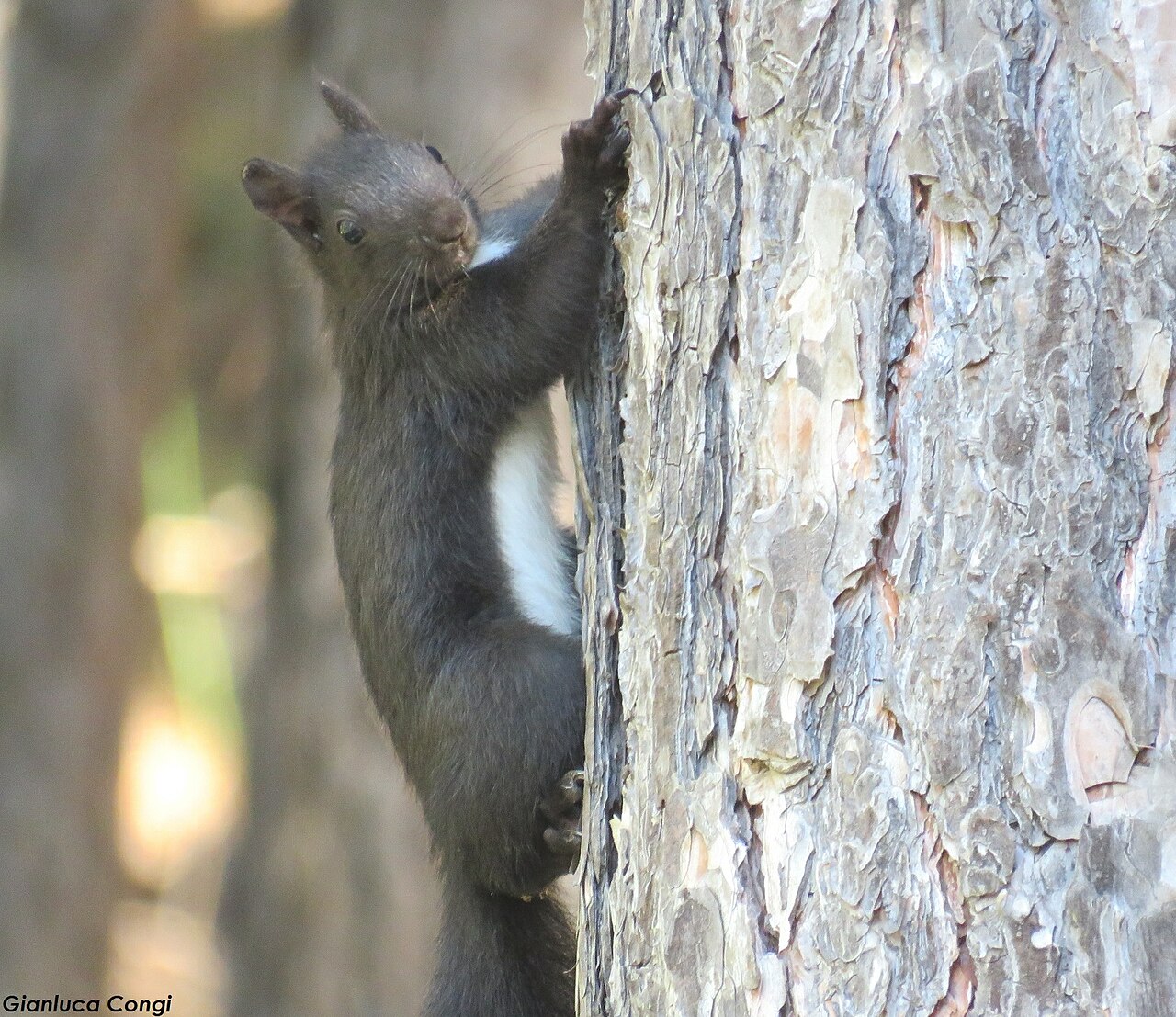
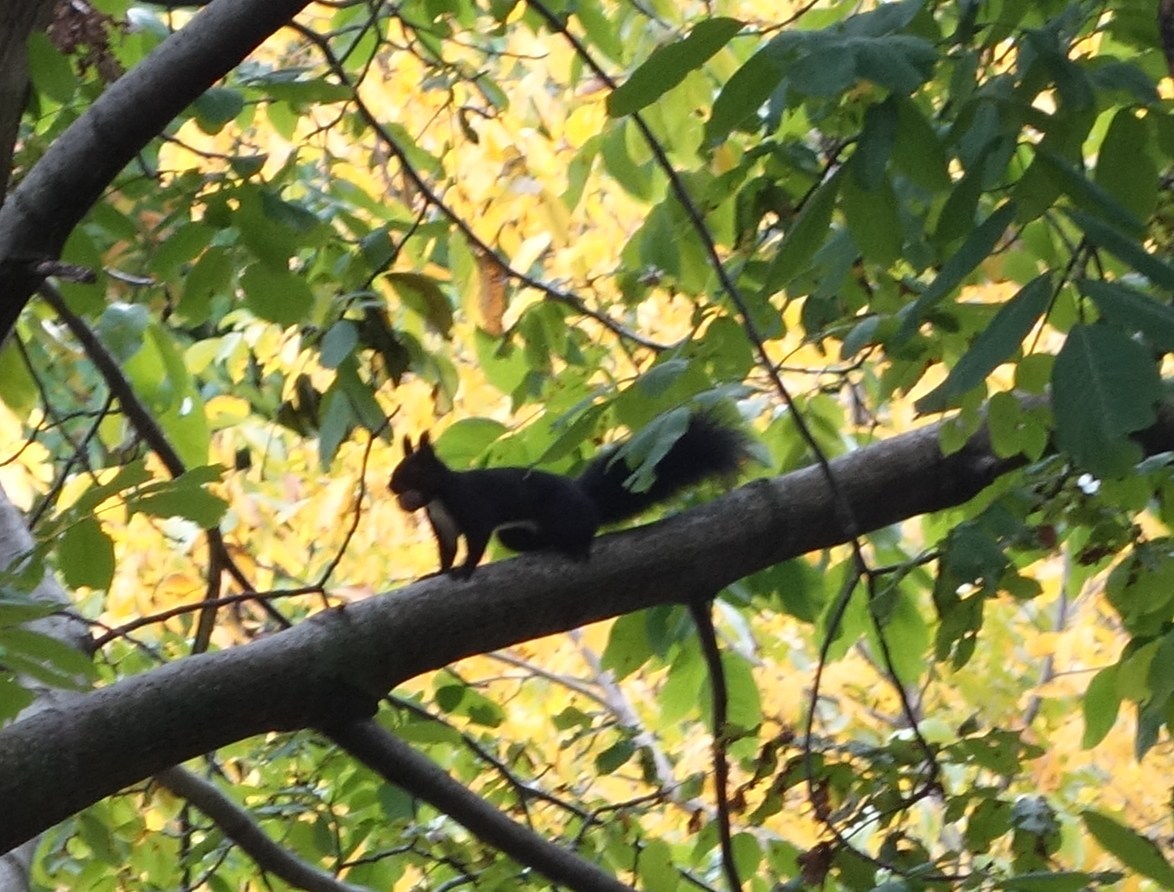
A large squirrel, comparable in measurements to the Red Squirrel but on average about a third heavier: live-trapped Red Squirrels in northern Italy average around 320 grams, this species more than 430 grams, with individuals up to 530 grams. The hind foot is also longer. The character is the coat: very dark brown to black on back, head, neck, flanks, feet and tail, in winter coat with a deep black gloss over the entire upper side, and a sharply demarcated, pure white belly. Soles, pads and claws are also black. The Red Squirrel varies from red to black and occurs in many shades within one wood; this species is uniformly coloured. It carries ear tufts in winter, none in summer.
Similar species
The species cannot be separated with certainty in the field from the Red Squirrel. The separation rests on genetics and range, not on an external character. Black squirrels with a white belly also occur in the Red Squirrel, in the Alps, the northern Apennines and parts of central Europe, and a single animal cannot be distinguished from this species in a photograph. Locality is decisive: within Calabria and Basilicata every squirrel is Sciurus meridionalis, and north of the zone without squirrels, more than a hundred kilometres wide, that separates the two ranges, every squirrel is Sciurus vulgaris. A weak indication is uniformity: a group of animals that are all equally black with the same white belly points to this species, whereas a Red Squirrel population is almost always mixed in colour. Size and weight point the same way, but overlap too much to identify a single animal.
Habitat
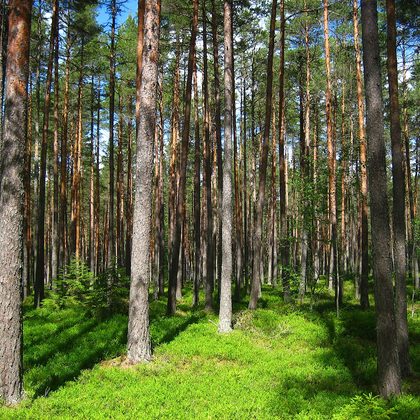
Mountain forest of the southern Apennines, roughly between 700 and 1900 m. The core is the Calabrian pine forest (Pinus nigra subsp. laricio) of the Sila and the Pollino, often in old, tall stands, and also beech forest, mixed beech and pine, old oak woods on the lower slopes and chestnut groves. In the Pollino and the Lucanian Apennines the species also uses broadleaved woodland with hornbeam and maple. It requires old trees with a closed canopy and a good seed crop; uniform young plantation is of little use to it.
Where the animal is most at home, classified with EUNIS — the European standard for habitats.


Distribution
Endemic to southern Italy. The range consists of three historically separate mountain massifs of Calabria: the Pollino on the border with Basilicata, the Sila plateau and the Aspromonte. Twentieth-century reforestation has since connected the Sila and Pollino populations, and the range is slowly expanding northward into the Lucanian Apennines of Basilicata. Between the northern limit and the nearest Red Squirrels lies a zone of more than a hundred kilometres without squirrels. Genetic work published in 2024 shows that the species arose in central Calabria in the Middle Pleistocene and has since expanded and fragmented repeatedly with the glacial cycles.
Way of life
Diurnal, with most activity in the early morning and late afternoon and in summer a rest during the midday heat. The species does not hibernate but keeps a winter rest: in bad weather it stays in the nest for days and lives on its caches. The diet consists mainly of seeds of the Calabrian pine, supplemented with beech mast, acorns, chestnuts, buds, young shoots, fungi and occasionally eggs or insects. In autumn thousands of seeds are buried in scattered shallow pits; seeds not recovered germinate. The animals live solitarily, with overlapping home ranges and a dominance order at the best feeding places. Breeding depends on the seed crop: two litters in a good mast year, one or none in a poor year, of about three young that are independent at about ten weeks. Five to six years is regarded as old age.
Where and when to look
The best areas are the Sila National Park and the Pollino National Park, in the old pine forests between 1000 and 1600 m, such as the woods of Fossiata, Gallopane and the Bosco Magnano. Walk a forest track in the first two hours after sunrise and watch for movement high in the crowns and listen for the scrape of claws on bark. In October and November, when the animals are caching food, they are most visible and come to the ground regularly. Without a sighting of the animal itself, cone cores on a stump indicate its presence. In this area black is the normal colour of a squirrel.
Conservation status
Near Threatened (2024). The status is based not on decline but on the small range, confined to a single region. The population is stable to slightly increasing, and twentieth-century reforestation has benefited rather than harmed the species. The risks are wildfire and large-scale felling in the pine forests, which can empty a sub-range in a single summer, and alien squirrels. The Grey Squirrel, which displaces the Red Squirrel where it settles, is established in northern Italy and, since the early 2000s, around Perugia in Umbria; that population is the closest to Calabria, and if the species spreads south along the Apennines this endemic species is at risk. Closer at hand is Finlayson's Squirrel (Callosciurus finlaysonii), released near Maratea in Basilicata in the 1980s, trapped there from 2013 to 2016 and now spreading inland in southern Campania.
Scientific name
Sciurus meridionalis | Lucifero, 1907
Lucifero described the species in 1907 and placed it straight away in the genus where it still stands. Sciurus is the Latin word for 'squirrel', from Greek skiouros, from skia, 'shadow', and oura, 'tail': the animal that shades itself with its tail. meridionalis is Latin for 'southern', from meridies, 'midday, south'; Lucifero described the animal from Calabria, the far south of Italy. The specimen the first description was based on came from Italy, Calabria.