All species › Even-toed ungulates › Bovids › Dorcas gazelle
Dorcas gazelle | Gazella dorcas
Dorcasgazelle | Gacela Dorcas
The Dorcas gazelle (Gazella dorcas) is a small, pale gazelle of the deserts and semi-deserts of North Africa and the Middle East. It can live without drinking water and is therefore one of the gazelles best adapted to the desert. In the guide area it lives in Morocco, Algeria, Tunisia, Libya, Egypt and Israel; the world population is estimated at 35,000 to 40,000 animals.
Tracks
Territorial males make dung middens: fixed places where they deposit droppings with a fixed marking display. Such heaps of small, pointed pellets along wadis and paths indicate the species. The slot is small, narrow and pointed; in sand the tracks are best seen after a windless night.
Identification
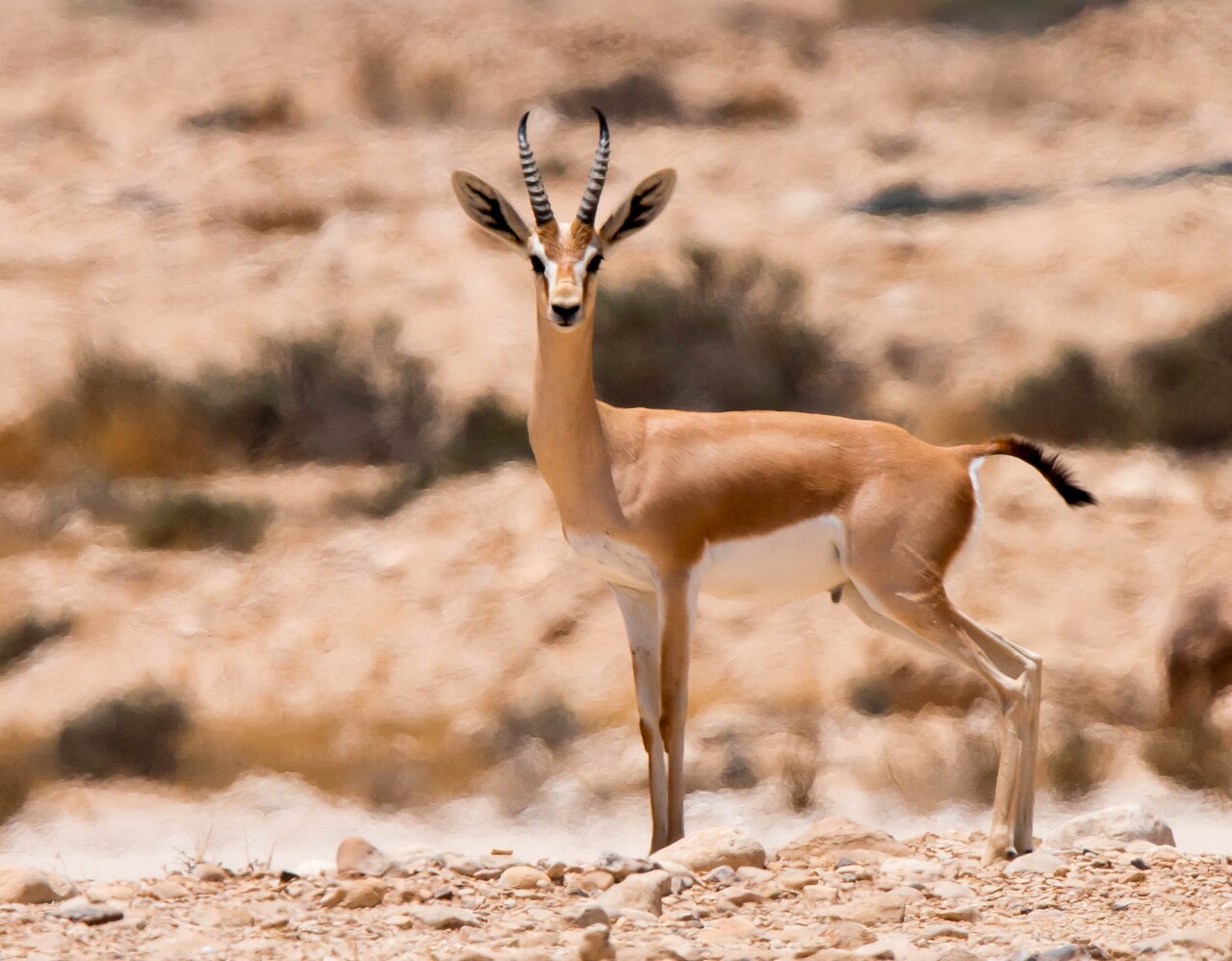
A small, slender gazelle of 90 to 110 cm head-body length, 55 to 65 cm shoulder height and 15 to 20 kg, with a tail of 15 to 20 cm. The upperparts are pale beige to sandy reddish, the belly and rump white, and a reddish-brown stripe runs along the lower flank. The face has white eye rings and a pale and a dark stripe from the eye to the corner of the mouth. The ears are large. The male carries lyre-shaped horns of 25 to 38 cm, which bend sharply backwards and curve upwards at the tip; the horns of the female are thinner and straighter, 15 to 25 cm.
Similar species
The mountain gazelle in Israel is dark brown and lives in Mediterranean hill country, not in the desert. The slender-horned gazelle is even paler, almost cream-white, with long, thin, slightly S-shaped horns, broadened hooves and a preference for sand dunes. Cuvier's gazelle is dark greyish brown and lives in the Atlas Mountains and uplands of Morocco, Algeria and Tunisia. The dama gazelle is much larger and long-legged, with a reddish-brown head and neck.
Habitat
Grassland, steppe, wadis, mountain desert and semi-desert, from flat gravel desert to rocky slopes, often with scattered acacias. The species also lives in areas without open water.
Where the animal is most at home, classified with EUNIS — the European standard for habitats.

Distribution
North Africa from Morocco and Western Sahara to Egypt and Sudan, the Sahara and the Sahel, and in the Middle East Sinai and Israel. In the guide area important populations live in the Eastern Desert of Egypt and in Morocco, Algeria, Tunisia and Libya; in Israel, in the Negev and the Arava, live 1000 to 1500 animals. In Morocco skins and horns are sold in markets despite legal protection.
- Native
- dark = core range, pale = thinly spread
Way of life
The Dorcas gazelle is active mainly from dusk to morning; in the hot months it rests in the shade by day. It does not need to drink and obtains moisture from its food: leaves, flowers and pods of acacias and other desert plants, and after rain also bulbs that it digs up. In harsh conditions the animals live in pairs; where food is more plentiful, family groups of one male with several females form, and groups may number up to 40, mixed groups up to 100. Mating takes place from September to November; after a gestation of about six months a single young is born, which is weaned after two to three months. Females are sexually mature at 9 months, males at 18 months. The Dorcas gazelle reaches speeds of 80 km per hour.
Where and when to look
In Israel the Dorcas gazelle can be seen in the Negev and the Arava, among other places around Sde Boker and on the open plains north of Eilat. Search at sunrise and in the last hour before sunset on plains with acacias and along wadis; in the middle of the day the animals lie in the shade. In North Africa the species is shy and usually only seen at great distance.
Conservation status
Vulnerable (VU, 2017). Threats are conversion of habitat to farmland, competition with livestock, hunting and the trade in skins and horns. The species has declined strongly in large parts of its range, while the total population of 35,000 to 40,000 animals is still relatively large.
Scientific name
Gazella dorcas | (Linnaeus, 1758)
Linnaeus described the species in 1758 as Capra Dorcas; because it was later moved to another genus, the author and year stand in brackets. Gazella goes back through French and Spanish to Arabic ghazāl, 'gazelle'. dorcas is Greek dorkas, 'gazelle, roe', traditionally linked with derkomai, 'to see keenly', after the large eyes; it stands as a noun in apposition to the genus name. The specimen the first description was based on came from Egypt.