All species › Passerines › Wagtails and pipits › American pipit
American pipit | Anthus rubescens
Pacifische waterpieper | Bisbita norteamericano
The third dark-legged pipit, and the hardest of the three. Buff-bellied pipit breeds on the tundra and in the high mountains of North America and north-east Siberia and winters in the southern United States, Mexico and East Asia; it has been treated as a species separate from water pipit since the 1990s. In the area of this guide it is a vagrant: a handful of birds a year, with the Azores, Ireland, south-west England and Iceland the regular addresses for the American form and Finland, Scandinavia and the Baltic for the Siberian one. Finding one puts you straight into the most awkward identification problem in the group.

Voice
The call matters more here than for any other pipit in the region, precisely because the plumage offers so little certainty. It is thin, high and sharp, and often comes as two notes in quick succession: tsip-it or pi-pit — the sound the American name hangs on. Against the full, single feest of water and rock pipits it is thinner, shorter and more clipped, and the tendency to double up is real, although the other two do sometimes call twice. The Siberian form sounds on average thinner and higher still. A sound recording therefore carries more weight than a plumage photograph, and many European records have been settled that way. The song, a monotonous rattling series of repeated notes in a high song flight over the tundra, is never heard in Europe.
No freely licensed recording is available for this species yet.
Identification
Size and build of a water pipit — 15–17 cm, long-winged, long-tailed, with white outer tail feathers — but the two forms that reach Europe look different, and it pays to know that in advance. The American form rubescens is the softest-looking of the three species: plain grey-brown above with hardly any streaking, warm buff to ochre below — not white — with relatively fine, narrow streaks on breast and flanks, a vague pale supercilium, a striking dark eye in a clean face, a well-marked dark malar stripe and dark legs. The overall effect is plain, gentle and warm-toned, without the sharp black-and-white of a winter water pipit. The Siberian form japonicus is the opposite: cold and contrasty, clean white below, with heavy, black, sharply defined streaks on breast and flanks, two obvious white wing-bars, a clear white supercilium — and, the single best character the species offers, pink to flesh-coloured legs, where water and rock pipits are always dark-legged.
Confusion species
Be honest about what is achievable. In winter, japonicus can be separated from water pipit with reasonable confidence on the combination of pink legs, heavier and blacker streaking and two crisp white wing-bars; on a silent bird in flat light, leg colour alone is not enough. American rubescens is much harder, because it shares dark legs with water pipit; there it has to come from the warm, unbroken buff ground colour of the underparts, the finer streaking and the very plain, unstreaked mantle — all gradual characters that shift with wear, light and moult. From rock pipit it is separated by the cleaner, warmer, less dingy underparts and the pure white outer tail feathers, but that too is a matter of degree. The practical consequence in north-west Europe is that almost every accepted record rests on good photographs from several angles, on sound recordings, and quite often on a bird that stayed for days in the same field. A silent, once-seen, dark-legged pipit in October is not a buff-bellied pipit, however good the view felt. Meadow and tree pipits are smaller and pale-legged and do not enter into it.
Habitat
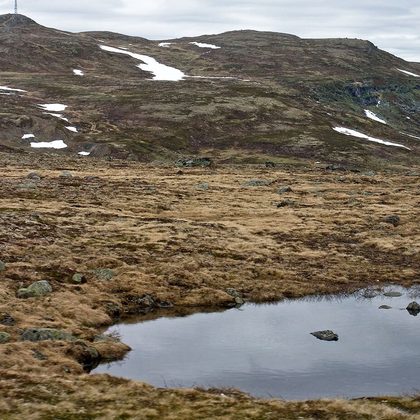
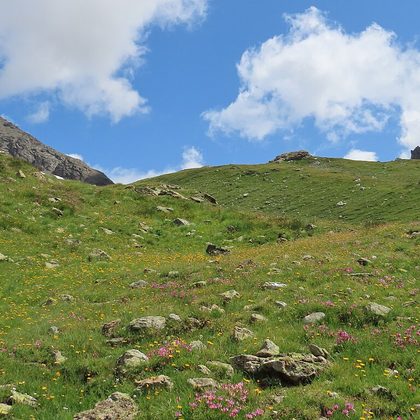
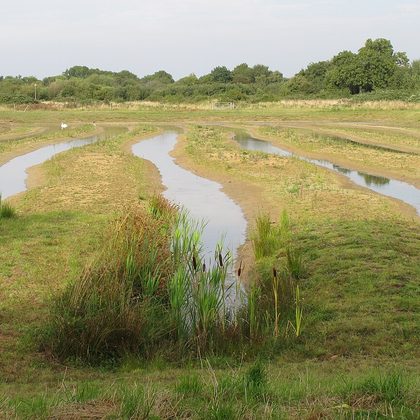
In the breeding range, bare short tundra and alpine meadow above the treeline, from Alaska and arctic Canada south into the Rockies, and in Asia the mountain tundra of north-east Siberia and Kamchatka; always open, low, stony ground with damp patches. Outside the breeding season it is a bird of bare, wet flats: drained mud, stubble and ploughed fields, short-grazed pasture, lake and lagoon margins, wrack beaches and saltmarsh. Vagrants in Europe are almost always found in exactly that sort of ground — a beach flat on Scilly, a potato field on an Irish headland, a golf course or an airfield edge on the Azores — and they regularly attach themselves to parties of meadow pipits.
Where the bird is most at home, classified with EUNIS — the European standard for habitats.

Range and movements
Breeds in arctic and alpine North America, from Alaska and northern Canada south into the Rockies and the Sierra Nevada of California, and additionally in north-east Siberia, Kamchatka and Japan; Asian birds winter in East and South-East Asia, American birds in the southern United States and Mexico. In the area of this guide it is a vagrant, with no breeding population, no regular wintering and no regular passage. The American form rubescens reaches the western edge nearly every year: the Azores hold the most records, followed by Ireland, south-west England and Iceland, with a strong peak in October and November. The Siberian form japonicus appears at the other end of the region, in Finland, Sweden, the Baltic states and Poland, with a scatter of records further west. Britain has a slowly growing total of accepted records, most of them from Scilly, Cornwall and the Northern Isles.
Where and when to look
This is emphatically a bird you meet rather than seek, and then in October or November in the right place: the Azores, an Irish or Cornish headland, or Scilly. Work the short-grazed fields, the potato ground and the beach flats where the meadow pipits are, and watch for one bird that looks bigger, plainer and warmer buff than the rest. If you find one, do three things in this order: record the call, even a single note; photograph the legs; and photograph the bird in profile, head-on and in flight. Then stay with it — these vagrants often hold to the same field for days, and that is the only way such a record is ever going to be nailed down.
Conservation status
Not globally threatened (LC): the range covers the arctic and alpine zone of two continents, the population runs to many millions and no decline has been demonstrated. For Europe the category means little, since we are dealing with displaced individuals. The pattern of records is more interesting: European occurrences have risen clearly since the 1990s, which almost certainly reflects the decision to treat the bird as a species separate from water pipit — observers have looked for it deliberately ever since — together with the photography and recording equipment that now make such a claim provable. In the longer term the breeding grounds face the same concern as all tundra habitats: the warming of the north is changing the open, short vegetation on which the species depends.
Scientific name
Anthus rubescens (Tunstall, 1771)
Tunstall described the species in 1771 as Alauda rubescens; because it was later moved to another genus, the author and year stand in brackets. The genus Anthus was introduced in 1805 by Bechstein. Anthus is the Latin name Pliny the Elder gave to a small bird of grasslands. rubescens is Latin for 'reddish', from ruber 'red'. The specimen the first description was based on came from Pennsylvania.