All species › Passerines › Wagtails and pipits › Pechora pipit
Pechora pipit | Anthus gustavi
Petsjorapieper | Bisbita de Pechora
A small, heavily streaked pipit from north-east Russia, named after the Pechora river. It winters in Indonesia and the Philippines and has no business in Europe, yet a handful reach the Northern Isles at the end of September nearly every year. It is a mousy, skulking bird that would rather be trodden on than flush, and that, infuriatingly, usually flushes in silence.

Voice
The call is hard, short and sharp: a metallic pwit or tzep, far harder and drier than the thin note of a meadow pipit and without the drawn-out complaint of a red-throated. It is often given as two or three notes in quick succession as the bird goes up. The difficulty is that on the one occasion you most need it — the moment it bursts out of the crop — it is nearly always silent, and that silence has itself become a pointer among vagrant hunters. The song, never heard in Europe, is a dry rattling insect-like phrase delivered from a low branch or in a short song flight over the bog tundra, closer to a cricket than to a pipit.
No freely licensed recording is available for this species yet.
Identification
Small and compact at 14–15 cm, short-tailed, with a notably stout short bill with a pink base. The upperparts are the key: heavily streaked black and buff, with two broad creamy-white lines running like braces down the mantle — broader and whiter than on any other pipit in the region, and visible even on a bird diving back into cover. The wing carries two bright, broad white bars formed by the pale tips of the median and greater coverts. Below it is white with a buff wash across the breast and heavy black streaks that run from the breast well down the flanks. One structural feature few people use is decisive: the primaries project far beyond the tertials, further than on any other small pipit, leaving a long dark wing point visible on the closed wing. The legs are flesh to pale pink. The whole bird is small, squat and strongly contrasted, and it keeps low and horizontal, creeping through the vegetation like a mouse.
Confusion species
Red-throated pipit is the first bird to eliminate and in juvenile and winter plumage is genuinely similar: also heavily streaked and with pale mantle braces, but longer-tailed, with a streaked rump, a shorter primary projection, a finer bill and a quite different call — a long, high, thin pseee that fades away, where Pechora's is hard and short. Its mantle braces are narrower and buffer, and there is usually a trace of pink or rust on the face or throat. Meadow pipit is duller and more olive, without the broad white braces or the heavy bill, and shows far less contrast on the wing. Tree pipit is bigger and longer-tailed, much plainer-backed, with fine flank streaks and an olive tone. Anyone who finds a heavily streaked small pipit in a Shetland potato field is well advised to start with all four and only then put a name to it.
Habitat
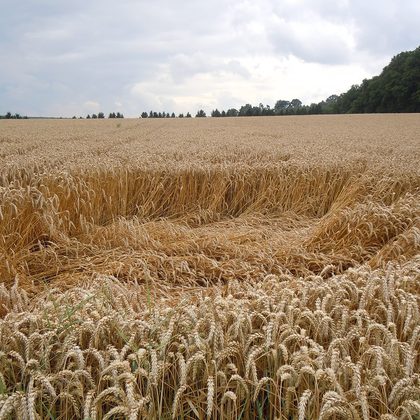
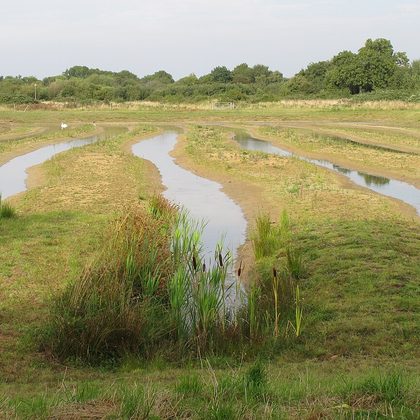
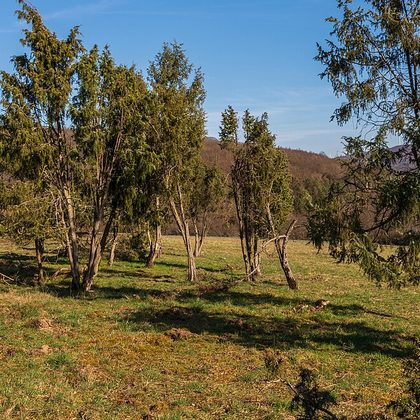
On the breeding grounds, wet tundra and marshy river plains with dwarf birch and willow scrub, always near water. European vagrants sit in dense low crops on the islands: potato and brassica fields, tall herb growth along dykes and ditches, barley stubble, iris and sedge beds, and rank grass around crofts. The picture is almost always the same — a bird that jumps out of the crop, flies forty metres low and straight and drops back into cover, after which it takes a long, patient wait to see it again.
Where the bird is most at home, classified with EUNIS — the European standard for habitats.
Range and movements
Breeds from the Pechora basin in north-east European Russia east through Siberia to Kamchatka and Chukotka, and winters in Indonesia and the Philippines. The western edge of the breeding range lies well outside this map, so within the map area the species is a vagrant. The centre of gravity for European records is Fair Isle, Shetland and Orkney, with the great majority of birds in the last week of September and the first days of October; there are scattered records elsewhere along the North Sea coasts, in Scandinavia and in central Europe. Fair Isle alone accounts for a large share of all British records, a pattern that says as much about coverage as about the bird.
Where and when to look
This is not a species you go and look for but one you walk into, and then only in the right place in the right week: late September on Shetland or Fair Isle after a spell of easterly wind. Work the potato patches and the rank strips along the drystone walls step by step — literally step by step, because it will not go up until you are almost on it. If something small, short-tailed and heavily streaked does flush, look at the back: two broad white braces down the mantle and two broad white wing bars are what you need. Then sit down and wait, because it will nearly always come back to the same corner.
Conservation status
Not globally threatened (LC): the breeding range covers a large part of northern Siberia and the population is large, though barely countable across such country. There is no evidence of decline, but the species depends on the bog tundra and northern river plains that are changing fastest. For Europe it stays a rarity, and the number of records in any one year depends mainly on the weather in late September and on how many observers happen to be on the Northern Isles.
Scientific name
Anthus gustavi Swinhoe, 1863
Swinhoe described the species in 1863 and placed it straight away in the genus where it still stands. The genus Anthus was introduced in 1805 by Bechstein. Anthus is the Latin name Pliny the Elder gave to a small bird of grasslands. gustavi honours the Dutch sinologist and field naturalist Gustaaf Schlegel (1840–1903), son of Hermann Schlegel. The specimen the first description was based on came from Xiamen, China.