All species › Passerines › Wagtails and pipits › Blyth's pipit
Blyth's pipit | Anthus godlewskii
Mongoolse pieper | Bisbita de Blyth
The smaller, shorter-billed counterpart of Richard's pipit, from Mongolia and Transbaikalia. In the field the two are barely separable, and that is not modesty but the honest position: a good share of the birds reported in Europe as 'Richard's or Blyth's' stays unnamed for good. To pin one down you need the call and a sharp photograph of the wing.

Voice
The call is the only character that can name a bird passing overhead. It is softer, shorter and far less rasping than Richard's: a nasal, slightly bleating pshee-oo or chew that falls away at the end instead of grating, pitched somewhere between a yellow wagtail and a young starling. Typically it is followed by a short dry chep or chip, or the bird uses that short note on its own; Richard's does not have it. The difficulty is that Richard's own call varies, and that tired or freshly flushed birds call more briefly and more softly, so a grey area remains. With these two a phone recording and a sonogram afterwards are not a luxury. The song, a simple repeated phrase from a high song flight over the steppe, has never been heard in Europe.
No freely licensed recording is available for this species yet.
Identification
A Richard's pipit in miniature: 15.5–17 cm, so noticeably smaller and above all more compact and shorter-legged, closer to a tree pipit in build and less markedly upright. The bill is shorter, finer and more pointed and so looks less heavy; the hindclaw is clearly shorter and more strongly curved than Richard's, roughly the length of the hind toe. The upperparts are warm sandy brown with dark streaking, the breast buff with fine short streaks, and the malar stripe is narrower than Richard's. The best plumage feature is on the median coverts: each feather has a black centre cut off square, with a broad, sharply defined creamy tip standing above it like a block. On Richard's that dark centre tapers to a point and the pale fringe is diffuse. The second-outermost tail feather also helps: on Blyth's the white is more restricted and buff-tinged, with the dark inner edge running obliquely almost to the tip. All three are characters of feathers, not of a bird flying away.
Confusion species
Richard's pipit is the only species that really matters, and the differences are set out above and on its own page. Remember the order in which they are usable: first the call, then the median coverts on a photograph, then the length of the hindclaw, and only after that general impressions of size, bill weight and stance — the exact reverse of how most people work in the field. Tree pipit matches Blyth's in size and build but is olive-brown rather than sandy, with finely streaked flanks, short pink legs and a short curved hindclaw, and its call is a hoarse teez. Tawny pipit is bigger, paler, longer-legged and has a clean unstreaked breast. A fair number of birds claimed as Blyth's turn out on review to be small Richard's; when in doubt, leave it as not established.
Habitat
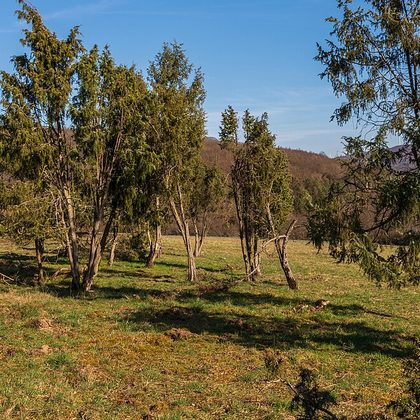
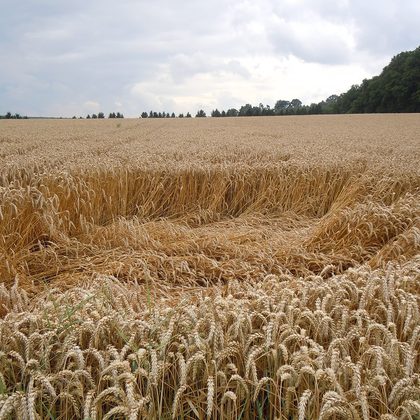
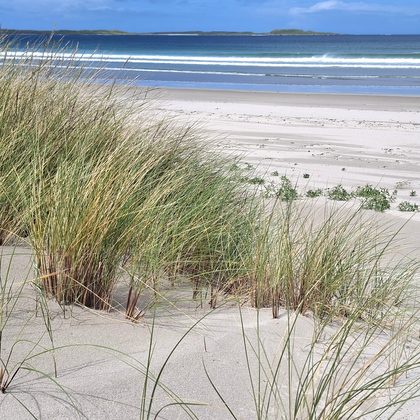
On the breeding grounds, dry stony hill steppe and grassy plains with scattered bushes, well above two thousand metres. European vagrants turn up where Richard's pipits are, but on average in shorter and drier grass: grazed pasture and field margins, mown airfield verges, harvested potato and beet fields, dune grassland and the upper edge of saltmarsh. They feed by walking on open ground and vanish into the nearest rank vegetation when disturbed.
Where the bird is most at home, classified with EUNIS — the European standard for habitats.
Range and movements
Breeds in Mongolia, southern Siberia east of the Altai, Transbaikalia and northern China, and winters in India, Nepal and Myanmar. In the map area it is a genuine vagrant, with a few tens of accepted records to date, heavily concentrated in Britain and Ireland, Scandinavia and the Netherlands and thinner in central Europe and around the Mediterranean. Britain has by far the largest share, with birds on Shetland, Fair Isle and Scilly and a scatter of long-staying individuals inland. Most appear in October and November, with a second smaller window in winter and early spring, some birds settling on one field for weeks.
Where and when to look
Realistically you do not find this species; you find a 'Richard's or Blyth's pipit'. In October and November work the same rough grassland, field edges and dune pasture as for Richard's, and record the sound of every calling bird at once — that matters more than the photograph. If you get the bird on the ground, do not shoot the portrait but the closed wing, side-on and sharp: the row of median coverts with their square-cut black centres and block-shaped pale tips is what a records committee wants to see. If neither works, leave the bird unnamed. With this pair that is not a failure but the normal outcome.
Conservation status
Not globally threatened (LC), with a large, thinly populated breeding range in the Central Asian steppe and no sign of decline. For Europe it is a rarity and nothing more. Accepted records have risen clearly since the 1980s, and that is almost certainly because observers learned the call and because digital recordings and photographs allow a suspicion to be proved after the event. It is the observing rather than the bird that has changed.
Scientific name
Anthus godlewskii (Taczanowski, 1876)
Taczanowski described the species in 1876 as Agrodoma godlewskii; because it was later moved to another genus, the author and year stand in brackets. The genus Anthus was introduced in 1805 by Bechstein. Anthus is the Latin name Pliny the Elder gave to a small bird of grasslands. godlewskii honours the Polish nobleman and field naturalist Wiktor Godlewski (1831–1900), who collected birds during his Siberian exile. The specimen the first description was based on came from the Argun valley, Transbaikalia.