All species › Passerines › Finches › Atlantic canary
Atlantic canary | Serinus canaria
Kanarie | Canario
Everybody knows the canary, and almost nobody knows the canary. The cage bird is a clear lemon yellow because that is what centuries of selection and breeding have produced; the wild bird is green-grey with a yellow breast and fine dark streaking, and it lives only on the Azores, Madeira and the Canary Islands. There it is not a rarity but an ordinary resident of open slopes with scrub, terraces and orchards, from the coast to high in the hills. The cage canary goes back to this bird: it has been kept and bred in captivity since the fifteenth century.

Voice
The song is a long, silvery, rolling stream of clear notes and trills, recognisable as canary song but looser, more varied and less shrill than the bred cage bird, with long unhurried passages. It is delivered for minutes on end from a wire, a treetop or a television aerial. The call is a soft, rolling, tinkling tirrlee or tsoo-eet, far softer than the dry jingle of a Serin.
No freely licensed recording is available for this species yet.
Identification
A slim, long-tailed finch, larger than a Serin. The male has a yellow forehead, face and breast, but the crown and nape are grey-green and the mantle is grey-green with strong dark streaks; belly and undertail are white, the flanks grey with fine streaks. The rump is a dull yellow-green. The female is greyer and much less yellow, with heavier streaking; juveniles are brownish and streaked all across the underparts, with no yellow at all. In short, a bird with as much grey and green on it as yellow — the opposite of the cage-bird image.
Confusion species
Serin is the species to measure it against, and four points settle the pair: the Canary is clearly larger, noticeably longer-tailed, far less densely streaked on breast and flanks, and has a dull yellow-green rump instead of the bright lemon rump that flares as a Serin turns away. Shape helps too: Serin is a little ball with a stubby bill, the Canary is longer-bodied with a slightly longer bill. Around island towns and harbours there are also escaped cage birds — bright yellow, white or orange, often ringed and often clumsy in behaviour — which do not belong in the notebook.
Habitat
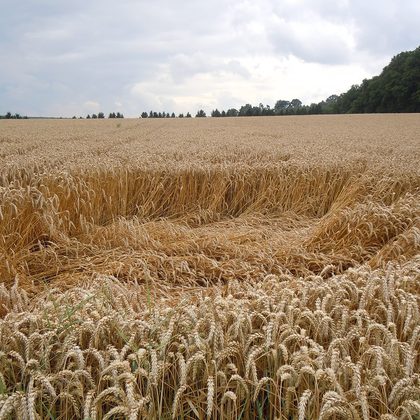
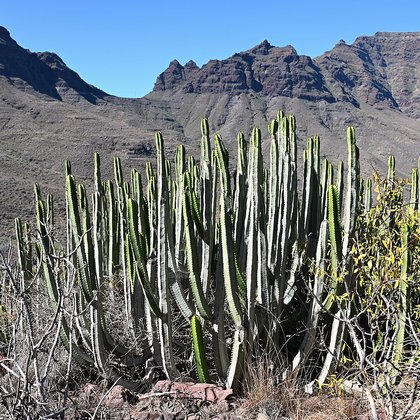
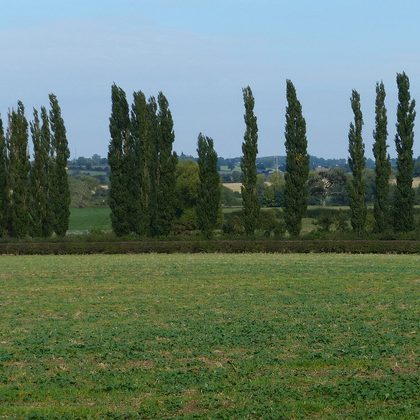
Half-open country with bushes and seed: scrubby hillsides, old farming terraces, orchards and banana plots, vineyards, village edges, gardens and parks, the edges of pine and laurel forest, and on the Canaries the coastal spurge scrub as well. It nests in a bush or low tree and feeds on the ground and at seeding herbs along paths and road verges.
Where the bird is most at home, classified with EUNIS — the European standard for habitats.

Range and movements
Three Atlantic archipelagos and nowhere else: the Azores, where it is common on every island, Madeira with Porto Santo, and the Canary Islands, where it is numerous on the western islands, more local on Gran Canaria and scarce on Lanzarote and Fuerteventura. It is resident, with at most a drift downhill in winter. It does not occur wild on the European mainland: any canary on the continent is an escape from a cage.
- Resident
Where and when to look
On Madeira, La Palma or Tenerife it takes little effort: drive up a levada track or a terraced slope, get out and listen for the long rolling song, usually from the highest point in view. February to June are the best months. Check the back and flanks of every bird first — grey-green and streaked is the wild bird, plain yellow is one out of a cage.
Conservation status
Not globally threatened (IUCN: Least Concern) and numerous on all three archipelagos. Centuries of trapping for the bird trade never broke the wild population, and the species is now protected. The abandonment of the old farming terraces cuts both ways: scrub regrowth offers nest sites, but the loss of small fields and orchards costs it seed-rich feeding ground.
Scientific name
Serinus canaria (Linnaeus, 1758)
Linnaeus described the species in 1758 as Fringilla canaria; because it was later moved to another genus, the author and year stand in brackets. The genus Serinus was introduced in 1816 by Koch. Serinus comes from French serin 'canary', possibly a corruption of Latin citrinus 'lemon-coloured'. canaria refers to the Canary Islands, whose name goes back to Latin canariae insulae 'islands of dogs', after the large dogs kept by the inhabitants. The specimen the first description was based on came from the Canary Islands.