All species › Passerines › Finches › European serin
European serin | Serinus serinus
Europese kanarie | Verdecillo
The Serin is Europe's smallest finch and, in the south, one of its commonest town birds. It sings from a television aerial, a telephone wire or the top of a cypress, and its fast glassy jingle belongs to a Spanish or Italian village square as much as the sound of scooters does. The canary of the cage, incidentally, is a different species, at home on the Canaries, Madeira and the Azores.

Voice
The song is what identifies the species fastest: a sustained, fast, high jingle of glassy hissing notes with no clear phrasing, sounding like a small clockwork mechanism running away with itself. It is delivered from a high open perch or in a slow song flight on wide-spread wings and deliberate beats. The flight call is a light, rolling, tinkling tirrilit, drier and a shade crosser than a Goldfinch's. Heard from February into August, and in the south into late summer too.
No freely licensed recording is available for this species yet.
Identification
Very small, compact and short-tailed, with a big head and a strikingly short, blunt bill. The male has a bright yellow forehead, head and breast, a yellow rump that flares as it turns away, and dark streaking on the flanks and the brown-green mantle. The female is greyer and much duller yellow, with heavier streaking; juveniles are brownish and closely streaked, with no yellow at all. The yellow rump is the best character in every plumage.
Confusion species
Siskin causes the most trouble, but it is bigger, longer tailed, greener, has an obvious yellow wingbar and a fine pointed bill, and in the male a black crown. Greenfinch is far bulkier and shows yellow edges in wing and tail. In the mountains of southern Europe watch also for Citril Finch, which is larger, plain-backed and unstreaked on the flanks. Small size, blunt bill and dense streaking together settle Serin.
Habitat
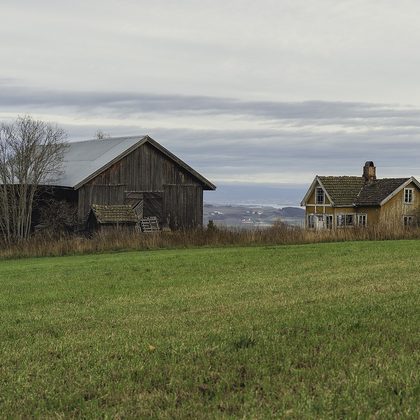
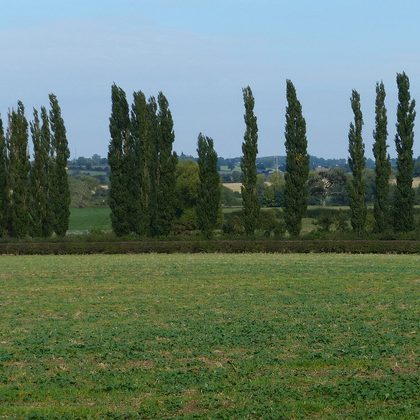
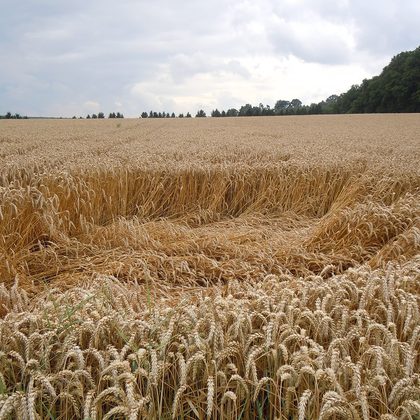
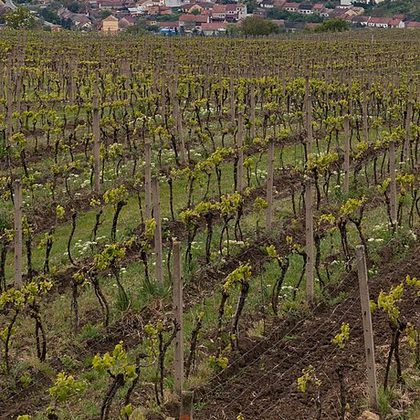
Half-open ground with trees and seed: village and town edges, parks, cemeteries, cloister gardens, orchards, olive groves, vineyards, nurseries and field margins. It nests high in a cypress, an ornamental conifer or a dense shrub, and feeds on the ground and at seeding herbs, often on paths and between paving stones.
Where the bird is most at home, classified with EUNIS — the European standard for habitats.

Range and movements
Breeds throughout southern and central Europe, from Iberia, southern France and Italy to the Balkans and Turkey, and beyond that in north-west Africa and on the Mediterranean islands. From the nineteenth century the range spread north into Germany and the Low Countries, where it is now a very scarce and erratic breeder. In Britain it is a scarce migrant, mainly to the south coast, and has bred only a handful of times. Northern birds leave in September for the Mediterranean.
- Resident
- Breeding (summer)
- Winter
- Passage
- dark = core range, pale = thinly spread
Where and when to look
Walk through a southern European village in April and look up at the wires and aerials: the jingle comes from above, and the singer is nearly always on the highest point around. North of the Alps your best chance is a cemetery or a leafy suburb full of conifers, early on a May morning. With flyover parties watch for the yellow rump, which still shows when the bird is too far off for the streaking.
Conservation status
Not globally threatened (IUCN: Least Concern), but a clear decline has been recorded in Europe, sharpest at the northern edge of the range — precisely where the species established itself during the twentieth century. In the Low Countries and Germany it has almost gone again. Around the Mediterranean it remains numerous; illegal trapping for the cagebird trade plays a local part there.
Scientific name
Serinus serinus (Linnaeus, 1766)
Linnaeus described the species in 1766 as Fringilla serinus; because it was later moved to another genus, the author and year stand in brackets. The genus Serinus was introduced in 1816 by Koch. Serinus comes from French serin 'canary', possibly a corruption of Latin citrinus 'lemon-coloured'. The specific name repeats the genus name. The specimen the first description was based on came from Switzerland.