All species › Passerines › Finches › Syrian serin
Syrian serin | Serinus syriacus
Syrische kanarie | Serín sirio
The Syrian Serin is a mountain bird with a small, broken range: the juniper and cedar slopes of Mount Lebanon, the Anti-Lebanon, Mount Hermon and the hill country of Israel and Jordan. In winter it leaves the mountains altogether and turns up in the acacia wadis of the Arava. It is the only bird in this group of finches to carry a Red List category.

Voice
The song is a soft, high, sweet twitter full of rolling trills, distinctly more musical and less shrill than the glassy rattle of a Serin, delivered from a juniper or in a slow song flight on deliberate wingbeats. The call is a light rolling tirrilit, softer than a Serin's, and in winter it is the best way of picking up parties in the acacias.
No freely licensed recording is available for this species yet.
Identification
A small, pale finch, long-tailed for its size and silvery in overall effect. Head and underparts are grey-white with a yellow forehead, a yellow eye-ring and a yellow wash over face and breast; the mantle is grey with faint dark streaks and the rump is yellow-green. Yellow edges run through wing and tail and show well on a fluttering bird. The female is paler and browner still with less yellow; juveniles are sandy brown and finely streaked. The overall impression is of a serin from which the colour has been washed out.
Confusion species
Serin winters in the same country and is the only real confusion. It is smaller and rounder, far more densely and heavily streaked on breast and flanks, has a bright lemon rump and a short blunt bill. Syrian Serin looks long, slim and pale, is barely streaked, and shows a yellow wash on the face rather than a bright yellow mask. Voice separates them too: soft and sweet against a dry jingle.
Habitat
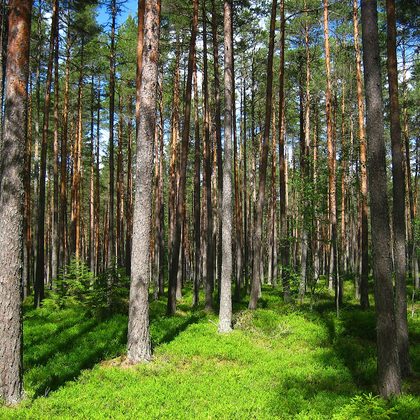
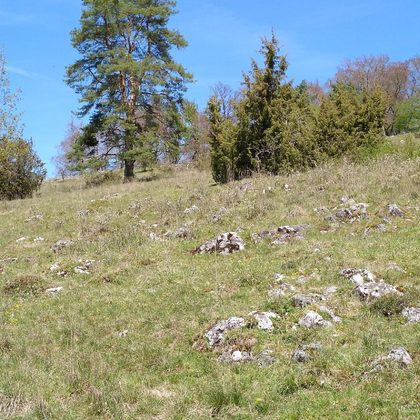
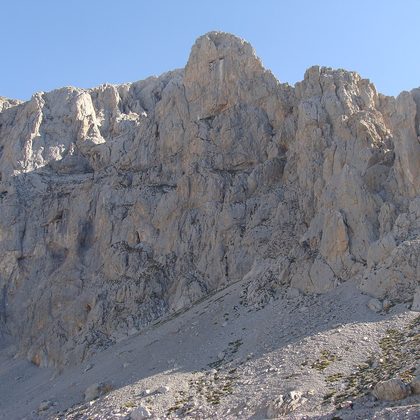
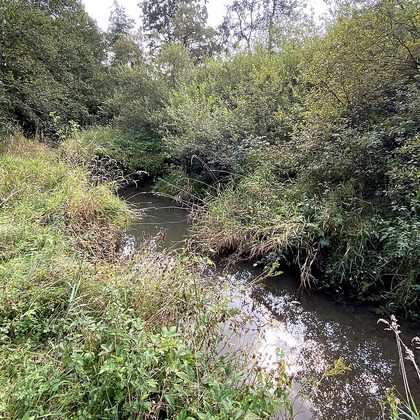
In summer, open mountain woodland of juniper, cedar and pine on rocky slopes between roughly 900 and 1900 m, with rock outcrops, scrub and the small fields and orchards of hill villages mixed in. In winter, the opposite: acacia wadis, tamarisk belts and seed-rich rough ground in the lowest and warmest desert rifts.
Where the bird is most at home, classified with EUNIS — the European standard for habitats.
Range and movements
A small Levantine range: the mountains of Lebanon and the Anti-Lebanon hold the core, with outliers in southern Syria, on Mount Hermon, in the hills of northern Israel and in the Jordanian mountains around Dana and Shobak. Birds move down in October to the Arava, the Jordan valley, Sinai and Egypt, returning in March and April. Away from this region the species simply does not occur.
- Resident
- Breeding (summer)
- Winter
- Passage
- dark = core range, pale = thinly spread
Where and when to look
In May and June work the slopes of Mount Hermon or the Lebanese ranges: find open juniper woodland and listen for the soft high song; in the afternoon heat the birds gather at water. Winter is easier, when parties come to drink at the water points of the Arava — Yotvata and the pools near Eilat are the classic sites. Judge length and paleness rather than yellow.
Conservation status
Vulnerable (IUCN). The range is small and fragmented and numbers are falling. The old juniper and cedar woodland is being cut and heavily grazed, so nothing regenerates, and in the wintering grounds trapping for the cagebird trade takes a share. For this bird, keeping the open mountain woodland of Lebanon is the whole question.
Scientific name
Serinus syriacus Bonaparte, 1850
Bonaparte described the species in 1850 and placed it straight away in the genus where it still stands. The genus Serinus was introduced in 1816 by Koch. Serinus comes from French serin 'canary', possibly a corruption of Latin citrinus 'lemon-coloured'. syriacus is Latin for 'Syrian', after the Levant, where the species breeds.