All species › Passerines › Finches › Azores chaffinch
Azores chaffinch | Fringilla moreletti
Azorenvink | Pinzón de las Azores
On the Azores this is the chaffinch, and it is everywhere: in the laurel forest, along the hydrangea hedges between the pastures, in the gardens of Furnas and on your picnic table before the coffee has cooled. It has been treated as a separate species since 2021, on the strength of genetic work, measurements and song; before that it stood with common chaffinch as an island form. Hold it against a plate of common chaffinch and the difference is immediate: the back is green, not rust-brown.

Voice
The song keeps the architecture of a chaffinch phrase but is shorter and plainer: an accelerating rattle that ends flat, without the flourish common chaffinch signs off with. It runs from February into June, delivered from a treetop or a telephone wire. The call is a short springy pink, softer and higher than common chaffinch's, and in damp weather a plaintive hweet — which on the Azores means most days.
No freely licensed recording is available for this species yet.
Identification
A chaffinch with a green back. The male has a dark blue-grey crown and nape, a small black forehead, a dark patch behind the eye and a pale line above it; the mantle is olive-green and the rump greenish. The underparts are a soft orange-pink on throat and breast, fading to off-white on the belly with grey flanks — nowhere the brick-pink of common chaffinch. The wing is black with a broad white shoulder patch and a second white bar, plus yellowish fringes to the flight feathers; the outer tail feathers are white. The bill is slightly heavier and blunter than a common chaffinch's. The female is grey-brown with a greenish rump and the same striking wing pattern.
Confusion species
Against common chaffinch it is not one character but three at once: the back is olive-green rather than rust-brown, the underparts are paler and more orange than pink, and the head is a darker blue-grey carrying a dark patch behind the eye where common chaffinch is plain. A few common chaffinches and bramblings reach the islands in winter; brambling gives itself away with the white rump and orange shoulder. The other island chaffinches are no practical problem — Madeira chaffinch is a thousand kilometres to the south and Canary Islands chaffinch further still. Worth knowing anyway: Madeira chaffinch has a blue lower back contrasting sharply with the green upper back, and on Canary Islands chaffinch head and back are one uniform deep blue-grey, with no green at all.
Habitat
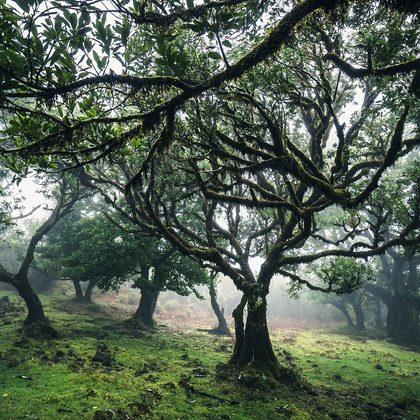
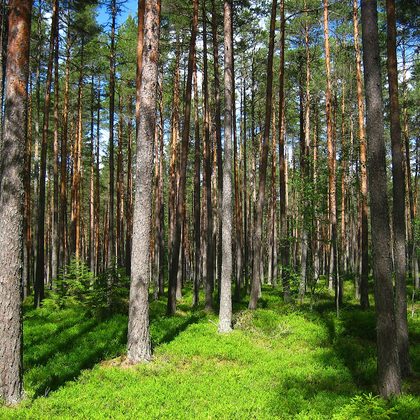
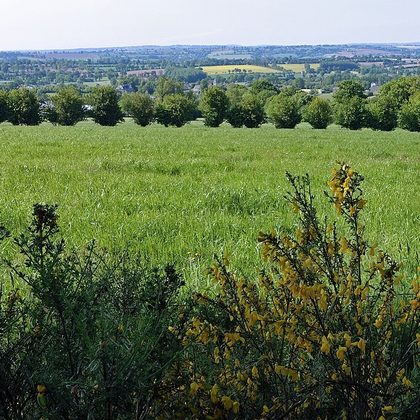
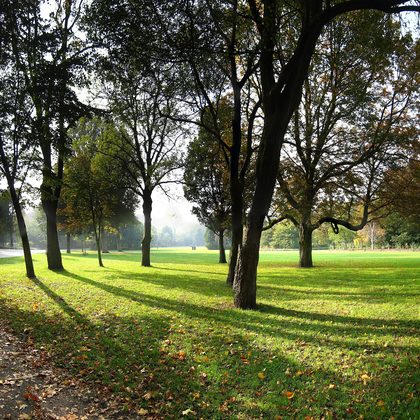
Anything on the islands that carries trees or bushes: the remaining laurel forest on the heights, the large Japanese cedar plantations, the hydrangea and tree-heath hedges along the roads and between the pastures, orchards, village gardens, parks and crater rims. It ranges from the coast to above two thousand metres on Pico. It feeds on the ground, on short grass and paths, and at seeding herbs.
Where the bird is most at home, classified with EUNIS — the European standard for habitats.
Range and movements
All nine Azorean islands, from Corvo and Flores in the west to Santa Maria in the east, and on every one of them among the commonest breeding birds. It does not migrate and barely crosses even between islands, so each island population stands on its own. It occurs nowhere outside the archipelago.
- Resident
Where and when to look
No effort required: park at the Parque Terra Nostra or at a viewpoint above Sete Cidades, sit down, and within ten minutes one will be walking round your feet. Then take your time over the back — that green is the whole story — and afterwards look for the dark patch behind the eye. In March and April they sing every hundred metres along the hydrangea hedges.
Conservation status
The category above is that of the common chaffinch. BirdLife, which assesses birds for the Red List, still keeps this finch within that species and so does not assess it separately; the guide therefore shows the category of the wider species rather than “not evaluated”, because assessed it has been — only under a broader species concept. In practice it is common to very common on all nine islands and stable. It takes to plantations, hedges and gardens without difficulty and is therefore far less vulnerable than most birds of this archipelago. The loss of the original laurel forest, which is ruinous for other Azorean birds, barely touches it.
Scientific name
Fringilla moreletti Pucheran, 1859
Pucheran described the species in 1859 and placed it straight away in the genus where it still stands. The genus Fringilla was introduced in 1758 by Linnaeus. Fringilla is the Latin word for 'finch'. moreletti honours the French naturalist Arthur Morelet (1809–1892), who collected in the Azores. The specimen the first description was based on came from the Azores.