All species › Passerines › Finches › Madeira chaffinch
Madeira chaffinch | Fringilla maderensis
Madeiravink | Pinzón de Madeira
The Madeira chaffinch is the handsomest of the set: a bird with a blue head, a green upper back, a blue lower back and a peach breast, and so tame that at Fanal or along the levadas it will feed off your shoe. It has been treated as a separate species since 2021, on the strength of genetic work, measurements and song. It lives on the main island only; it is absent from Porto Santo and the Desertas.

Voice
The song is a short rattling chaffinch phrase that accelerates and then ends flat; it lacks the cheerful flourish of common chaffinch and so sounds cut off. It runs from January into June, usually from a branch over a path. The call is a clear short pink, slightly softer than common chaffinch's, and in rain — so, often, on the north side of the island — a drawn-out plaintive hweet.
No freely licensed recording is available for this species yet.
Identification
A little smaller and more compact than common chaffinch, and far more colourful. The male has a slate-blue crown and nape with a small black forehead, an olive-green upper back that changes sharply into a blue-grey lower back and rump, and soft peach-orange underparts fading to off-white on the belly, with a blue-grey wash across the flanks. The wing is black with a broad white shoulder patch, a second white bar and yellow fringes along the flight feathers; the outer tail feathers are white. The female is grey-brown with a cream breast, a greenish rump and the same wing pattern. Juveniles resemble the female.
Confusion species
Common chaffinch is not a regular bird on Madeira, but it remains the yardstick: there the back and rump are rust-brown and greenish and the breast brick-pink; here the upper back is green, the lower back blue and the breast peach-orange. Against Azores chaffinch, which comes closest, the contrast between green upper back and blue lower back is far sharper here, and the blue-grey wash over the flanks is absent from the Azores bird. Canary Islands chaffinch is one uniform blue-grey over head and back, with no green. Atlantic canary, which uses the same gardens and terraces, is green-grey, streaked and sharp-billed — a confusion for the first glance only.
Habitat
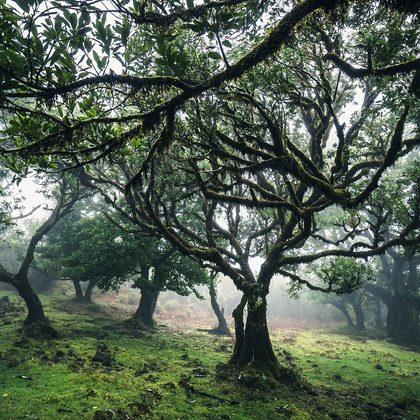
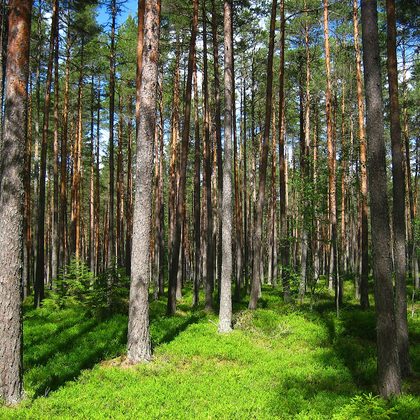
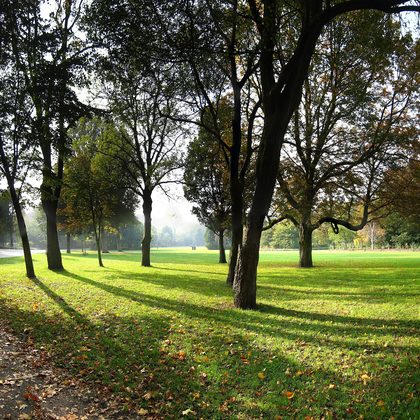
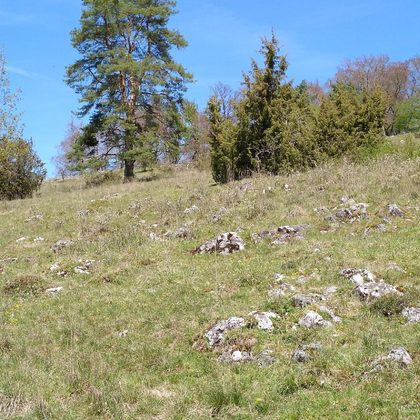
The laurel forest of the damp northern slopes and the crater rims, the pine, eucalyptus and acacia plantations around it, the tree-heath country higher on the mountains, and beyond that the levada paths, gardens, parks, orchards and terraces. It ranges from about three hundred metres to near the summits. It feeds mainly on the ground, on paths and in short grass, and on seeds and crumbs at the picnic sites.
Where the bird is most at home, classified with EUNIS — the European standard for habitats.
Range and movements
The island of Madeira and nowhere else, and there common across almost the whole island, from the lowest woodland edges to the high mountains. It does not occur on Porto Santo or the Desertas, and it does not leave the archipelago: no record away from Madeira stands up.
- Resident
Where and when to look
Fanal in the mist, or the trailhead of the Levada das 25 Fontes at Rabaçal: at both you will find them on the car park. They are tame enough that at a metre you can follow the change from green to blue down the back at leisure — exactly the character a distant photograph loses. March and April are the best months for song.
Conservation status
The category above is that of the common chaffinch. BirdLife, which assesses birds for the Red List, still keeps this finch within that species and so does not assess it separately; the guide therefore shows the category of the wider species rather than “not evaluated”, because assessed it has been — only under a broader species concept. In practice it is common across the island and stable. It is not tied to the laurel forest and does just as well in plantations, gardens and orchards, which leaves it far safer than the Trocaz pigeon and the Madeira firecrest of the same island. Feral cats and rats take nests, but not on a scale that shows in the population.
Scientific name
Fringilla maderensis Sharpe, 1888
Sharpe described the species in 1888 and placed it straight away in the genus where it still stands. The genus Fringilla was introduced in 1758 by Linnaeus. Fringilla is the Latin word for 'finch'. maderensis means 'of Madeira', the island where the bird belongs. The specimen the first description was based on came from Madeira.