All species › Passerines › Weavers › Black-headed weaver
Black-headed weaver | Ploceus melanocephalus
Zwartkopwever | Tejedor cabecinegro
A short, stocky yellow bird with a black hood that hangs its nest as a woven ball between two reed stems. The black-headed weaver belongs in Africa south of the Sahara; its Iberian presence goes back to escaped cage birds that gained a foothold in the Portuguese marshes from the 1990s onward. The nest gives it away before the bird does: a tightly woven globe of reed strips, a little larger than a tennis ball, turning above the water in June.

Voice
No song in the ordinary sense: a dry, hissing churr that swells out of the reeds like static, roughly chik chik — zzzzzzrrrr, delivered with drooping, quivering wings from a half-built nest. Between bursts, short hard tsek notes of alarm. In a colony ten or twenty males rattle across one another, which from a distance sounds like a vacuum cleaner starting up. Heard April to September, loudest in the middle of the day.
Recording: Anne Ndung'u — CC BY-SA 4.0 · Wikimedia Commons
Identification
Slightly smaller than a house sparrow but heavier-built, with a thick conical bill and a short tail. The breeding male is deep egg-yolk yellow below, plain yellow-green and unstreaked on the mantle, with an entirely black hood covering chin, throat and ear coverts and ending in a point on the upper breast, often with a warm rusty wash along the edge of the black. The nape is yellow, so the hood sits on the bird like a loose mask. The eye is dark and the bill black in the breeding season. Females and non-breeding males are dull and sparrow-like: olive-brown with faint streaking above, a dingy yellow supercilium, a yellowish wash across the breast and a pale horn bill. In every plumage the bird works its way up and down vertical stems in short jerky hops, which no sparrow does.
Confusion species
The yellow-crowned bishop is clearly smaller, and its male has a yellow crown and a black belly — the reverse pattern. Escaped village weavers, which turn up now and then in Iberia, are bulkier, with a black-and-chestnut head, a mottled back and a striking red eye. The dull plumages are the hard ones: at any distance a female weaver is barely separable from a sparrow, and the decision rests on the heavy, deep bill, the yellow wash on the breast and the behaviour — weavers climb about in the reeds and hang upside down while doing it, sparrows merely sit in them.
Habitat
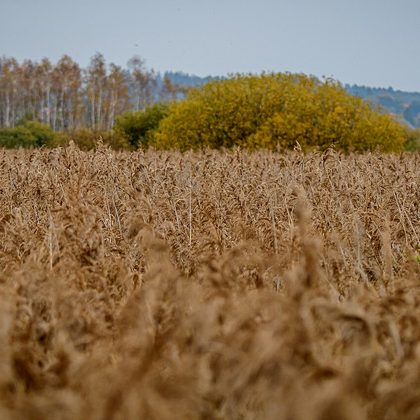
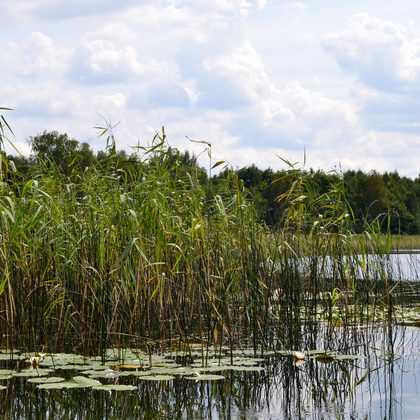
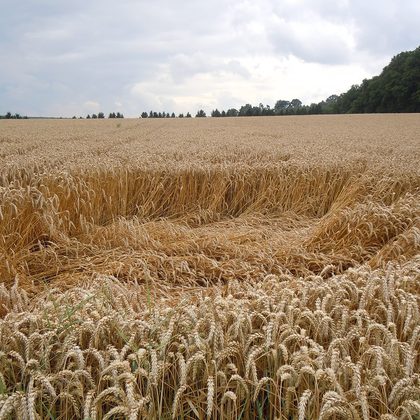
Reedbeds of coastal lagoons, river mouths and freshwater marshes, where the nest is woven low over the water into living reed; also rice fields, wide reed-fringed ditches and the reedy margins of ornamental ponds and golf-course lakes. Feeds close to the reeds on the seeds of reed, grass and rice, and on insects and spiders in the breeding season, usually clambering among the stems and rarely out on open ground.
Where the bird is most at home, classified with EUNIS — the European standard for habitats.

Range and movements
Natively a bird of West, Central and East Africa, from Senegal to Sudan and Uganda. In Portugal it was found in the 1990s in the Tagus estuary and at Vilamoura, breeding in both, and it has largely stayed put since. The strongholds are the Tagus estuary, the central Algarve around Faro and Quinta do Lago, the Paul da Tornada, and in recent years the Barrinha de Esmoriz south of Porto. In Spain it breeds locally in Catalonia — the Maresme, La Selva and the mouth of the Tordera — with scattered birds elsewhere along the Mediterranean coast. Everywhere the picture is the same: small, tightly clustered populations, locally numerous and overall scarce.
- Resident
- Breeding (summer)
- Passage
- dark = core range, pale = thinly spread
Where and when to look
Go to an Algarve reedbed in June or July — the lakes of Quinta do Lago and the reeds at Ludo are the best known — and look for the nests before you look for the bird. They hang at eye to head height from one or two reed stems over the water, fresh yellow when newly finished and straw-coloured after a season. Stand still, wait for the hissing to start, and the male will come to the ball on his own. The Lagoa Pequena near Sesimbra is a second reliable site in Portugal; in Spain the mouth of the Tordera is the surest bet.
Conservation status
Not globally threatened (IUCN: Least Concern); in Africa the species is common and locally a pest in rice. In Europe it is an alien bird whose presence goes back to escaped and released cage birds; Spain lists it as an invasive alien species, which bans its sale and keeping. The concern is that it pushes native reed nesters such as reed warbler and sedge warbler out of the best patches and competes with them for seeds and insects; in Catalonia weavers have been seen keeping other species out of a breeding site. Evidence of damage on any larger scale is so far lacking, mainly because the population has stayed small and highly concentrated. A breeding black-headed weaver is worth reporting: in a species that has sat on the same handful of sites for thirty years, every new cluster counts.
Scientific name
Ploceus melanocephalus (Linnaeus, 1758)
Linnaeus described the species in 1758 as Loxia melanocephala; because it was later moved to another genus, the author and year stand in brackets. The genus Ploceus was introduced in 1816 by Cuvier. Ploceus is Greek, from plokeus 'weaver', from plekō 'to plait', after the woven nests. melanocephalus is Greek, from melas 'black' and kephalē 'head'. The specimen the first description was based on came from Guinea.