All species › Passerines › Weavers › Yellow-crowned bishop
Yellow-crowned bishop | Euplectes afer
Napoleonwever | Obispo coronigualdo
A bird the size of a wren that hangs over the rice fields in summer like a yellow pompom come loose. The yellow-crowned bishop belongs in Africa south of the Sahara; its Iberian presence goes back to escaped cage birds, noticed in the Algarve in the 1980s and spread since then across the large Portuguese wetlands. Out of the breeding season it vanishes altogether: it is then a small brown streaky thing you would take for a young sparrow.

Voice
A thin, high hissing buzz, zi-zi-zi-zrrrrr, poured out without a break by the displaying male as he bounces over his patch of grass on fast whirring wingbeats — the sound of a large fly at a window pane. Besides that a short sharp tsip as a contact call in the flock. Really conspicuous only in the breeding season, from May into September.
No freely licensed recording is available for this species yet.
Identification
Very small and round, with a short tail and a thick conical bill. The breeding male cannot be mistaken: bright egg-yolk yellow on forehead, crown and hindcrown, running on as a broad yellow collar round the neck, and black on face, throat, breast and belly; back and rump yellow, wings brown. In display he raises the back and rump feathers until the bird is almost spherical and the yellow crown stands up like a cap. Females and non-breeding males are dull brown with dark streaking above, a pale supercilium and finely streaked flanks — sparrow-like, but much smaller, shorter-tailed and paler-billed. Non-breeding males keep dark wing feathers, which separates them with some effort.
Confusion species
The black-headed weaver is considerably larger, with a black head on a yellow body, and climbs in the reeds rather than dancing above the grass. Other escaped bishops of the genus Euplectes — the northern red bishop above all — show red or orange instead of yellow in breeding plumage; when in doubt, look at the crown, which in this species is always yellow. In dull plumage the bird can barely be done on plumage at all: the size, the very short tail and the company of other small seed-eaters along a rice field say more than the feathers.
Habitat
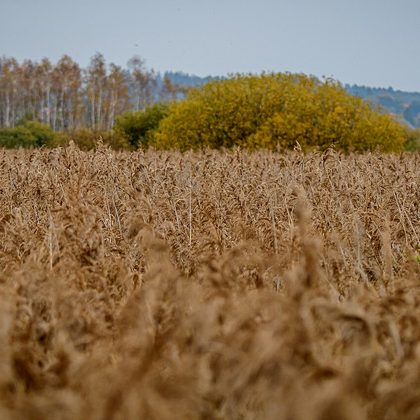
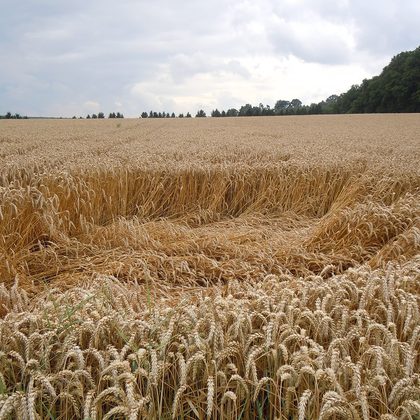
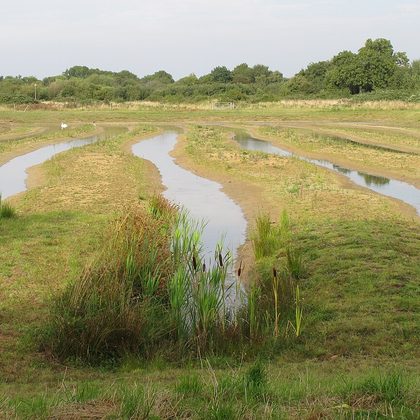
Damp grassy ground with tall standing stems: rice fields and their banks, flooded pasture, wet rough grassland and the broad edges of reedbeds and ditches. The nest is a small oval structure of fine grass woven low between upright stems with the entrance at the top; one male builds several, each for a different female. Feeds almost entirely on the seeds of grasses, reed and rice, with small insects added in the breeding season.
Where the bird is most at home, classified with EUNIS — the European standard for habitats.

Range and movements
Natively a bird of the open wet grasslands of Africa south of the Sahara, from Senegal to Ethiopia and South Africa. In Portugal it was recorded in the Algarve in the 1980s and has expanded strongly over the last two decades: the rice fields and reedbeds of the Tagus and Sado estuaries, the Aveiro lagoon and several Algarve wetlands now hold it as a matter of course. In Spain it breeds locally in the rice districts and reed marshes of Andalusia, Valencia and Catalonia, and in southern France there are a few small clusters in the Rhône delta and along the coast. Numbers are highest in Portugal and still rising there.
- Resident
- Breeding (summer)
- dark = core range, pale = thinly spread
Where and when to look
Find a rice field in the Tagus estuary in July or August — the Lezíria at Vila Franca de Xira is the obvious one — and drive slowly along the canal banks. A displaying male shows from far off: a vivid yellow ball rising over the crop on buzzing wings, hanging for a few seconds, then dropping back in. Look early, because the bird falls silent in the heat. In the Algarve the reedbeds at Ludo and the Ria de Alvor are reliable; in Spain try the rice fields of the Guadalquivir marshes and the Ebro delta.
Conservation status
Not globally threatened (IUCN: Least Concern); in Africa it is abundant and locally a pest in wheat and sorghum. In Europe it is an alien bird whose presence goes back to escaped and released cage birds; Portugal counts it among its established exotics, and Spain restricts trade in these African seed-eaters. Of the three African weavers and whydahs in Iberia this is the one that has grown fastest, which makes it the one worth watching: it occupies the same wet grasslands and rice fields in which native seed-eaters breed, and whether anything gives way there in the long run is still unknown. Damage to the rice crop has so far been negligible. What is certain is that the population is here to stay — with a small, scattered, fast-breeding bird, eradication is no longer a road that leads anywhere.
Scientific name
Euplectes afer (Gmelin, 1789)
Gmelin described the species in 1789 as Loxia afra; because it was later moved to another genus, the author and year stand in brackets. The genus Euplectes was introduced in 1829 by Swainson. Euplectes joins Greek eu 'fine, good' to New Latin plectes 'weaver'. afer is Latin for 'African'. The specimen the first description was based on came from Senegal.