All species › Passerines › Waxbills › Black-rumped waxbill
Black-rumped waxbill | Estrilda troglodytes
Zwartstaartastrild | Estrilda culinegra
A pale little waxbill with a coral-red bill, a thin red line through the eye and a jet-black rump and tail that only show properly as it takes off. The black-rumped waxbill belongs to the Sahel belt, from Senegal east to Ethiopia. In Iberia it goes back to escaped cage birds, but unlike its close relatives it never quite gets going here: it turns up, breeds occasionally, and fades away again.

Voice
A high, thin tsit or tsee, less nasal and less grating than the call of common waxbill, and usually given in flight. The song is a short, wispy, slightly hesitant phrase of a few squeaky notes closing on a drawn-out, faintly falling one, delivered from a low bush or a grass stem. Softer than any other waxbill here and already inaudible at a few tens of metres.
No freely licensed recording is available for this species yet.
Identification
At nine to ten centimetres the smallest of this group, and the palest. The upperparts are light grey-brown with an extremely fine barring that disappears at any distance; the underparts are plain creamy white with a soft pink wash across breast and belly and no pattern at all. A narrow, sharply defined red stripe runs through the eye, shorter and thinner than on common waxbill. The bill is coral red with a dark ridge. Rear end and tail settle it: the rump is black and so is the tail, while the undertail coverts stay white to off-white — a black-and-white contrast that jumps out the moment the bird flies. Juveniles are paler still, lack the pink, and have a black bill.
Confusion species
Common waxbill is larger, much darker and finely barred over the whole underside, with a red patch in the middle of the belly, a grey-brown rump and black undertail coverts. The arrangement is exactly reversed: black rump and white vent on black-rumped waxbill, brown rump and black vent on common waxbill. Orange-cheeked waxbill is as small but has no eye-stripe, an orange cheek patch and an orange-red rump. A red avadavat in winter dress shows white spots on the wing coverts and a short rounded tail; here the tail is long and pointed. Cage birds of other species escaping from an aviary can look similar, but the combination of red bill, unmarked creamy underparts and black rump is unique in Europe.
Habitat
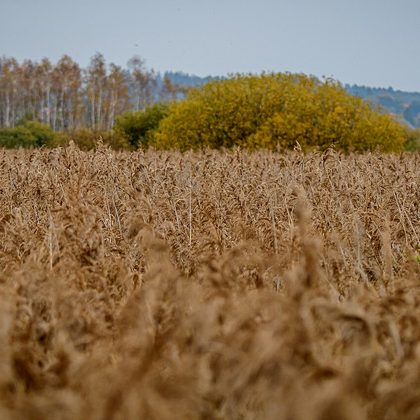
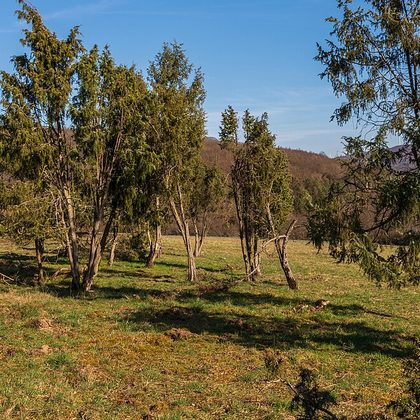
Open grassy ground with bushes and tussocks of tall grass: rough banks and dykes, reed edges, fallow land, field margins and the verges of irrigation canals. Less tied to water than common waxbill or red avadavat and more often found in dry, weedy places. Feeds on the ground and at the seed head on fine grass seed, in parties of five to twenty, often mixed in with other small seed-eaters. The nest is a ball of grass low in a tussock or a low bush, with a side entrance.
Where the bird is most at home, classified with EUNIS — the European standard for habitats.


Range and movements
Natively a bird of the broad grass belt south of the Sahara, from Senegal and Mauritania through Mali, Niger, Chad and Sudan to Ethiopia. In Europe it has been recorded in southern Spain and Portugal, with records from Andalusia, Extremadura, Valencia and the Barcelona area, and further out on the Canary Islands. Nowhere does it form large or stable numbers. Outside Europe it has become naturalised in Japan, Puerto Rico and on several of the Lesser Antilles.
- Resident
- Breeding (summer)
- Passage
- dark = core range, pale = thinly spread
Where and when to look
There is no point looking anywhere common waxbill is not already present, because black-rumped waxbill travels with it. In Andalusia or Extremadura work the edges of irrigation canals and rice fields and take the time to go through a party bird by bird: you are looking for one pale, unmarked bird among dozens of barred ones. The best moment is when the flock lifts — the black rump turns towards you for a second. Expect disappointment; this is the scarcest of the six and many birds are no more than a recently escaped aviary bird.
Conservation status
Not globally threatened (IUCN: Least Concern) and common in the Sahel. In Europe it is an alien bird going back to escaped cage birds, and the weakest case of the six. The Spanish review of alien birds classes it as a species that establishes but does not expand; part of the records probably concern loose escapes rather than free-living breeders. In the large ringing study in the lower Guadalquivir so few were caught that no survival estimate could be made at all. Spain has placed the whole genus Estrilda on its national list of invasive alien species, regulating trade and keeping. No damage has been demonstrated anywhere.
Scientific name
Estrilda troglodytes (Lichtenstein, 1823)
Lichtenstein described the species in 1823 as F[ringilla] troglodytes; because it was later moved to another genus, the author and year stand in brackets. The genus Estrilda was introduced in 1827 by Swainson. Estrilda was formed from astrild, the specific name Linnaeus gave to this bird. troglodytes is Greek trōglodytēs 'cave-dweller', from trōglē 'hole' and dyein 'to enter'. The specimen the first description was based on came from Senegambia.