All species › Passerines › Waxbills › Red avadavat
Red avadavat | Amandava amandava
Tijgervink | Bengalí rojo
Twice a year this is a different bird. In summer the male is crimson from head to rump, with a scatter of small white spots across wings and flanks — hence the name. In winter a grey-brown, sparrow-like bird sits on the same reed stem, and only the red rump and the red bill still say what it is. The red avadavat comes from tropical Asia; its Iberian and Italian presence goes back to escaped cage birds, and of the six this is the species with the largest free-living numbers in Spain.

Voice
The call is a single high, thin pseep, often given in flight and, at any distance, the first sign that a party is in the reed. While feeding the birds add a soft, low chirping. The male's song is a run of five to eight low, hesitant, slightly jangling notes, slower and heavier than the squeaking of the waxbills, repeated from a reed head or a wire with the red breast feathers raised and the body swaying gently.
No freely licensed recording is available for this species yet.
Identification
Nine to ten centimetres, small and compact, with a short, rounded, almost black tail. The bill is thick and conical and coral red in every plumage. The breeding male is deep crimson to blood red on head, breast, flanks and rump, with a black lore round the eye, dark wings and a blackish belly; dozens of small round white spots stand across the wing coverts and flanks like flicked paint. Out of the breeding season that same male is grey-brown above and pale buff below, with a black eye-stripe, a handful of white spots on the wing coverts and — this is the handle — a bright red rump and uppertail coverts above a short black tail. The female looks like that all year. Juveniles are plain dull brown, with a dark bill and no white spots.
Confusion species
A male in full breeding dress can be confused with nothing in Europe. Winter dress is the real problem. From common waxbill it is separated by the absence of the fine barring, by the white spots on the wing and by the short rounded tail against that bird's long pointed one; note too that common waxbill's red stripe runs through the eye, where the avadavat has a black lore. Orange-cheeked waxbill also has a red rump, but with an orange cheek and no spots. Black-rumped waxbill has a black rump — exactly the reverse. A female pin-tailed whydah is larger, striped on the crown and has a long ordinary tail. And from a young house sparrow the red bill separates it at a glance.
Habitat
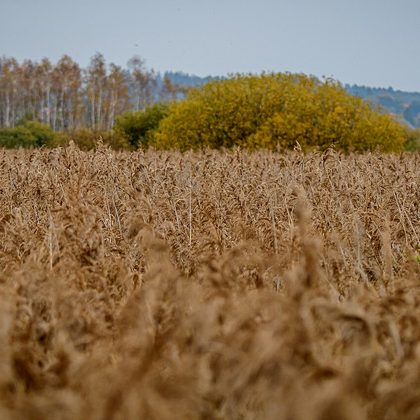
Wet, densely vegetated farmland and marsh: reedbeds and sedge along rivers and lagoons, rice, sugar cane, wet meadows, the banks of irrigation canals and the rough margins of fields. More tied to reed and water than the other five. Feeds in parties of ten to a hundred on grass seed, rice and spilt grain, climbing the stems and working the ground beneath, with small insects taken in the breeding season. The nest is a ball of grass with a side entrance, low in reed or dense grass. The largest flocks form outside the breeding season, when the birds roost communally in reed.
Where the bird is most at home, classified with EUNIS — the European standard for habitats.



Range and movements
Natively a bird of tropical Asia, from Pakistan and India through South-East Asia to Indonesia. In Europe Spain carries the weight: it has bred there since the 1970s and the national estimate runs to some six thousand birds, with the largest concentration in the Guadiana valley, where two nearby roosts have held more than fourteen hundred birds between them. It also occupies the Guadalquivir near Seville, the Guadalfeo near Granada, the Guadalhorce and Vélez near Málaga, the Tagus and Jarama marshes near Madrid, Extremadura and Catalonia, with recent footholds on Tenerife and the Galician coast. Free-living parties occur in Portugal and in the rice fields of northern Italy as well.
- Resident
- Winter
- Passage
- dark = core range, pale = thinly spread
Where and when to look
From June to September go to the reed edges and rice fields of the Guadiana or the Guadalquivir and scan the reed tops early in the morning: a breeding male is a red point against a grey-green background and shows at long range. Then sit down and wait, because the flocks arrive in waves. Winter is a different exercise altogether: work by ear on the high pseep, and watch for the red rump above the short black tail as birds lift. Reed roosts are easiest to find at dusk.
Conservation status
Not globally threatened (IUCN: Least Concern), though the species is declining in parts of South-East Asia through trapping for the trade — it is one of the classic cage birds of the Asian bird market. In Europe it is an alien bird going back to escaped cage birds, and the most numerous of the six: Spain holds some six thousand free-living birds and the population is still spreading, though it fluctuates sharply. Hard winters cut deep holes in it, and that is probably the brake that holds the species in place in Iberia. No damage has been demonstrated; the concern is possible competition with native seed-eaters in reedbeds should numbers keep rising. Unlike the three Estrilda species, the avadavat is not on the Spanish list of invasive alien species, but it is tracked there as an exotic.
Scientific name
Amandava amandava (Linnaeus, 1758)
Linnaeus described the species in 1758 as Fringilla amandava; because it was later moved to another genus, the author and year stand in brackets. The genus Amandava was introduced in 1836 by Blyth. Amandava goes back to Ahmedabad in Gujarat, the Indian city from which these birds were traded as cage birds. The specific name repeats the genus name. The specimen the first description was based on came from Calcutta, India.