All species › Passerines › Accentors › Alpine accentor
Alpine accentor | Prunella collaris
Alpenheggenmus | Acentor alpino
Eat your sandwiches above the treeline in the Alps, the Pyrenees or the Sierra Nevada and you will usually get company: a stout grey-brown bird with an orange flank and a yellow bill base walks in among the stones and takes the crumbs. Alpine accentor is one of very few songbirds that can stay high all year, and on the summits of southern Europe it is tamer than any garden bird.

Voice
The song is a fairly long, rolling and musical phrase of clear jingling notes, faster and richer than Dunnock's hurried jingle and with something lark-like about it, delivered from a boulder or in a short song flight in which the bird rises on stiff quivering wings and glides down again. The call is a short rolling tchirrp or a slightly nasal drüü that hangs in the wind over the scree; alarmed birds add a fine trill.
No freely licensed recording is available for this species yet.
Identification
A third larger than Dunnock and far bulkier: heavy head, short tail, broad wings, closer to a small thrush than to a sparrow in build. Head, throat and upper breast are grey, the back grey-brown with dark streaks, and broad chestnut streaks run down the flanks and breast sides, reading at any distance as a warm orange panel. Two features clinch it. The first is the throat: white, finely and densely spotted black, a small chequered bib no other accentor carries. The second is the bill: thin and pointed as in all accentors, dark at the tip, but with a bright yellow base to the lower mandible that catches the light at close range. On the closed wing two rows of white feather tips show as a double line of spots, and the outer tail feathers are white-tipped. The eye is dark brown, the legs orange-red. Sexes alike; juveniles are duller, with a less crisply spotted throat and washed-out flanks. It moves over rock and short turf in quick springy steps and flies low and briefly from boulder to boulder.
Confusion species
Dunnock is the only real confusion and the difference is large once you look: a third smaller and much slimmer, plain slate-grey throat with no spotting, no chestnut flank panels, no white spotting on the wing and an all-dark bill. At distance among scree an Alpine accentor can suggest Rock sparrow, but that bird has a heavy horn-coloured seed-cracking bill, a broad pale supercilium and a yellow throat spot. Water pipit and skylark walk the same ground but are slimmer and longer-legged, streaked below, with no grey hood and no chequered throat. The family rule holds here as everywhere: a fine pointed insect bill separates any accentor from any sparrow, bunting or finch on the mountain.
Habitat
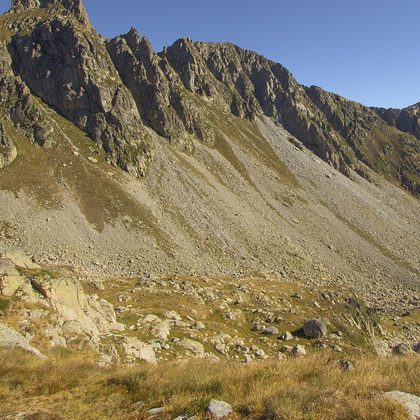
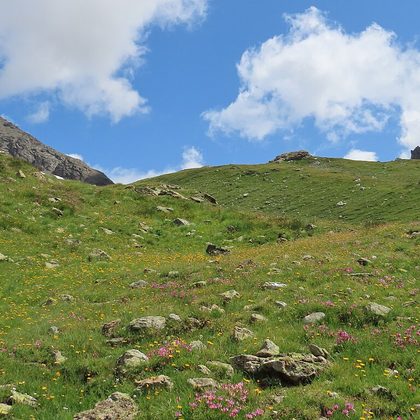
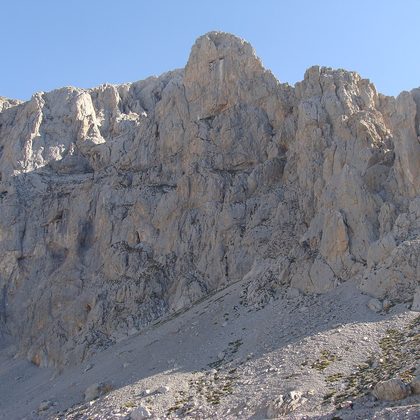
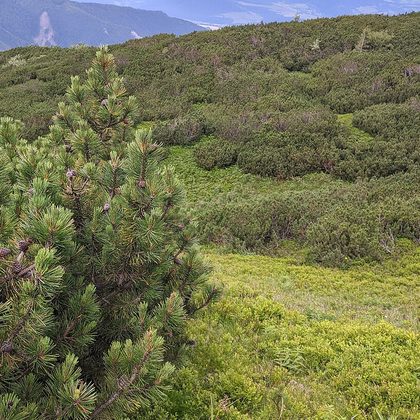
Open rocky ground above the treeline: scree slopes and boulder fields, cliffs with ledges and crevices, and alpine grassland where short turf alternates with bare rock. In the Alps and Pyrenees usually between 1800 and 3000 m, locally higher; around the Mediterranean also lower, on bare limestone massifs. It forages on foot among the stones, along snow patches and on closely grazed turf, taking insects and spiders in summer and largely seeds in winter. Outside the breeding season it uses lower ledges, gorges, old castle walls, mountain villages and ski stations, and in Greece and Turkey sea cliffs as well.
Where the bird is most at home, classified with EUNIS — the European standard for habitats.
Range and movements
A mountain-by-mountain distribution. Within the area of this guide it breeds in the Cantabrians, the Pyrenees, the Iberian System and the Sierra Nevada, in the High Atlas of Morocco, on Corsica and Sicily, in the Alps and the Apennines, in the Carpathians and throughout the Balkans to Greece and Crete, and across Turkey and the Caucasus. It is resident, with an altitudinal rather than a latitudinal movement: birds drop a few hundred metres in winter, sometimes into the valleys, but rarely leave the mountains at all. Records in lowland north-west Europe are exceptional; Britain has a short list of one-day birds on cliffs, quarries and rooftops, and the Netherlands only a handful.
- Resident
- Breeding (summer)
- Winter
- Migration direction
- dark = core range, pale = thinly spread
Where and when to look
The easiest place is the top station of a cable car. Alpine accentors learn quickly that mountain stations, refuges and high car parks are worth visiting, and in July and August they walk with their young to within a few metres of the picnic tables. Otherwise work the topmost hairpins of a high pass early in the morning: one bird on a post with a rolling song phrase gives away the rest. Count them while you are there, because there are rarely just two — the birds live in groups of three or four males with as many females sharing one range, which is why the ground near a nest is a constant traffic of chases and of the raised, quivering wing display. In winter the search changes: sunlit cliffs lower in the valley, castle walls, and along the Mediterranean the sea cliffs.
Conservation status
Not threatened, with a large population thinly spread over tens of thousands of square kilometres of high ground and assessed as stable across Europe. The species escapes most lowland problems but not the upward creep of the vegetation belts: as scrub and closed turf climb, the open stony ground it depends on shrinks. Ski-area expansion and piste levelling take breeding sites locally, while a ski station in winter provides food. The smallest and most isolated populations sit along the southern edge of the range: Sierra Nevada, the High Atlas, Crete and Cyprus.
Scientific name
Prunella collaris (Scopoli, 1769)
Scopoli described the species in 1769 as Sturnus collaris; because it was later moved to another genus, the author and year stand in brackets. The genus Prunella was introduced in 1816 by Vieillot. Prunella is a diminutive of Late Latin brunus 'brown', formed after German Braunelle, the name for the accentors. collaris is Latin for 'collared', from collum 'neck'. The specimen the first description was based on came from Carinthia, Austria.