All species › Passerines › Accentors › Radde's accentor
Radde's accentor | Prunella ocularis
Steenheggenmus | Acentor de Radde
Radde's accentor is a bird of dry, sunlit mountain slopes in eastern Turkey, the southern Caucasus and Iran: it sits on top of a thorn bush or a boulder, a broad creamy supercilium seeming to split the dark head in two. Of the four accentors in this guide it is the least known — within the map area it reaches only eastern Turkey, and a small number of birds winter south into the Levant.

Voice
The song is a short, fast, slightly shrill phrase of clear jingling notes, higher and thinner than Alpine accentor's and with less roll in it, usually from the top of a thorn bush or a boulder and occasionally in a brief song flight. Calls are a fine, high tsi-tsi-tsi and a short rolling trill. In winter, in gorges and along streams, that call is often the only thing that gives the bird away.
No freely licensed recording is available for this species yet.
Identification
About the size of a Dunnock but far more strongly marked about the head. Crown and ear-coverts are dark grey-brown to blackish-brown, and between them runs a broad, long creamy-white supercilium continuing well behind the eye; a pale patch below the dark ear-coverts often adds a second stripe, so that the head reads as banded at any distance. The eye itself sits in the middle of that dark field and is hard to pick out. The throat is creamy white, the breast and flanks pale buff with clear dark brown streaking along the breast sides and flanks, and the belly is off-white. The back is grey-brown with dark streaks. The bill is thin, straight and pointed, dark with a paler base; the legs are reddish brown. Sexes alike. It walks and shuffles over the ground and among stones, and when disturbed drops into the nearest thorn bush rather than flying off.
Confusion species
Within its range Dunnock is the only real confusion: grey on head, throat and breast, with no broad pale supercilium at all, and with a conspicuous red-brown to orange-red eye that shows clearly in the plain face. Alpine accentor shares the same mountains but is far bigger and heavier, grey-hooded, with a white throat spotted black, broad chestnut flank panels, white spotting on the wing and a yellow bill base. Siberian accentor, a vagrant from much further east, carries the same head pattern but with the supercilium in deep ochre rather than cream, and far more orange underparts. And as everywhere in this family the bill separates it at a glance from the sparrows and buntings it feeds among: fine, straight and pointed against a short, thick cone.
Habitat
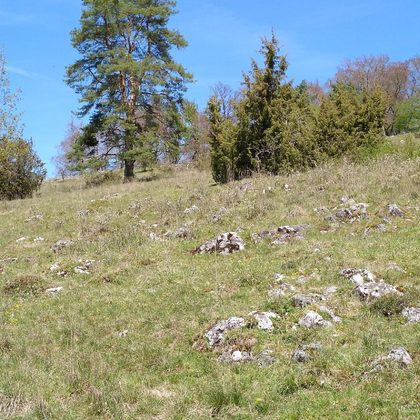
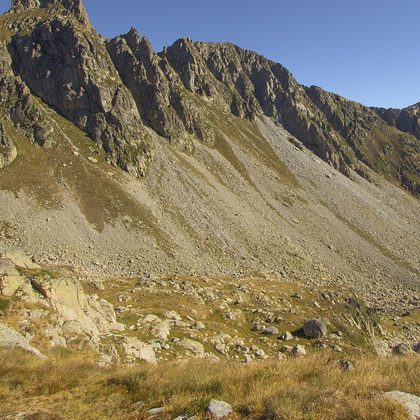
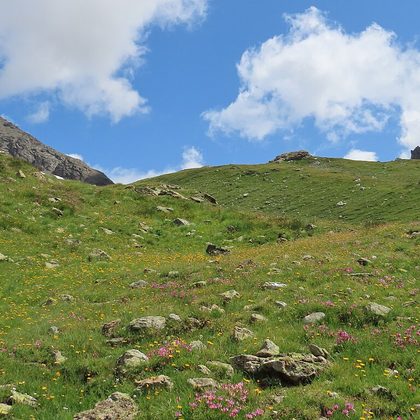
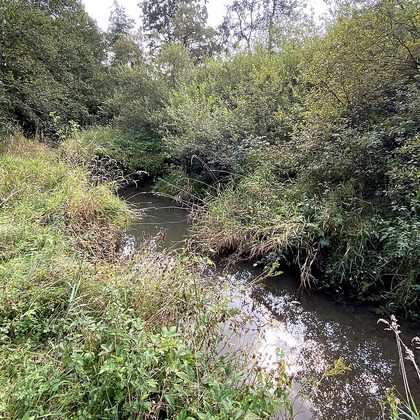
Dry, sunny mountain slopes with scattered thorn scrub, juniper and cushion astragalus, broken by stone fields and rock ribs, roughly between 1000 and 3000 m. Water counts for a great deal: the densest numbers are along mountain streams and around springs, where sea buckthorn and willow scrub grow. It also uses closely grazed alpine pasture with boulders, and abandoned stone piles and walls. In winter it drops into lower gorges, wadis and stream valleys with dense scrub, where thickets beside running water are almost always the deciding element.
Where the bird is most at home, classified with EUNIS — the European standard for habitats.
Range and movements
Breeds in eastern Turkey, the southern Caucasus — Armenia, southern Georgia and Azerbaijan, the Talysh being where the species was described in 1884 — and on through western and northern Iran into Turkmenistan. A second form lives far away in the mountains of Yemen and south-west Arabia and is now often treated as a separate species. For the map area that means eastern Turkey only, roughly from the highlands around Erzurum, Van and Ararat eastwards, plus a small number of wintering birds in the Levant, where Israel records it in small numbers in most years. Otherwise it is resident, with an altitudinal movement of a few hundred to a thousand metres in winter.
- Resident
- Breeding (summer)
- Winter
- dark = core range, pale = thinly spread
Where and when to look
June and July in the highlands of eastern Turkey, above the last villages: find a slope with scattered thorn scrub and a stream through it, and listen early in the morning for short jingling phrases from the bush tops. The bird sings in the open and is shy at the same time — it picks the highest twig but drops at the slightest disturbance — so stand still and wait for the second phrase rather than walking towards it. Outside the song period it is a matter of patience along streams and in gorges; then watch for the broad pale supercilium, which in backlight burns as a white stripe across a dark head and outweighs every other character. In Israel, from December to February, it means deliberate searching in the northern hills and the wadis, where the birds sit in dense scrub beside water.
Conservation status
Not threatened: the range is large and in suitable ground the species is locally common, though everywhere thinly spread and hard to census. The main concerns are overgrazing of the mountain slopes, which removes the low thorn scrub it nests and shelters in, and the damming and abstraction of mountain streams, which takes away the thickets along the water. Because much of the range lies in remote or politically difficult country there has been little recent fieldwork and there are no reliable trend figures; the assessment rests mainly on the extent of the range.
Scientific name
Prunella ocularis (Radde, 1884)
Radde described the species in 1884 as Accentor ocularis; because it was later moved to another genus, the author and year stand in brackets. The genus Prunella was introduced in 1816 by Vieillot. Prunella is a diminutive of Late Latin brunus 'brown', formed after German Braunelle, the name for the accentors. ocularis is Latin for 'of the eye', from oculus 'eye', after the conspicuous pale supercilium. The specimen the first description was based on came from the Talysh Mountains, Azerbaijan.