All species › Passerines › Accentors › Dunnock
Dunnock | Prunella modularis
Heggenmus | Acentor común
The Dunnock is the bird everyone has seen a hundred times and never once noticed: a grey-brown shape shuffling along the bottom of the hedge and under the feeder, always within a hop of cover. Look properly and there is no sparrow there at all — a slate-grey head, a thin pointed insect-eater's bill and a warm orange-red eye. And sit still for half an hour in March and you will see something no other garden bird here can match: not a pair at a nest, but three birds, chasing one another through the shrubbery.

Voice
The song is a short, hurried, faintly shrill phrase of two to three seconds, flat in pitch and with no clear beginning or end, like a squeaky wheel being turned somewhere in the hedge; it sounds harassed and slightly cross, and is repeated from a fence post, a hedge top, a gutter or a bare twig. Heard from January into July, and in mild weather in December too. The call is a thin, penetrating and rather level tseeh that carries straight through a hedge without the bird ever showing; agitated birds add a fast series of high notes and a fine trill.
No freely licensed recording is available for this species yet.
Identification
House-sparrow sized but noticeably slimmer, with a smaller head, a longer tail and a quieter, more compact look. The bill settles it: thin, straight, sharply pointed and blackish, made for picking insects out of leaf litter, where any sparrow carries a short, thick, horn-coloured cone. Head, throat and breast are slate-grey, the crown streaked brown and the ear-coverts brown, so that the grey runs as a broad band from the bill over the eye and down across the breast. Back and wings are warm brown with heavy black streaks, the flanks are streaked rufous, the belly is off-white. Legs are orange-brown and the adult's eye is warm red-brown to orange-red, startlingly bright at close range. The sexes cannot be told apart in the field; males average slightly greyer and more contrasted, but the overlap is complete. Juveniles show no grey at all, are wholly brown with a finely streaked breast, and have a dark eye. On the ground the bird creeps and shuffles with a slightly hunched back, and every few seconds a short nervous flick runs through wing and tail.
Confusion species
House sparrow is the classic confusion and the reason for the old name hedge sparrow. Go to the bill: a short, thick seed-cracking cone on any sparrow, a thin dark spike on Dunnock. Beyond that the male house sparrow has a black bib and a grey crown with chestnut sides, the female a plain buff head with a pale supercilium — neither has the unmarked slate-grey throat and breast. Tree sparrow has a chestnut crown and a black spot on a white cheek. Wren is far smaller, rufous and finely barred, and cocks its tail. Within the family, Alpine accentor is a third bigger and much bulkier, with a white throat finely spotted black, broad chestnut flank streaks, rows of white feather tips on the wing and a yellow bill base. Siberian accentor has a broad ochre supercilium above a blackish cheek and warm buff underparts; Radde's accentor has a broad creamy supercilium in a dark head. None of the three is likely at home, but the first of them stands on the path in the Alps and the Pyrenees.
Habitat
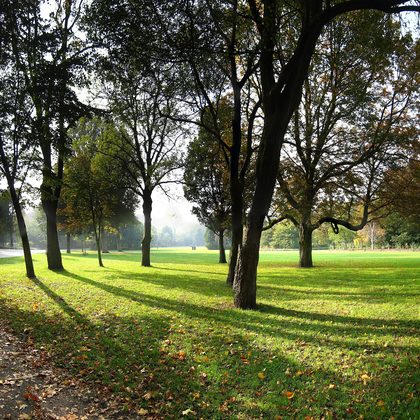
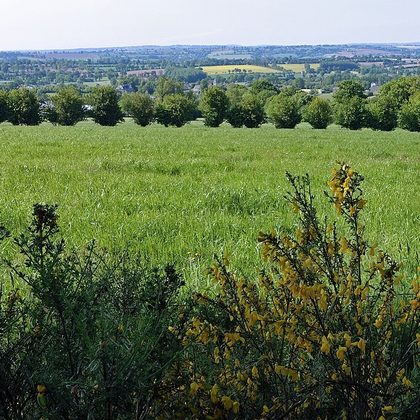
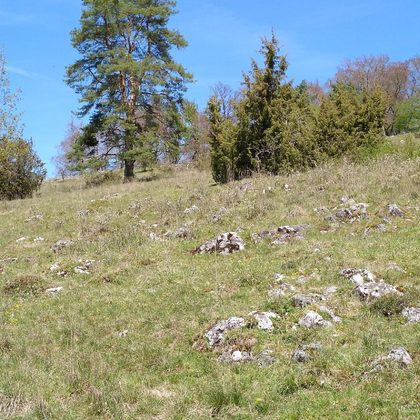
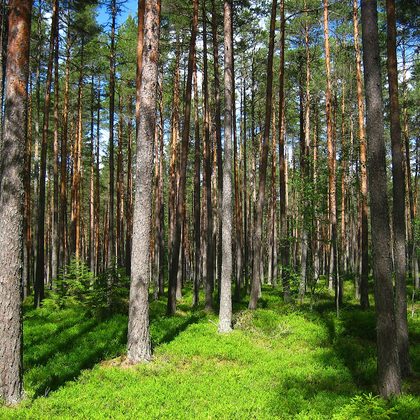
Anything low, dense and walkable underneath: gardens with shrubs, hedges, hedge banks, bramble tangles, young conifer plantation, clear-fells with regrowth, rank corners of parks, dune scrub and the understorey of broadleaved and mixed woodland. What matters is the combination of knee-high cover with bare, worked soil beneath it; a clipped hedge over a mown lawn offers nothing, an untidy corner with leaf litter offers everything. In the mountains up into the dwarf-shrub and juniper zone, and in southern Europe mainly in broom and damp montane woodland.
Where the bird is most at home, classified with EUNIS — the European standard for habitats.
Range and movements
From Ireland and northern Iberia deep into Russia, north to Lapland and south into the mountains of Spain, Italy, the Balkans and Turkey; the Caucasus and northern Iran hold their own races. In Britain and Ireland it is a numerous and widespread resident of garden, hedgerow, scrub and young plantation, present all year. Birds from the north and east of the range are migratory and winter in western and southern Europe, so October brings continental birds through the east coast and adds them to the wintering population. In Iberia it breeds in the Cantabrians, the Pyrenees, the Iberian System and a few southern sierras, and in winter spreads across almost the whole peninsula.
- Resident
- Breeding (summer)
- Winter
- Passage
- Migration direction
- dark = core range, pale = thinly spread
Where and when to look
The mating system is the best thing this bird has to offer, and all it takes is a chair in March or April. Sit where a hedge meets an open patch of bare ground and count the birds: very often there are three. What follows is a running chase — two males driving each other low through the scrub, and the dominant one refusing to let the female out of his sight, because his share of the paternity rests on that guarding. Watch above all for wing-waving: a bird lands on a low branch and flicks one wing, or both, rapidly up and down, sometimes with the tail cocked, between bursts of song. Copulation itself lasts under a second and is preceded by an action easily missed: the female crouches with quivering wings and the male pecks briefly beneath her tail before mounting. This goes on dozens of times a day. And in May look at the nests: Dunnock is the commonest cuckoo host in north-west Europe, and unlike most hosts it gets an egg that looks nothing whatever like its own unmarked sky-blue clutch — and still, in most cases, hatches it.
Conservation status
Not threatened, with a large European population that is stable to slightly increasing. In Britain numbers fell sharply between 1975 and 1985, which put the species on the amber list, and have since largely recovered; the Dutch and central European populations have been steady or rising. Prolonged frost with snow cover causes local losses, from which recovery is quick. The one real concern is the tidying away of the shrub layer: where hedges, hedge banks, bramble edges and rough garden corners give way to fencing, decking and close-mown grass, the Dunnock goes with them.
Scientific name
Prunella modularis (Linnaeus, 1758)
Linnaeus described the species in 1758 as Motacilla modularis; because it was later moved to another genus, the author and year stand in brackets. The genus Prunella was introduced in 1816 by Vieillot. Prunella is a diminutive of Late Latin brunus 'brown', formed after German Braunelle, the name for the accentors. modularis is Latin for 'singing', from modulari 'to sing melodiously'. The specimen the first description was based on came from Sweden.