All species › Passerines › Accentors › Siberian accentor
Siberian accentor | Prunella montanella
Bergheggenmus | Acentor siberiano
October 2016 produced something western European birders had not thought possible. A bird of the Siberian taiga, of which barely thirty individuals had been seen in Europe in a century and a half, turned up in hundreds of places within a few weeks. Siberian accentor is a small, surprisingly colourful accentor with a broad ochre supercilium above a blackish cheek, and the birds that reach us are usually remarkably confiding.

Voice
In Europe you will hear the call and nothing else: a high, thin, faintly silvery ti-ti-ti in three quick syllables, pipit-like but shorter and sharper, and typically given as the bird flies up. Agitated birds add a fine rolling trill. The song, not to be heard here, is a short, high, clear chiri-chiri-chiri, fast and slightly shrill, delivered from the top of a larch or a willow.
No freely licensed recording is available for this species yet.
Identification
Slightly smaller and more compact than Dunnock, and far warmer in colour. The head makes the bird: a blackish-brown crown and an equally dark ear-covert patch, and between them a broad, long supercilium of deep ochre-yellow running from the bill base to well behind the eye and kinking upwards at the rear. Throat, breast and flanks are ochre to creamy orange, the flanks with diffuse cinnamon streaking; the back is warm brown with black streaks and the closed wing shows two narrow pale bars. The bill is thin, straight, pointed and dark; the legs are pinkish to reddish brown. The eye is warm red-brown with a narrow pale orbital ring, giving the face a soft expression at close range. Sexes alike, though females average duller on the breast. Almost every bird that reaches Europe is a first-winter: slightly less crisply marked on the head, with fine dark spotting on the breast sides.
Confusion species
Dunnock is grey where this bird is ochre, lacks the black cheek entirely and has no supercilium worth the name. Alpine accentor is much larger and heavier, grey-headed and grey-breasted, with a white throat spotted black. The real trap is not in this guide: Black-throated accentor Prunella atrogularis, from the Urals and Central Asia and an equally exceptional vagrant, has exactly the same head pattern but a black or dark-mottled throat and cooler, less orange underparts. Outside the family, Rustic bunting is the commonest misidentification: it arrives in the same weeks from the same direction and is warmly marked too, but it has a conical bill, a small peaked crest, a streaked breast and white outer tail feathers. With any brownish bird shuffling out from under a bramble, the bill is the quickest test: fine and pointed on every accentor, short and conical on every sparrow and bunting.
Habitat
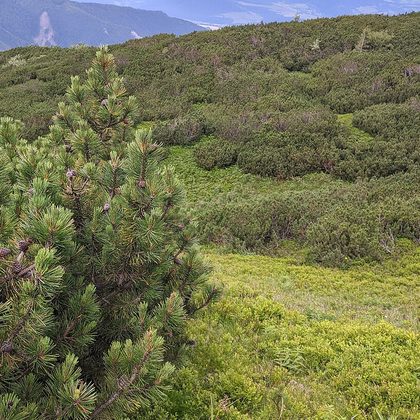
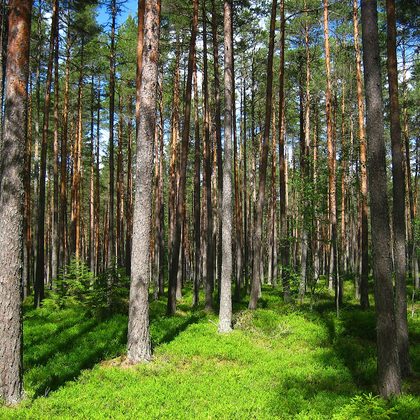
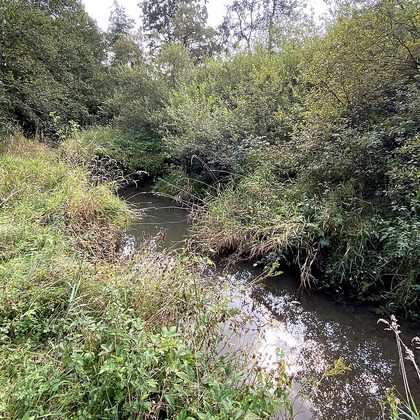
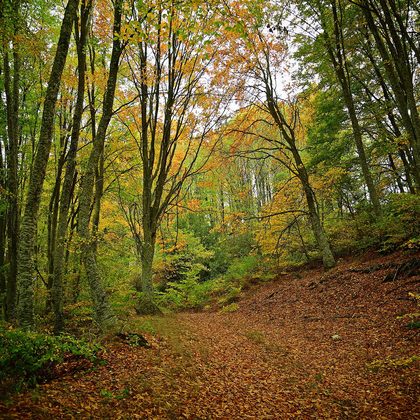
Breeds in the scrub and open forest of the Siberian taiga and forest-tundra: willow and birch thickets along streams and bog margins, open larch and spruce forest with a dense understorey, and the last clumps of trees at the tree limit. It forages on foot over damp ground among moss, herbs and dwarf shrubs. In the winter quarters it uses bushes and hedges by streams, dry grassland and copses. European vagrants pick something that looks much the same: nettle and bramble along a sea wall, scrub on a dock, a quarry, an allotment, a compost heap or the edge of dune scrub — almost always low, dense and with bare ground beneath.
Where the bird is most at home, classified with EUNIS — the European standard for habitats.
Range and movements
Breeds across northern Russia from the Urals to the Pacific with a southern arm through Siberia, and winters in eastern China and Korea, so its normal migration runs almost at right angles to the route to Europe. Before 2015 about thirty European records existed in total. October and early November 2016 brought an unprecedented influx: at least two hundred and thirty birds in fourteen countries, including firsts for Britain, Germany, Estonia and the Netherlands, with the Shetland, Yorkshire and North Sea coast birds staying long enough to be seen by thousands. Good autumns since have produced the odd single bird, but never those numbers again. The window runs from early October to mid-November, with most records on North Sea and Baltic coasts and islands.
Where and when to look
This is a species you travel for. Watch the news services from late September to mid-November and expect a bird that has found a suitable corner to stay for days or weeks; most are strikingly unconcerned and feed on quietly a few metres away. To find your own, work the rough edges of an east-coast island or headland in the second half of October, after a long spell of easterly winds: nettle, bramble and sea buckthorn along paths, allotments, quarry floors, back corners of villages and dock walls. Listen for the thin ti-ti-ti, and with any brown bird creeping away low, look at the head first. A broad ochre supercilium over a black cheek settles it at ten metres; the ochre breast and the fine bill are the confirmation.
Conservation status
Not threatened. The breeding range is vast and largely uninhabited, the population is put at several million birds and there is no sign of decline. For the area of this guide it remains a vagrant: no part of the map produces it regularly, and the records that exist are of single lost birds. No settled explanation for the 2016 influx has been agreed; an exceptional breeding season combined with a persistent easterly airflow is the usual reading. What those weeks showed most clearly is how far the European record total depends on how many people are out looking.
Scientific name
Prunella montanella (Pallas, 1776)
Pallas described the species in 1776 as Motacilla montanella; because it was later moved to another genus, the author and year stand in brackets. The genus Prunella was introduced in 1816 by Vieillot. Prunella is a diminutive of Late Latin brunus 'brown', formed after German Braunelle, the name for the accentors. montanella is a diminutive of Latin montanus 'of the mountains': 'little mountain bird'. The specimen the first description was based on came from Transbaikalia, Siberia.