All species › Passerines › Sparrows › Rock sparrow
Rock sparrow | Petronia petronia
Rotsmus | Gorrión chillón
Rock sparrow is the big, heavy-set sparrow of bare southern slopes, gorge rims, castle walls and mountain villages. At range it passes for a coarse, streaky house sparrow, but it carries a broad pale stripe down the centre of the crown and, when the tail opens, a row of white spots along its tip — two features no other sparrow in the region has. Its nasal, complaining call belongs to the sound of the Mediterranean as much as the cicadas do.

Voice
The call is the best-known sound of many a southern gorge: a loud, nasal, complaining pey-yu-ee or vweee, rising and bleating in quality, carrying a long way and usually coming from an invisible rock face. The Spanish name gorrión chillón, the shrieking sparrow, is taken from it. Alongside it come a hard short chip and a fast rolling series in alarm. The song is a slow repetition of that nasal call, given from a rock point, a roof tile or a wire, from March into June.
No freely licensed recording is available for this species yet.
Identification
Large and thickset, with a strikingly heavy pale conical bill and a short tail. The head pattern is the first thing to register: a broad off-white stripe down the centre of the crown, bordered on each side by a dark brown band, and below that a wide pale supercilium and a dark eye-stripe. The upperparts are sandy brown with heavy dark streaks, the underparts dirty white with fine streaking on breast and flanks. A small lemon-yellow spot sits in the centre of the throat, but it is often hidden under the chin and is not a feature to rely on. The character that counts on a flushed bird is the tail: each feather carries a white spot at the tip, forming a row of pale dots when the tail is spread. The sexes are alike; juveniles are duller and warmer buff, with the same crown and tail pattern.
Confusion species
At distance and against the light this is a house sparrow. Four things separate them: rock sparrow is larger and heavier, with a noticeably thicker bill; it is finely streaked all across the underparts rather than plain; it has a broad pale crown stripe between two dark bands where house sparrow has a smooth grey or brown cap; and it shows white spots at the tail tip, which house sparrow lacks. Spanish sparrow shares much of the same country, but its male has a chestnut crown with a large black bib and boldly black-streaked flanks, and its female is more diffusely streaked and has no crown stripe. Female finches such as serin are far smaller and greener. Flush a big pale streaky sparrow in rocky country and see white dots flash in the tail, and the identification is finished.
Habitat
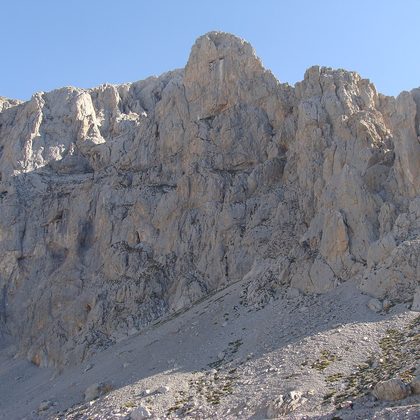
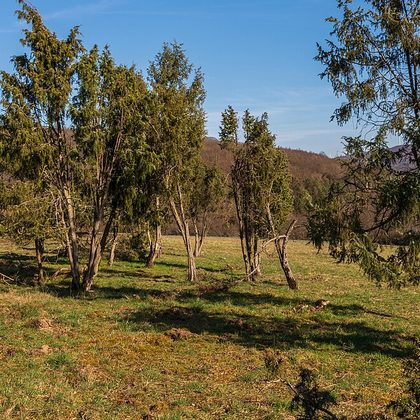
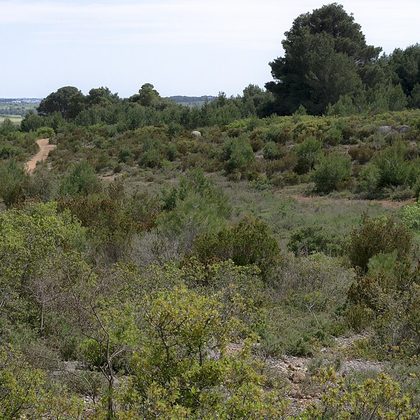
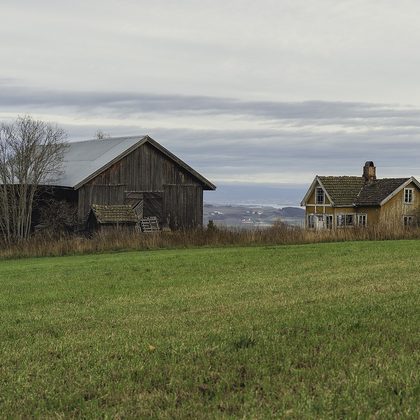
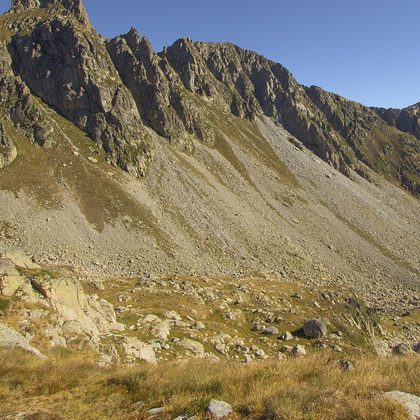
Open, hot, stony ground with vertical nest sites: cliffs and rock pavements, ravines, screes, old town walls, castles, church towers, bridges and abandoned mountain villages, surrounded by dry poor grassland, garrigue, terraces and almond and olive groves where it feeds on the ground on seed and insects. The nest is an untidy ball of grass and feathers deep in a rock crevice or a hole in masonry. From sea level to high in the mountains, and above four thousand metres in Asia.
Where the bird is most at home, classified with EUNIS — the European standard for habitats.
Range and movements
A breeding bird of virtually the whole southern half of the map: Madeira and the Canaries, Iberia, southern France, Italy, the Balkans, Greece, Turkey and the entire Maghreb, and eastwards through Asia to Mongolia and China. It was lost as a breeding bird from central Europe during the twentieth century and is now a rarity north of the Alps; British and Dutch records are exceptional. In Spain it is widespread across the interior and in every mountain range from the Pyrenees to the Sierra Nevada, and is missing mainly from the damp northern coast. It does not migrate but drops out of the highest ground in winter and then wanders in flocks over stubble and steppe.
- Resident
- Breeding (summer)
- Winter
- Passage
- dark = core range, pale = thinly spread
Where and when to look
Look for it at an old hill village or an abandoned stone barn on a south-facing slope, between nine and eleven in the morning in May. Stand by the wall and wait for the nasal pey-yu-ee; the birds usually sit on the ridge tiles or fly out of a hole in the masonry. Take the time to get one on the ground, because that is where the crown stripe reads properly. If it flies, watch nothing but the tail: the row of white spots is the proof. In winter it pays to work through sparrow flocks on bare stubble high in the interior, where it sits among the house sparrows.
Conservation status
Not globally threatened (IUCN: Least Concern) and still numerous across its huge range. It has gone as a breeding bird from central Europe and declines locally in parts of southern Europe: the loss of extensively grazed poor grassland, the restoration and repointing of old walls, church towers and bridges that removes nest cavities, and the abandonment and rebuilding of hill villages. Where old buildings with open joints stand beside grazed steppe it remains common.
Scientific name
Petronia petronia (Linnaeus, 1766)
Linnaeus described the species in 1766 as Fringilla petronia; because it was later moved to another genus, the author and year stand in brackets. The genus Petronia was introduced in 1829 by Kaup. Petronia comes from a local name for the rock sparrow used around Bologna in Italy. The specific name repeats the genus name. The specimen the first description was based on came from northern Italy.