All species › Passerines › Sparrows › White-winged snowfinch
White-winged snowfinch | Montifringilla nivalis
Sneeuwvink | Gorrión alpino
White-winged snowfinch is not a finch but a sparrow, and the sparrow that lives highest of all: above the treeline among rock, snow patches and close-cropped alpine turf, summer and winter alike. On the ground it is a big, dull grey-brown bird with a grey head. Put it up and the picture inverts: the wing opens into a broad white panel with a black tip and the tail flashes white with a black centre. That contrast is the whole story of the species.

Voice
The call is a hard, slightly nasal tsee-oo or pchee, with a rolling prrit reminiscent of crested tit; flocks keep up a constant chatter. The song is strikingly unmusical: a slow, stumbling series of those same hard dry notes, repeated from a boulder, a lift pylon or in a short song flight on slow, conspicuously white wingbeats. Heard from late March into July, and delivered in hard frost and wind alike.
No freely licensed recording is available for this species yet.
Identification
Bulky and long-winged, heavier-built than a house sparrow. The head is ash grey, the mantle warm coffee brown, the underparts dirty white. In breeding plumage the bird has a black throat patch and a black bill; in winter the throat is only faintly mottled and the bill is yellow with a dark tip. The sexes are closely similar, the male averaging more contrasted with a larger black throat patch. Perched it looks surprisingly plain, because the white is mostly hidden. In flight it is unmistakable: black primaries against brilliant white secondaries and greater coverts give a broad white wing panel with a black tip, and the tail is white with black central feathers and a narrow black terminal band. Juveniles are browner and duller but carry the same wing pattern.
Confusion species
On the ground and at range it is regularly written off as a house sparrow around a mountain station — the size and the stance fit, and none of the white shows. The only cure is to make it fly: no other sparrow opens a wing that black and white, and none has a mainly white tail. Horned lark, the shore lark of the coast, breeds in the same zone and is likewise a ground bird, but is smaller, wears a yellow-and-black face mask and has an all-dark tail with white sides. Alpine accentor shares the screes but is smaller and streaked, with a thin bill and rusty streaked flanks. Snow bunting, a scarce winter visitor to the Alps, shows far more white in the wing and a white head.
Habitat
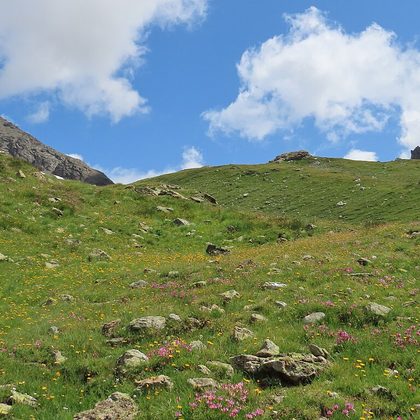
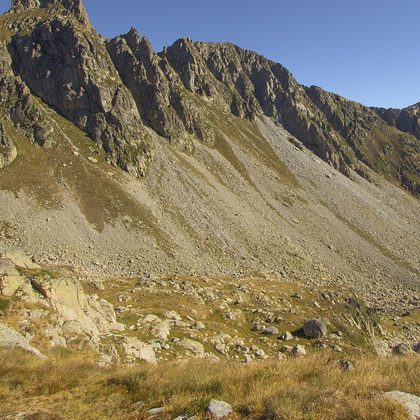
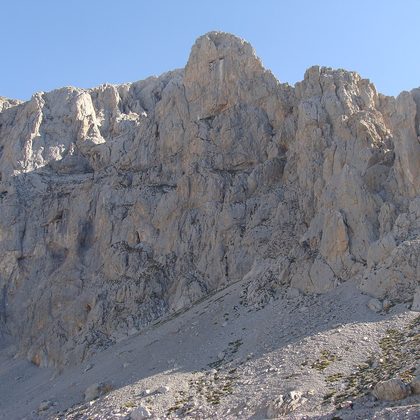
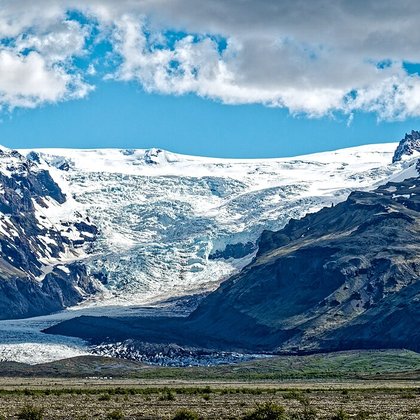
Alpine grassland and stone desert above the treeline, typically between 1,900 and 3,100 metres, with screes, cliffs, lingering snow patches and closely grazed turf where it picks springtails, beetles and seed from the ground. The nest is a thick feather-lined ball in a rock crevice, a hole in masonry or a marmot burrow. Increasingly also around cable-car stations, lift buildings, car parks and mountain huts, where it feeds on scraps and becomes almost tame in winter. It rarely drops below 1,500 metres, even under heavy snow.
Where the bird is most at home, classified with EUNIS — the European standard for habitats.
Range and movements
Within the map area it holds the high mountains of southern Europe and the Near East: the Pyrenees, the Alps, the Apennines, the Balkan ranges of Croatia, Montenegro, North Macedonia, Bulgaria and Greece, and on into the Turkish highlands and the Caucasus. Beyond it the species continues through the mountains of central Asia. In Spain it breeds in the Pyrenees and the Cantabrian mountains and wanders rarely in winter to the Sierra Nevada and the Iberian System. It does not migrate: at most it shifts a few hundred metres of altitude or crosses to the other side of the ridge.
- Resident
- Breeding (summer)
- Winter
- Passage
- dark = core range, pale = thinly spread
Where and when to look
Take the first cable car up in July or August and walk a circuit of the top station: on the car park, around the terrace tables and along the edge of the snow they often sit at a few metres, and the grey head, black throat and yellow bill base can be seen without binoculars. In April, with the pastures still half under snow, it is better to wait at the edge of a snowfield and flush a small party, because only in the air does the English name explain itself. Do not take flurries of snow for wing pattern: look for the black tip.
Conservation status
Not globally threatened (IUCN: Least Concern), but this is a strongly cold-adapted bird with nowhere left to go: a species already on the summit cannot move higher as the climate warms. Declines are reported at the lowest breeding sites in the Alps and the lower limit is shifting upwards, with Swiss work pointing to a shrinking envelope of suitable ground. Alongside that come the loss of extensive alpine grazing, which lets the short turf grow rank, and the expansion of ski areas — though the latter locally provides food.
Scientific name
Montifringilla nivalis (Linnaeus, 1766)
Linnaeus described the species in 1766 as Fringilla nivalis; because it was later moved to another genus, the author and year stand in brackets. The genus Montifringilla was introduced in 1828 by Brehm. Montifringilla combines Latin mons, montis 'mountain' with fringilla 'finch'. nivalis is Latin for 'snowy', after the high mountains the bird inhabits. The specimen the first description was based on came from Switzerland.