All species › Passerines › Sparrows › Pale rockfinch
Pale rockfinch | Carpospiza brachydactyla
Bleke rotsmus | Gorrión pálido
Pale rockfinch is the most featureless bird in the whole region: sandy grey from crown to tail, without a single stripe, spot or bar on the head. It breeds on hot dry hillsides in Israel, Jordan, Syria and south-eastern Turkey, appears in hundreds one year and is almost absent the next, and gives itself away chiefly by a buzzing, insect-like sound that hardly registers as a bird at all.

Voice
The voice is the best character and matches no other sparrow: a long, drawn-out, dry buzzing dzeeeee, like a cricket or a stretched rubber band, often closed with a short click. It is repeated endlessly from a stone, a low bush or a wire, including through the middle of the day in full heat. Flocks add a soft, slightly tinny chirp. Once the sound is known, the bird can be found by ear in a landscape in which it is visually invisible.
No freely licensed recording is available for this species yet.
Identification
A medium-sized, slim sparrow with a heavy blunt conical bill and notably long, pointed wings, so that in flight it suggests a lark rather than a sparrow. The whole bird is sandy grey to washed-out buff, slightly warmer above, dirty white below, and the head is entirely plain: no crown stripe, no cheek spot, no eye-stripe, at most a faint pale supercilium and a small dark eye that looks large in consequence. The coverts and secondaries carry broad pale fringes that form two soft, ill-defined wingbars and give a fresh bird a scaly look above. The bill is blue-grey to dark when breeding and flesh-coloured otherwise. The sexes are alike; juveniles are paler and sandier still.
Confusion species
Every drab sparrow in the Near East gets written off as a female house sparrow, but a female house sparrow always shows a clear pale supercilium, a darker ear-covert patch and a streaked mantle, whereas pale rockfinch lacks all head markings and looks far more uniform. Rock sparrow occurs in the same country but is larger and heavier, finely streaked below, and has the broad pale crown stripe and white tail spots that this species has not. Yellow-throated sparrow is likewise plain-headed, but is smaller and finer, with a crisp white double wingbar instead of soft pale fringes, and the male shows a chestnut shoulder patch and a small yellow throat spot. When in doubt, read the wing shape: no other sparrow has the long triangular wing and lark-like flight of pale rockfinch.
Habitat
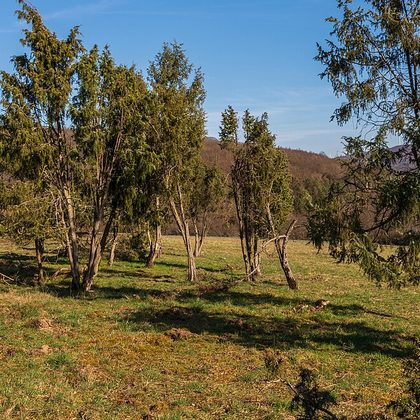
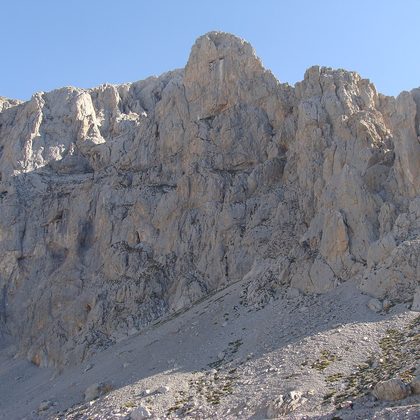
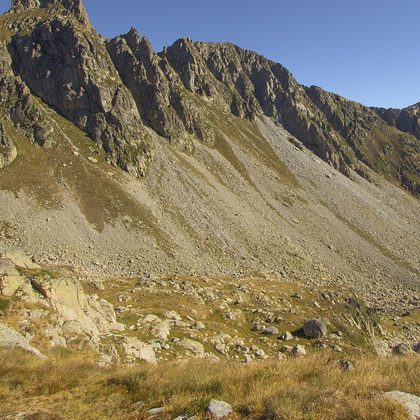
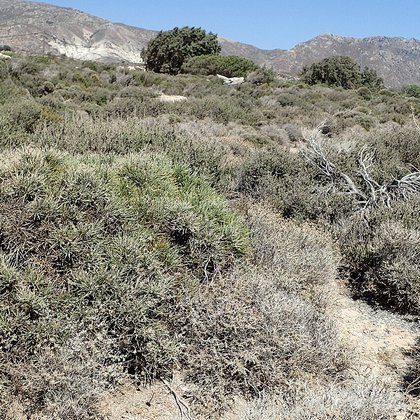
Dry, open, stony hillsides with scattered low bushes and dwarf shrub, limestone plateaux, gorge rims and screes, up to about three thousand metres. It nests on the ground or low in a bush and forages on foot among the stones for seed and insects. After breeding it gathers in large flocks on stubble fields and at drinking places, which is when it is easiest to find.
Where the bird is most at home, classified with EUNIS — the European standard for habitats.
Range and movements
Within the map area it breeds in south-eastern Turkey, Syria, Lebanon, Jordan and northern and eastern Israel; eastwards the range continues to Iran, Turkmenistan and Afghanistan. It is a true migrant, present on the breeding grounds from March to September and wintering in southern Arabia and along the Red Sea into Sudan and Ethiopia. Its occurrence is also markedly erratic: a slope holding dozens of singing birds one year may be empty the next, apparently in step with the winter rains and the crop of seed and grasshoppers that follows them.
- Breeding (summer)
- Passage
- dark = core range, pale = thinly spread
Where and when to look
April and May are the best months, with birds in song and the grass not yet burnt off. In Israel or Jordan drive to a bare limestone slope above roughly eight hundred metres, switch the engine off and listen: the buzzing dzeeeee comes before the bird, and only then does the sandy grey shape on a stone resolve. In July and August work drinking places and cut wheatfields for flocks. Expect a site that held birds last year to be empty this year; that is part of the species.
Conservation status
Not globally threatened (IUCN: Least Concern). Its violent fluctuations make trends hard to establish, but in the western part of the range the conversion of hill slopes to irrigated farming, overgrazing, and road and building development all press on the open, poor slopes it depends on. At the western edge of the range, in Israel, it is regarded as a scarce and irregular breeder.
Scientific name
Carpospiza brachydactyla (Bonaparte, 1850)
Bonaparte described the species in 1850 as Petronia brachydactyla; because it was later moved to another genus, the author and year stand in brackets. The genus Carpospiza was introduced in 1854 by Müller. Carpospiza is Greek, from karpos 'fruit, seed' and spiza 'finch'. brachydactyla is Greek, from brakhus 'short' and daktulos 'toe'. The specimen the first description was based on came from Al Qunfudhah, Saudi Arabia.