All species › Passerines › Sparrows › Yellow-throated sparrow
Yellow-throated sparrow | Gymnoris xanthocollis
Indische rotsmus | Gorrión cuelligualdo
Yellow-throated sparrow is a small, smooth-looking sparrow with no head pattern at all, present in the map area only along the far western edge of a large Asian range: the Jordan valley and south-eastern Turkey. Despite the older name of chestnut-shouldered petronia it is a bird of trees rather than rocks — acacia, tamarisk, date palm and the tree lines along irrigated fields — and it gives itself away by a monotonous, metronomic chirping from a canopy.

Voice
The sound is monotonous and very regular: a series of short, clear, slightly tinny notes — cheep … cheep … chirrup — repeated in a fixed rhythm, usually from a bare twig at the top of an acacia or a date palm, for hours on end in the early morning. It is a house sparrow set to a metronome. The call is a dry short chirp, with a soft rolling note in flight. In a landscape where the bird disappears visually, the rhythm of the song is the best way of finding it.
No freely licensed recording is available for this species yet.
Identification
Small and slim, smaller than a house sparrow, with a short tail and a neat, fine head. The upperparts are plain sandy grey to light brown, the underparts dirty white, and there is no streaking anywhere: the head is entirely unmarked, with no supercilium, cheek spot or crown stripe. The breeding male carries three characters that together settle it: a black bill, a small but vivid lemon-yellow spot in the centre of the throat, and a chestnut shoulder patch on the lesser coverts. He also shows a crisp white double wingbar that stands out sharply on the drab wing. The female is duller, keeps a pale flesh-coloured bill all year, lacks the chestnut, and has the yellow throat spot much reduced or absent. Juveniles resemble the female but have buff rather than white wingbars.
Confusion species
The female is routinely passed off as a female house sparrow, and that is the error one glance can correct: a female house sparrow has a pale supercilium and a streaked mantle, whereas yellow-throated sparrow has no streaking at all and a completely plain head and back. Pale rockfinch shares the plain head but is clearly larger and heavier, with a thick blunt bill, long lark-like wings and soft, diffuse pale wing fringes instead of two crisp white bars. Rock sparrow is much larger, streaked below, with a broad pale crown stripe and white tail spots. Dead Sea sparrow, also of the Jordan valley, is smaller still, and its male has a grey head with a yellow patch at the side of the neck and a black bib.
Habitat
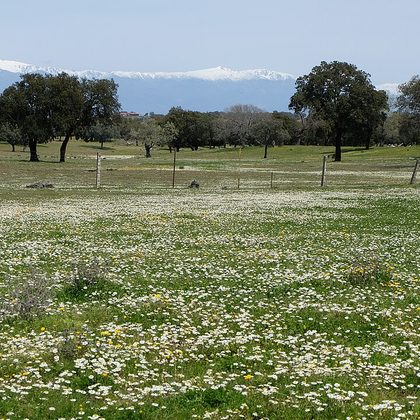
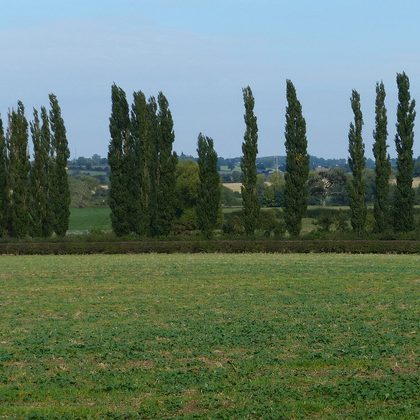
Open dry wooded country: acacia savanna, tamarisk scrub along wadis, date palm plantations, tree lines and shelter belts beside fields and irrigation channels, village gardens and old parks. It forages both in the canopy, for insects and flower buds, and on the ground below for seed. The nest goes in a tree hole — a disused woodpecker or barbet hole, a crack in a dead trunk or a hole in masonry — from April into July.
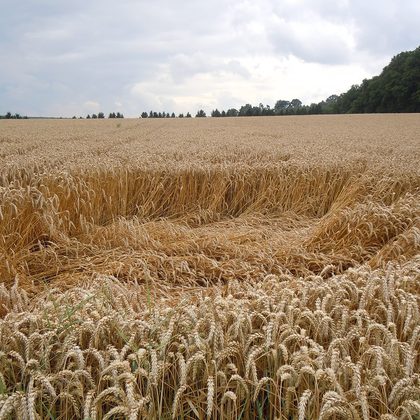
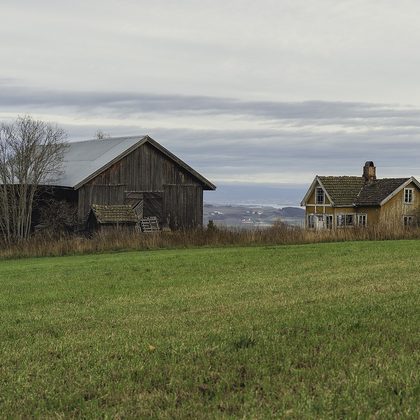
Where the bird is most at home, classified with EUNIS — the European standard for habitats.
Range and movements
Breeds from Turkey and the Levant east through Iraq and Iran to Pakistan, India and Bangladesh. Within the map area only a narrow western fringe is involved: the Jordan valley in Israel and Jordan, with small numbers in south-eastern Turkey and along the Euphrates. There it is a summer visitor, arriving in April and leaving south and east in August and September; Indian birds are largely resident. In Kuwait and along the Gulf it breeds locally and otherwise passes through. It has never been recorded in Europe.
- Breeding (summer)
- Passage
- dark = core range, pale = thinly spread
Where and when to look
In May or June go early to an acacia edge or an old date garden in the Jordan valley and search by ear: the steady, metronomic chirping almost always comes from a bare twig high in the crown, where the male sits fully in the open. Check the bill first — black means a breeding male — and then look for the chestnut shoulder, which only truly lights up in good side light. The yellow throat spot is small and vanishes in the least shade; use it as confirmation, not as the opening character.
Conservation status
Not globally threatened (IUCN: Least Concern) and numerous over most of its Asian range. Along the western edge, in the Jordan valley and south-eastern Turkey, it is local and tied to old trees with cavities; the clearing of dead trunks, the removal of tamarisk and acacia stands along wadis and the conversion of extensive orchards into intensively worked ground all reduce its nest sites. Against that it benefits locally from planting along irrigation channels.
Scientific name
Gymnoris xanthocollis (Burton, 1838)
Burton described the species in 1838 as Fringilla xanthocollis; because it was later moved to another genus, the author and year stand in brackets. The genus Gymnoris was introduced in 1845 by Blyth. Gymnoris is Greek, from gumnos 'bare' and rhinos 'nostrils', after the unfeathered nostrils. xanthocollis means 'yellow-necked', from Greek xanthos 'yellow' and Latin collum 'neck', after the yellow throat patch. The specimen the first description was based on came from the Ganges between Calcutta and Varanasi.