All species › Passerines › Sparrows › Eurasian tree sparrow
Eurasian tree sparrow | Passer montanus
Ringmus | Gorrión molinero
Tree sparrow is the sparrow of the farmed countryside: smaller, neater and shyer than the house sparrow, with an entirely chestnut cap and a sharp black spot in the middle of a white cheek. Male and female look exactly alike, which by itself sets it apart from every other sparrow in the region. Once the difference from house sparrow has been learned it is an easy bird — and learning it also shows how thoroughly the farmyard, the hedge and the stubble field have been taken apart.

Voice
Everything is drier and pitched slightly higher than in house sparrow. The flight call is the trademark and betrays any passing group: a hard, wooden tek tek or tet-tet-tet, like a stick tapped on timber. Alongside it come a bright tswit and a short nasal chip. The song is no more than a string of those same chirps in an uneven rhythm, delivered from a gutter, a pollarded willow or the entrance of a nest box, and is heard from March into August.
No freely licensed recording is available for this species yet.
Identification
Smaller and more compact than house sparrow, with a round head, a short tail and a brisk, upright stance. The whole crown and nape are warm chestnut, with no grey at all. A round, sharply defined black spot sits in the middle of the white cheek, and the black throat patch is small and tidy rather than the broad bib of a house sparrow. A narrow white collar runs from cheek to nape and makes the head look almost pied. The mantle is rufous with black streaks and the wing shows two narrow white bars. The bill is black in the breeding season and horn-yellow with a dark tip in winter. Juveniles are duller, with a greyish cheek spot and a muted crown, but the pattern is already in the right places. The sexes are identical, and there is no meaningful seasonal change.
Confusion species
House sparrow is the only real confusion species, and the head settles it. A male house sparrow has a grey crown edged with chestnut, a big black bib running onto the breast and a plain greyish-white cheek with no spot; a female is a plain grey-brown bird with a pale supercilium and no head pattern at all. On tree sparrow the black cheek spot and the wholly chestnut crown are always present, and — this is the decisive point — identical on both sexes. If a flock plainly contains males and females, they are house sparrows; if every bird looks the same and carries a cheek spot, they are tree sparrows. In winter flocks it mixes with finches and buntings: a female chaffinch is slimmer, unstreaked olive-brown above and shows two broad white wingbars. Dunnock is still called hedge sparrow in places, but has a thin insect-eater's bill and a slate-grey head and breast.
Habitat
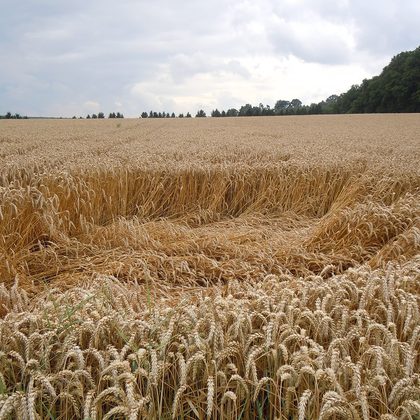
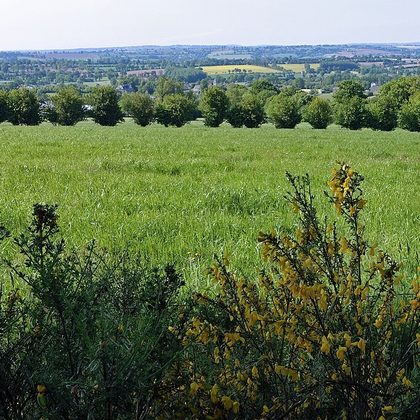
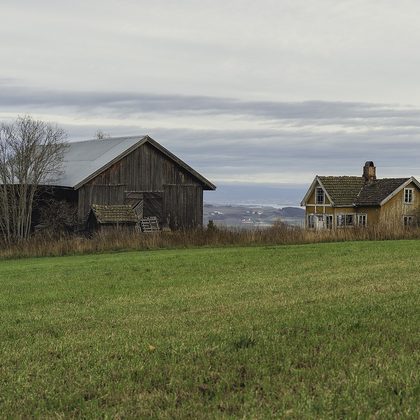
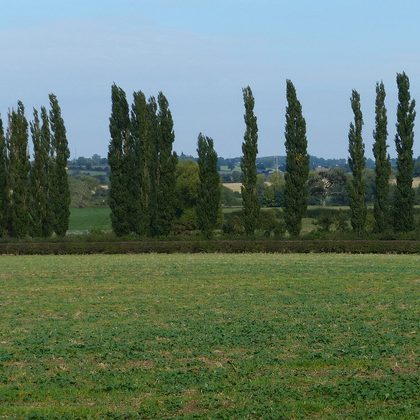
Small-scale farmland and its untidy edges: farmyards, old orchards, lines of pollarded willows, hedge banks and hedgerows beside cereal fields, village fringes, allotments and rough field margins. The nest is an untidy domed ball of grass and feathers in a tree hole, a pollard, a crack in a barn, a hollow concrete post or a nest box, usually in loose colonies of a handful of pairs. In autumn and winter it feeds in flocks on stubble, around farm feeding places and along weedy margins. Unlike house sparrow it avoids town centres in western Europe; in eastern Asia the roles are reversed and it is the sparrow of the street.
Where the bird is most at home, classified with EUNIS — the European standard for habitats.
Range and movements
From Portugal and Ireland to Japan, and from central Scandinavia to the Mediterranean; it is virtually absent from North Africa and the Near East, so the southern edge of the map is also its own. In Britain it is a scarce and very local farmland bird after one of the steepest declines on record, holding on best in eastern England where winter feeding and nest-box schemes are run. Across the North Sea the Dutch population, put at 25,000 to 38,000 pairs, has roughly halved since 1990. Northern and eastern birds drift south-west in autumn, so small parties pass along the coast in October. In Spain it breeds mainly in the north and centre, in poplar rows, villages and orchards, and is scarce and patchy in the south.
- Resident
- Breeding (summer)
- Winter
- Passage
- dark = core range, pale = thinly spread
Where and when to look
Go to a freshly cut cereal field with a hedge or a line of trees beside it in August or September. Whole families sit in the cover and drop onto the stubble in turn; at the slightest disturbance the group rattles back into the hedge with that wooden tek tek, and the call alone is enough. A second reliable moment is an old standard orchard in late March, when males chirp beside their holes. And make a habit of giving every countryside sparrow one second on the cheek: a single black spot closes the case.
Conservation status
Not globally threatened (IUCN: Least Concern) and still enormously numerous in eastern Asia, but in north-west Europe the species has collapsed within a few decades. The British population fell by roughly nine tenths from the 1970s onwards and remains far below its old level; the Dutch population has roughly halved since 1990. The causes all lie in the same direction: the disappearance of overwinter stubbles, of weed seed and insect-rich field margins, of hedges and old orchards, and the tidying up or sealing of the barns and hollow trees it nested in. Where seed-rich margins, winter feeding and nest boxes are provided together it recovers locally and quickly.
Scientific name
Passer montanus (Linnaeus, 1758)
Linnaeus described the species in 1758 as Fringilla montana; because it was later moved to another genus, the author and year stand in brackets. The genus Passer was introduced in 1760 by Brisson. Passer is the Latin word for 'sparrow'. montanus is Latin for 'of the mountains', from mons 'mountain', though the bird is one of open farmland rather than the hills. The specimen the first description was based on came from Bagnacavallo, Italy.