All species › Passerines › Sparrows › Desert sparrow
Desert sparrow | Passer simplex
Afrikaanse woestijnmus | Gorrión sahariano
Desert sparrow looks like a sparrow with the colour bleached out of it: sandy grey above, white below, with black only on the face and in the wing. It lives in true sand desert south of the Atlas, in southern Morocco, the Algerian Sahara and southern Tunisia, and it is so scarce and so scattered there that finding one is the highlight of many a desert trip. Its voice suits the setting: where house sparrow shrieks, this bird chirps softly and clearly, and in the silence the sound carries further than expected.

Voice
The most musical voice in the family. The song is a slow, clear series of sweet piping chirps, far softer and more tuneful than a house sparrow's screeching, with a cheerful rolling undertone; the bird sings from an acacia twig, a date palm frond or the top of a mud wall. Calls include a short soft chirrup and a fine rolling trill. In desert silence a singing male carries for hundreds of metres, and that is usually how it is found.
No freely licensed recording is available for this species yet.
Identification
A sparrow the size of a house sparrow but slimmer-looking, with a finer head pattern and a fairly heavy conical bill. The male is strikingly pale: crown, nape and mantle are plain pale grey to sandy grey with no streaking at all, and the entire underside is clean white. The face carries black lores running back past the eye, and below them a small, neatly bounded black bib on chin and throat. The second half of the pattern is in the wing: black centres to the coverts and flight feathers, broadly edged white, giving a black-and-white shoulder on a perched bird and a marked contrast in flight. The bill is black in the breeding season and blue-grey to horn outside it. The female is paler still and almost patternless: uniform sandy above, off-white below, with no black on the head and far less in the wing. Juveniles resemble the female. Compared with every other sparrow in the region, two things are missing altogether: chestnut, and streaking on the back.
Confusion species
In its own habitat confusion is barely possible, since this is the only sparrow of open sand desert and the palest sparrow in the whole map area. In oasis villages and along the Saharan fringe it does share ground with house sparrow, and there the difference is instant: house sparrow is brown and heavily streaked above, this bird is plain sandy grey without any streaking and pure white below. Spanish sparrow, which may occupy the same villages, is also boldly streaked on mantle and flanks. In harsh light and at range a female could suggest a desert lark or a pale wheatear, but those have thin bills; the heavy conical bill and squat sparrow stance settle it. Anyone who sees a brilliant white bird with black in the wing fly off across the dunes has it.
Habitat
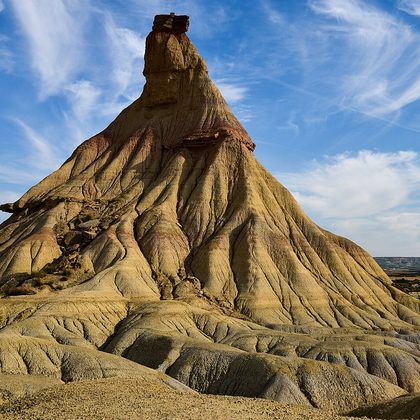
True sand desert and its edges: dune fields and sand plains with scattered tamarisk, acacia and desert shrubs, dry wadis, and beyond them the surroundings of oases, date gardens, wells, nomad camps, small desert villages and the tracks between them. The nest is a large loose ball of grass and feathers in a thorn bush, in a date palm crown, in a hole in a mud wall or under the eaves of a ksar. It feeds on the ground on desert grass seed and, in spring, on insects, and comes regularly to springs and wells to drink.
Where the bird is most at home, classified with EUNIS — the European standard for habitats.
Range and movements
Within the map area, the Sahara south of the Atlas: south-eastern Morocco around the Draa and the Tafilalt, the Algerian Sahara and southern Tunisia, so that the northern edge of its range falls just inside the window. Beyond it, southwards through Mauritania, Mali, Niger, Chad and Sudan. It is nowhere numerous and the distribution is extremely patchy: whole stretches of apparently suitable desert are empty while one palm garden with a well stays occupied for years. It does not migrate, but wanders within the region to wherever seed and water are.
- Resident
- Winter
- Passage
- Migration direction
- dark = core range, pale = thinly spread
Where and when to look
The best chances come in the early morning around the well-known desert sites of southern Morocco and southern Tunisia, at a well, a palm garden or a camp with water. Sit quietly by the water rather than walking the dunes: on a hot day every desert bird comes to drink at some point. Above all, listen, since the sweet piping song sounds nothing like the shrieking of the house sparrows in the village and gives the bird away before anything is seen. And on a bird flying off, watch the wing: black with white edges on an otherwise brilliant white bird is decisive.
Conservation status
Not globally threatened (IUCN: Least Concern), but scarce and locally lost along the North African edge of its range. Its existence hangs on a thin thread of human use of the desert: abandoned ksour, wells bricked up and traditional palm gardens given up cost it nest sites and drinking water, while overgrazing and the cutting of acacia and tamarisk remove the last cover. Where old oasis gardens stay in use and water stands at the surface, it holds on. Reliable numbers are lacking; the country is too large and too thinly peopled to count.
Scientific name
Passer simplex (Lichtenstein, 1823)
Lichtenstein described the species in 1823 as Fringilla simplex; because it was later moved to another genus, the author and year stand in brackets. The genus Passer was introduced in 1760 by Brisson. Passer is the Latin word for 'sparrow'. simplex is Latin for 'plain, unmarked', after the unpatterned sandy plumage. The specimen the first description was based on came from Ambukol, Sudan.