All species › Passerines › Sparrows › Dead Sea sparrow
Dead Sea sparrow | Passer moabiticus
Moabmus | Gorrión del Mar Muerto
Dead Sea sparrow is the smallest sparrow in the region and the only one to look for in a tamarisk thicket rather than a village. It lives in the hot, deep lowlands of the Levant — the Jordan valley, the shores of the Dead Sea, the Arava and the southern Negev — always where fresh or brackish water lets tamarisk grow. The male carries a yellow patch on the side of the neck that no other sparrow here shows, and the colony builds nests that are absurdly large for so small a bird.

Voice
Everything is softer, higher and more musical than in house sparrow. The song is a series of thin, fine chirps without the harsh edge of house sparrow, delivered at an unhurried pace from the top of a tamarisk. The flight call is a high two-syllable chi-wit, usually the first sign of a passing party. A breeding colony produces no roar as Spanish sparrow does, but a soft continuous tinkling from inside the branches.
No freely licensed recording is available for this species yet.
Identification
Clearly smaller and finer than a house sparrow, with a short pointed bill, a round head and a light, quick impression. The male has a grey crown and grey cheeks, black lores and a small, sharply bounded black bib on chin and throat. A broad pale supercilium runs back from the eye, turning buff at the rear and passing into a bright lemon-yellow patch on the side of the neck — the character the species turns on, even though on a moving bird it shows for barely a second. The mantle is rufous with black streaks, the shoulder carries a warm chestnut patch, and the underparts are plain greyish white. The female is a miniature female house sparrow: pale grey-brown, streaked above, with a dull supercilium, a smaller and finer bill, and sometimes a wash of yellow on the neck sides. Juveniles resemble the female.
Confusion species
Size helps first: this is plainly the smallest sparrow to be met here, with a finer bill than any other. The male causes no trouble, since no other sparrow in the region combines a grey crown with a small bib, a broad pale supercilium and yellow on the neck. The female is the real trap, because it is exactly a small pale female house sparrow; go on the smaller bill, the palest tone of any sparrow here, and the company the bird keeps. Habitat helps more than with any other sparrow: house and Spanish sparrows sit around people and arable land, while Dead Sea sparrow sits in dense waterside tamarisk and rarely goes near buildings. If a bird in reeds or scrub first passed for a bunting or a warbler but has the stocky build and conical bill of a sparrow, this is the first candidate.
Habitat
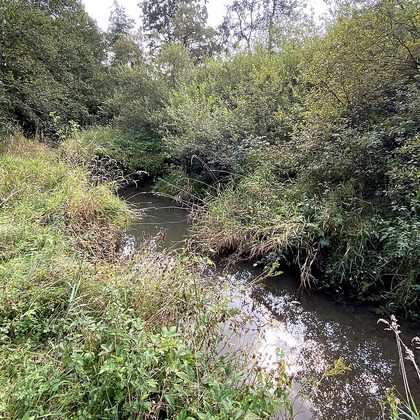
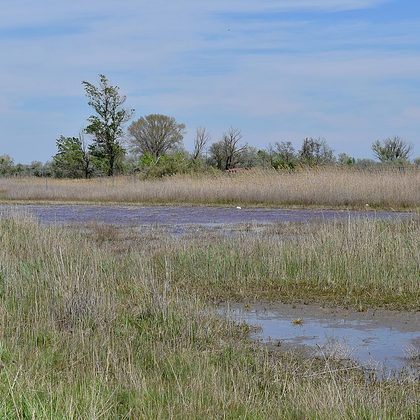
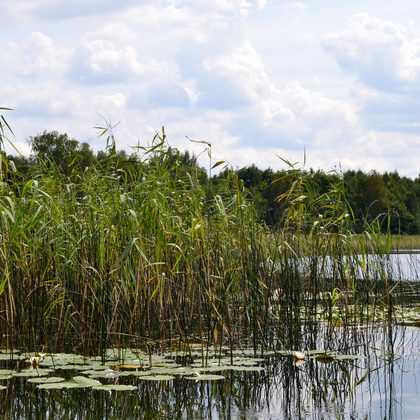
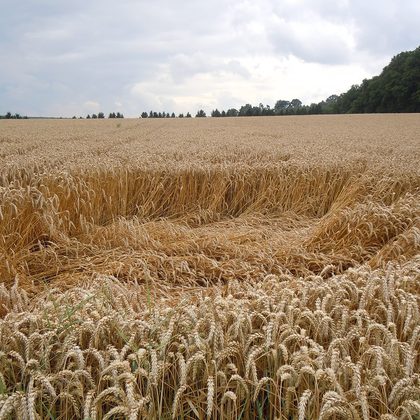
Dense tamarisk and other scrub along fresh and brackish water in hot lowlands: river banks, channels, salt marshes, oases, fish ponds and irrigation canals, with adjoining fields and gardens where it takes seed. It breeds in loose colonies. The nest is the species' trademark: a huge, thorny, domed ball of twigs with a side entrance, high in a tamarisk or an acacia, and so large that from a distance it looks like the nest of a far bigger bird. Several nests often share one bush.
Where the bird is most at home, classified with EUNIS — the European standard for habitats.
Range and movements
Within the map area it is virtually confined to the Levant: the Jordan valley from the Sea of Galilee southwards, the surroundings of the Dead Sea, the Arava and the southern Negev, plus a few sites along the Euphrates in south-eastern Turkey and Syria; it has been recorded on Cyprus but is no longer to be expected there. Beyond the map it continues east into Iraq, Iran and Afghanistan. The distribution is patchy throughout and follows the watercourses strictly, so that a suitable valley is full of them while the ground alongside is empty. Part of the population leaves the breeding grounds after nesting and moves south, beyond this map.
- Resident
- Breeding (summer)
- Winter
- Passage
- Migration direction
- dark = core range, pale = thinly spread
Where and when to look
Go early in the morning, in March or April, to a tamarisk belt along water in the Jordan valley or the Arava. Walk the edge of the thicket and look at the bushes themselves first: as soon as a large untidy ball of twigs appears in a tamarisk you are standing at the colony and need only wait. Keep your distance and watch the birds that settle on the outer twigs, because only there does the male's yellow neck patch come into view. Listen meanwhile for the high chi-wit, which gives the birds away well before the eye does.
Conservation status
Not globally threatened (IUCN: Least Concern) and locally numerous across its range, but within the map area it depends entirely on a small and vulnerable habitat. Where rivers and streams are drawn off for irrigation and the water table falls, the tamarisks die and the species goes; the same follows from canalising and dredging banks and from converting marshy fringes to farmland. The fall of the Dead Sea and the abstraction of water from the Jordan have cost a great deal of suitable scrub in recent decades. Against that, it takes quickly to fish ponds, irrigation canals and planted tamarisk.
Scientific name
Passer moabiticus Tristram, 1864
Tristram described the species in 1864 and placed it straight away in the genus where it still stands. The genus Passer was introduced in 1760 by Brisson. Passer is the Latin word for 'sparrow'. moabiticus is Latin for 'Moabite', after Moab, the biblical land by the Dead Sea where the species was first found breeding. The specimen the first description was based on came from Palestine.