All species › Passerines › Waxbills › Common waxbill
Common waxbill | Estrilda astrild
Sint-helenafazantje | Estrilda común
Along almost every Portuguese river they sit in the reeds: birds the size of a wren, grey-brown and finely barred from head to vent, with a bill like a drop of red sealing wax. They drop from stem to stem in tight parties, chattering nasally over one another the whole time. The common waxbill belongs in Africa south of the Sahara; its European presence goes back to escaped cage birds. Of the six feral waxbills of Iberia, this is by far the most firmly settled.

Voice
Two sounds give the species away. The first is a short, nasal, faintly grating chek, passed back and forth continually in flight and among the stems; from a party of thirty it comes across as a soft, irregular crackling. The second is the song: a scratchy cher-cher-preee with the last note drawn sharply upward, delivered from a reed head or a wire. Heard all year; the scratchy song mostly from April to August.
No freely licensed recording is available for this species yet.
Identification
A small, slender bird of ten to thirteen centimetres, of which the long, graduated tail takes up nearly half. The whole plumage is grey-brown and very finely barred, breast and flanks included; close to, the bird looks watered like silk. The short triangular bill is bright coral red, and a broad red stripe runs back from it past the eye — a red mask on an otherwise plain head, with white throat and white cheeks below it. A red patch sits in the middle of the belly, larger and deeper on the male than on the female. The undertail coverts are blackish brown, the rump grey-brown like the back. The tail is flicked up and down continually as the bird hops. Juveniles are duller, much more faintly barred, with a black bill and little or no red on the belly.
Confusion species
Black-rumped waxbill is the hard one: smaller, paler, plain creamy white below with a pink wash, without the barring and without the red belly patch, with a black rump and whitish undertail coverts — where common waxbill has a grey-brown rump and a black vent. Orange-cheeked waxbill has no eye-stripe at all but a bright orange cheek and an orange-red rump. A red avadavat in winter dress looks similar at a distance but lacks the barring, shows white spots on the wing coverts, a red rump and a short rounded black tail. A female pin-tailed whydah has a striped crown and plain, unbarred underparts. Scaly-breasted munia is bigger and heavier, with a dark horn-coloured bill instead of a red one.
Habitat
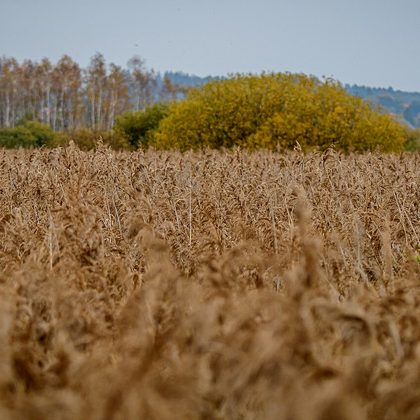
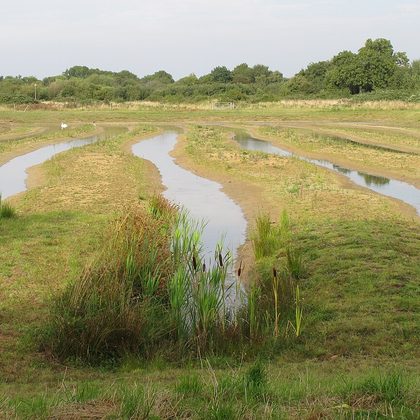
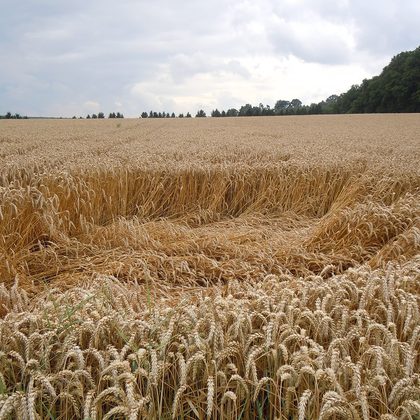
Reedbeds, sedge and rough banks along rivers, canals, ditches and lagoons, together with field margins, rice fields, fallow land, tall roadside grass and gardens and parks on the edge of built-up ground. Feeds almost entirely on grass seed, taken from the head either by climbing the stem or by riding it down under its own weight, with small insects added in the breeding season. The nest is a large ball of interwoven grass low in dense cover, with a long entrance tube angled downwards at one side.
Where the bird is most at home, classified with EUNIS — the European standard for habitats.


Range and movements
Natively a bird of virtually all Africa south of the Sahara. In Europe Portugal is the stronghold: established around Lisbon from the 1960s and now present along nearly every river in the country from the Minho to the Algarve, locally one of the commonest small birds of the wet lowlands. Expansion in Spain is rapid; the most recent national estimate runs to 2,800–12,000 breeding pairs with breeding recorded in twenty-one provinces — Andalusia, Extremadura, south-west Galicia, Valencia, Murcia, Catalonia, Madrid, Mallorca and Ibiza, and on Tenerife and Gran Canaria. Scattered birds also in southern France and Italy.
- Resident
- Breeding (summer)
- Winter
- Passage
- dark = core range, pale = thinly spread
Where and when to look
Walk a reed edge early in the morning along the Tagus, the Ria de Aveiro or the lower Guadalquivir, and listen first: the nasal chek arrives before the birds do. They rarely sit still, moving through the vegetation in waves of ten to thirty; stand still and let the party come to you. In winter check fallow fields and rice stubble too, where dozens feed together on the ground. The big grass nests with the tube at one side hang low and show up well once the reed has been cut.
Conservation status
Not globally threatened (IUCN: Least Concern) and common in Africa. In Europe it is an alien bird going back to escaped cage birds, and the best established of the six feral waxbills: an ordinary breeding bird in Portugal and expanding strongly in Spain. Spain has placed the whole genus Estrilda on its national list of invasive alien species, which regulates trade and keeping; the species is not on the EU list. Demonstrated damage is slight. Grain and rice are taken, and competition with native seed-eaters in reedbeds is suspected, but convincing evidence of displacement is missing; an attempt to measure survival in the lower Guadalquivir failed because colour-ringed birds were almost never recaptured. It is, however, the principal host of the pin-tailed whydah in Iberia, and that bird can exist here only for as long as the waxbill does.
Scientific name
Estrilda astrild (Linnaeus, 1758)
Linnaeus described the species in 1758 as Loxia astrild; because it was later moved to another genus, the author and year stand in brackets. The genus Estrilda was introduced in 1827 by Swainson. Estrilda was formed from astrild, the specific name Linnaeus gave to this bird. astrild is of uncertain origin: perhaps a German or Dutch aviculturists' term for a waxbill, perhaps a misprint for Estrilda. The specimen the first description was based on came from Cape Town.