All species › Passerines › Waxbills › Orange-cheeked waxbill
Orange-cheeked waxbill | Estrilda melpoda
Oranjewangastrild | Estrilda carinaranja
Of all the small waxbills of Iberia this is the one you can name on colour alone: a grey-brown bird with a blazing orange cheek, as though someone had put a thumbprint of paint on the side of its head. The orange-cheeked waxbill comes from West and Central Africa and goes back in Europe to escaped cage birds. It sits mainly in Portugal and in the far south of Spain, in small parties along marsh edges and irrigation ditches.

Voice
A clear, rising tseep or tsee-oo, higher and purer than the nasal grating of common waxbill, repeated continually while the birds feed. The song is a short, thin run of three to five squeaky notes, falling away and without a scratchy final note. In a party the contact call dominates; once you know it, you pick the species out of a mixed flock by ear before you see the cheek.
No freely licensed recording is available for this species yet.
Identification
Ten centimetres, stockier and shorter-tailed than common waxbill. Head and neck are pale ash grey, back and wings dull olive-brown, the underparts off-white with a sandy to faintly orange wash over flanks and belly. The head carries the mark: a sharply bounded, bright orange patch covering the ear coverts and the area below and behind the eye, with no red eye-stripe. The bill is coral red, shorter and thicker than on the other waxbills. Rump and uppertail coverts are orange-red to rust and light up against the black tail as the bird flies. The underparts are barred nowhere. Juveniles have a duller, more ochre cheek and a black bill.
Confusion species
Common waxbill has a red eye-stripe instead of an orange cheek, is finely barred over the whole underside, and shows a red belly patch. Black-rumped waxbill also has a red eye-stripe, is paler and plain white below, and has a black rather than an orange-red rump. A red avadavat in winter dress has a red rump much like this one, but carries white spots on the wing, lacks the orange cheek and has a short rounded tail. In short: no eye-stripe but a cheek patch, no barring, and an orange-red rump above a black tail — that combination is enough.
Habitat
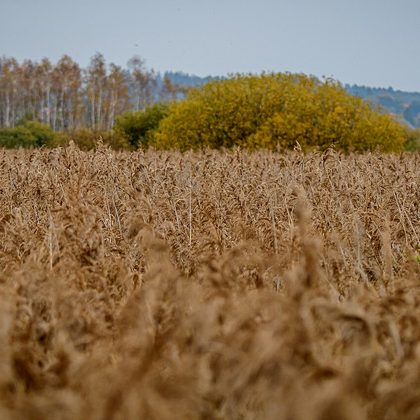
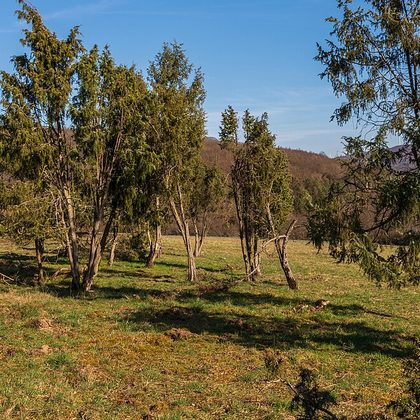
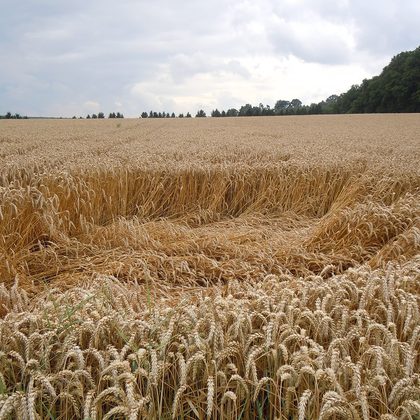
Grassy, open ground with scattered bushes and tussocks of tall grass, in Europe mostly close to water: marsh edges, reedbeds, the shores of lagoons and river arms, ditches and dykes through irrigated land, field margins and rice fields. Feeds acrobatically at the seed head itself, hanging and clambering, and on the ground beneath the stems; small insects such as termites and gnats are added in the breeding season. The nest is a dense ball of grass low in a tussock or just above the ground, with a side entrance.
Where the bird is most at home, classified with EUNIS — the European standard for habitats.

Range and movements
Natively a bird of West and Central Africa, from Senegal and the Gambia east to Congo and Zambia. In Europe the core lies in Portugal, along the lower Tagus and Sado and scattered further along the west coast. In Spain there are smaller clusters in Andalusia — Seville, Cádiz and Málaga — with loose parties in Galicia, Castellón, Biscay and on the Canary Islands. The Spanish review calls the species close to establishment, but with too little data to speak of real expansion. Outside Europe it has gone feral in Puerto Rico, Singapore and southern California.
- Resident
- Winter
- Passage
- dark = core range, pale = thinly spread
Where and when to look
In southern Portugal or the Guadalquivir delta, look for places where tall grass runs into reed and where common waxbills are already present. Sit down and wait for a party to arrive; the orange-cheeked waxbill is usually in there, two or three among the rest. Listen first — the clear rising call stands out among the nasal grating — then find the head. In low morning light the cheek patch burns so brightly that the bird is nameable at fifty metres. Watch the rust-red rump as the flock lifts, too.
Conservation status
Not globally threatened (IUCN: Least Concern) and common in Africa, over a range of several million square kilometres. In Europe it is an alien bird going back to escaped cage birds. The Portuguese population is small but has held on for decades; in Spain the species counts among the birds on the point of establishment, with data too thin to say whether numbers are growing. Spain has placed the whole genus Estrilda on its national list of invasive alien species, regulating trade and keeping. No damage to native birds or crops has been established; the concern is chiefly that the three feral Estrilda species together may come to dominate the reed vegetation of southern Iberia.
Scientific name
Estrilda melpoda (Vieillot, 1817)
Vieillot described the species in 1817 as Fringilla melpoda; because it was later moved to another genus, the author and year stand in brackets. The genus Estrilda was introduced in 1827 by Swainson. Estrilda was formed from astrild, the specific name Linnaeus gave to this bird. melpoda is Ancient Greek and is linked to melpō, 'to sing'. The specimen the first description was based on came from Senegal.