All species › Passerines › Waxbills › Scaly-breasted munia
Scaly-breasted munia | Lonchura punctulata
Muskaatvink | Capuchino punteado
A sturdy, short-tailed finch with a heavy lead-grey bill, a dark brown head and underparts that look as if fish scales had been laid on them: every feather white with a black rim. The scaly-breasted munia comes from tropical Asia and is one of the most heavily traded cage birds in the world; its Iberian presence goes back to escaped birds. Anyone who sees one rarely sees only one — they sit shoulder to shoulder on a wire or in a grain field, and the young birds beside them are plain brown and look like nothing at all.

Voice
A soft, plaintive, slightly nasal pee-tee or ki-tee with a whistled undertone, used constantly within a party; a sharper chit as the birds take off. The male's song is remarkably quiet and barely audible a few metres away: a series of squeaked and clicking notes running out into a long thin whistle, delivered with the throat feathers raised and the body bobbing slightly. To hear the song you have to get close.
Recording: K L Vinay — CC BY-SA 4.0 · Wikimedia Commons
Identification
Eleven to twelve centimetres, compact, with a short tapering tail. The bill is heavy, deep at the base and conical, blue-grey to nearly black — a true seed cracker. Head, throat and upper breast are deep chestnut to chocolate brown and unmarked; back and wings are plain warm brown. From the breast down the underparts are white and closely set with dark crescent edges, so that breast and flanks look scaled; on the belly the scaling fades gradually into off-white. Rump and uppertail coverts are ochre to olive-yellow and the tail is pointed. Male and female are alike. The juvenile is another bird altogether: uniform light brown above, uniform pale buff below, without the dark head and without a single scale, but with the same heavy dark bill.
Confusion species
The adult cannot be confused with any European species: nothing else here combines a brown head with scaled white underparts. The juvenile is the problem. Being plain brown, it suggests a young house sparrow, but it lacks the pale supercilium and the streaked back, and carries a far heavier, darker bill; it also looks rounder and shorter-tailed. Indian silverbill is about the same size but much paler, with a silver-grey bill, unmarked white underparts, a white rump and a long pointed black tail. The heavy dark bill separates it from common waxbill at once — that bird's is red. When in doubt always start with bill colour: lead-grey to black and heavy on munia, red on every waxbill.
Habitat
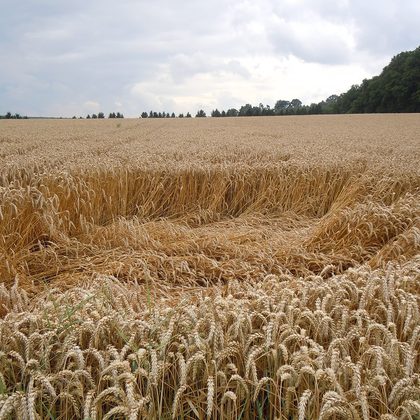
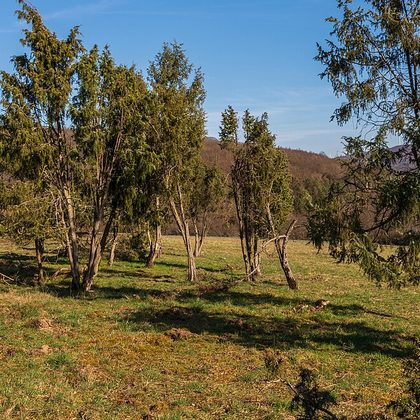
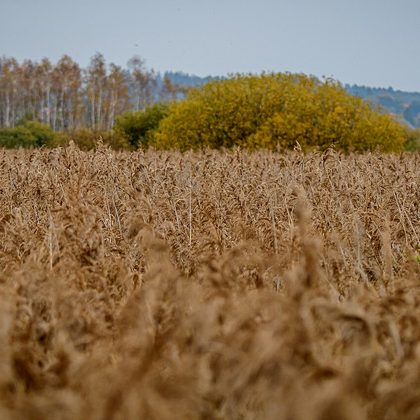
Open farmland: cereal fields and field margins, rice, fallow ground, rough verges and dykes, tall grass round irrigation ditches, and at the edge of these gardens, parks and orchards. In Iberia nearly always near buildings or irrigated land. Feeds in tight parties on half-ripe and spilt grass seed, rice and grain, hanging from the ear or working the ground, with small insects and algae taken in the breeding season. The nest is a large ball of laid grass blades, reed or bamboo leaf with a side entrance, in a bush or a dense tree, often several close together.
Where the bird is most at home, classified with EUNIS — the European standard for habitats.

Range and movements
Natively a bird of tropical Asia, from India and Sri Lanka through South-East Asia to Indonesia and the Philippines. In Europe it is a matter of birds gone feral from the bird trade, with small local parties in Portugal and Spain, chiefly on the south and east coasts, inland in Extremadura and Andalusia and on the islands; the first free-living groups were reported only in recent decades and breeding records are scarce and scattered. Almost nothing is yet known of cores held year after year. Outside Europe the species is naturalised on a large scale, including Hawaii, Puerto Rico, Florida, California and Australia.
- Resident
- Winter
- Passage
- dark = core range, pale = thinly spread
Where and when to look
In southern Spain or along the Portuguese coast look where cereal or rice runs up against gardens and village edges, and watch the wires and the field margins. The parties are compact and fly low and fast, with a slightly undulating flight and a soft continuous squeaking. Check every bird separately: a flock of fifteen often holds a couple of scaled adults and a majority of plain brown juveniles, and it is precisely those juveniles that get written off as sparrows. In winter they feed on the ground on stubble.
Conservation status
Not globally threatened (IUCN: Least Concern), though the species is declining in parts of South-East Asia through trapping for the bird trade. In Europe it is an alien bird going back to escaped cage birds, and a case that can hardly be judged yet: numbers are small, the parties local, and it is unclear whether any population anywhere maintains itself without a supply from aviaries. Unlike the three Estrilda species, the munia is not on the Spanish list of invasive alien species. Elsewhere in the world, notably in Hawaii and Australia, it has become numerous and damage to rice and grain is reported; nothing of the kind applies in Iberia.
Scientific name
Lonchura punctulata (Linnaeus, 1758)
Linnaeus described the species in 1758 as Loxia punctulata; because it was later moved to another genus, the author and year stand in brackets. The genus Lonchura was introduced in 1832 by Sykes. Lonchura is Greek, from lonkhē 'spear-head' and oura 'tail', after the pointed tail. punctulata is modern Latin for 'finely spotted', after the scaly markings on the breast. The specimen the first description was based on came from Calcutta, India.