All species › Passerines › Waxbills › Indian silverbill
Indian silverbill | Euodice malabarica
Loodbekje | Capuchino picoplata
A pale, sand-coloured finch with a thick bill that looks as though it were cast in polished lead or silver — hence the name. The Indian silverbill belongs to the dry country of the Indian subcontinent and the Middle East and has travelled the world as a cage bird. Around the Mediterranean its presence goes back to escaped birds: in Israel and Jordan it is now firmly settled, while in southern Spain and Italy it is a matter of small parties whose future is still open.

Voice
A soft, continuous, slightly squeaky cheep-cheep, passed back and forth without a break while the birds feed, and enough to give away a party in dense scrub before anything moves. The call quickens and sharpens as they take off. The song is a long, very quiet, rambling phrase of squeaked and trilled notes, given with the breast feathers raised and the body bowing slightly; it carries a few metres at most.
No freely licensed recording is available for this species yet.
Identification
Eleven to eleven and a half centimetres, a good deal of it tail. The bill is heavy and conical and a striking silver-grey to blue-grey, far paler than the head — the feature that catches the eye first, even at range. The upperparts are light sandy brown, faintly darker-streaked above; the cheeks are a warmer brown. The whole underside is creamy white to white, without streaking or barring, with a light buff wash on the flanks. The wings are dark brown and stand out clearly against the pale back. The rump is white and flares between the dark wings and the black tail as the bird takes off. That tail is long and pointed, the feathers shortening from the centre outwards. Sexes alike; juveniles are buffier below and shorter-tailed.
Confusion species
Scaly-breasted munia is the same size but has a much darker, blue-black bill, a chocolate-brown head, scaled white underparts and a yellow rump; a juvenile munia is plain brown below and darker than a silverbill, with a short tail and a dark bill. The waxbills all have red bills and are smaller and darker. A closely related species with a black rump occurs outside Europe, so a bird in the hand, or well seen from behind, should be checked on the white rump. From a young house sparrow the silverbill is separated by the pale unstreaked underparts, the silver bill and the long pointed tail.
Habitat
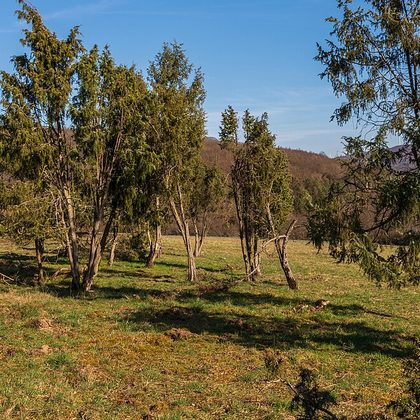
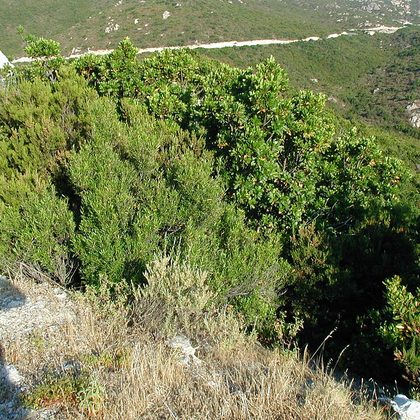
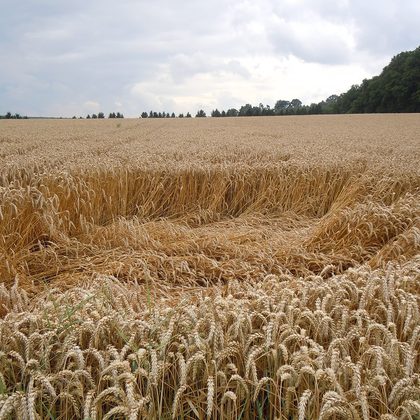
Dry, open country: thorn scrub and acacia steppe, semi-desert with scattered bushes, dry grassland, field margins and stubble, and beyond that gardens, date gardens, parks and the green edges of villages and towns. Comes to water to drink and bathe but otherwise lives dry. Feeds in parties on the ground and at the stem on fine grass seed and spilt grain, with small insects added in the breeding season. The nest is an untidy ball of grass with a side entrance, low in a thorn bush or an acacia, sometimes in the base of a larger raptor's or stork's nest.
Where the bird is most at home, classified with EUNIS — the European standard for habitats.

Range and movements
Natively a bird of the dry parts of the Indian subcontinent and the Middle East, from Pakistan and India west to Iran and the Arabian peninsula. Within the area of this guide it is established in Israel and Jordan, where it has become an ordinary bird of farmland and town edges over recent decades, and for a few years now in Egypt as well. In Europe it is a matter of birds gone feral from the bird trade: small parties in southern Spain, a cluster around Nice in southern France and records from Italy, where a possible first establishment has been written up. It is naturalised further in Kuwait, Oman, Qatar, Saudi Arabia, Puerto Rico and parts of the United States.
- Resident
- Breeding (summer)
- Winter
- Passage
- dark = core range, pale = thinly spread
Where and when to look
In Israel and Jordan it is straightforward: work the thorn hedges and stubble of the Jordan valley, or the fields and date gardens of the Arava, and listen for the soft, continuous squeaking. The birds sit low and packed together and, when flushed, cross to the next bush in a fast, slightly undulating flight — the moment at which the white rump between the dark wings shows best. In Spain, finding one is a matter of luck: check town edges, palm gardens and irrigated ground on the south coast, and bear in mind that most birds there have left an aviary only recently.
Conservation status
Not globally threatened (IUCN: Least Concern) and common and increasing in its native range, helped by irrigated farming making dry country suitable for it. Around the Mediterranean it is an alien bird going back to escaped cage birds. In Israel and Jordan that establishment has carried through and the species is now a fixture of farmland and town edges; what this means for native seed-eaters has not been studied. In Spain and Italy the picture is quite different: loose parties, few breeding records and no sign of a population sustaining itself without a supply from aviaries. The species is on neither the Spanish list of invasive alien species nor the EU list.
Scientific name
Euodice malabarica (Linnaeus, 1758)
Linnaeus described the species in 1758 as Loxia malabarica; because it was later moved to another genus, the author and year stand in brackets. The genus Euodice was introduced in 1863 by Reichenbach. Euodice is Greek, from eu 'good' and ōdikos 'singing', so roughly 'good singer'. malabarica refers to Malabar, the coastal region of south-western India. The specimen the first description was based on came from Malabar, India.