All species › Passerines › New World warblers › Blackpoll warbler
Blackpoll warbler | Setophaga striata
Zwartkopzanger | Reinita estriada
The American warbler you are most likely to meet on this side of the ocean, and that is no accident. In autumn it flies from the coast of Nova Scotia and New England straight out over the sea to the Caribbean and South America: more than two thousand kilometres of open water, two to three days without a pause. A bird of twelve grams eats itself up to nearly double that weight before setting off. If one is caught out over the sea in a westerly airstream, the way back is shorter than the way on, and it ends up here. Almost always in October, and almost always as a pale first-autumn bird.

Voice
The song is a run of eight to twenty identical thin tsit notes on one pitch, swelling and then dying away, and at around nine kilohertz one of the highest sounds any bird makes; anyone who has lost the kinglets has lost this song too. It does not sing in autumn. The call is a short, sharp, slightly metallic chip, and in flight a thin rising zeet. Vagrants are remarkably silent: they are exhausted, they feed without pause, and you almost always see one before you hear it.
No freely licensed recording is available for this species yet.
Identification
Forget the plate in the book: the black cap, white cheek and black moustachial stripe belong to the spring male, and that plumage is virtually never seen here. The bird you get is olive to grey-green above, with fine dark streaking over mantle and crown, and two clean white wingbars. The underparts are off-white with a yellow wash across breast and flanks, and on that sits the mark that matters: faint, narrow dark streaking down the sides of the breast and along the flanks, sometimes no more than a few pencil lines. The undertail coverts are pure white and strikingly long. The second mark is at the bottom: the legs are pale, straw to pinkish, and the soles of the feet often bright orange-yellow — on almost every other American warbler the legs are dark. Add a short, thin, sharply pointed bill, a faint pale supercilium and a long wingpoint, which makes the tail look short.
Confusion species
At first glance a European observer thinks of a leaf warbler: the same size, the same greenish cast, the same behaviour high in the foliage. Two things rule that out — the two crisp white wingbars, and the fine streaking on mantle and flanks that no Phylloscopus shows in that way. Among the American warblers there are two hard ones. The first wears the same green autumn dress with wingbars but has no flank streaking at all, a warm buff wash across breast and flanks, buff rather than white undertail coverts, and dark legs: that is bay-breasted warbler, of which only a handful of records exist on this side. The second is pine warbler, with an unstreaked back, a longer tail and, again, dark legs. In short: white undertail coverts, streaks on the flanks and pale legs together point to this species. Be aware that leg colour can look dark against the light; check the soles of the feet when the bird is on a branch.
Habitat
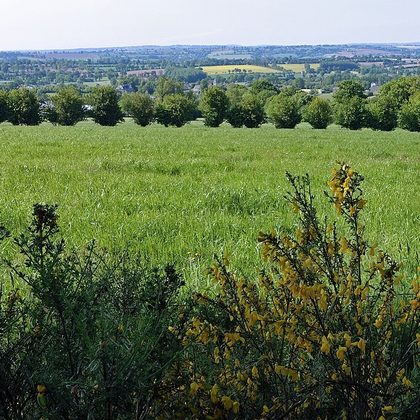
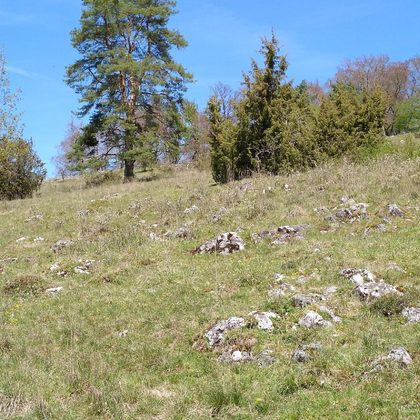
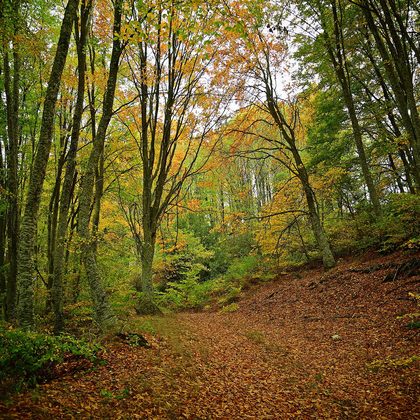
Here it means whatever cover stands just behind the surf: a garden hedge, an ivy-covered wall, a clump of sycamores by a farm, tamarisk, or a dense bramble bank in a coastal village. The bird works slowly at low to middle height, picking along twigs and leaf stalks, and will let you approach to half a metre — which surprises people, given the rarity, but is nothing more than hunger. On the breeding grounds it is a bird of low, dense conifers at the edge of the treeline and of spruce regrowth; in winter it lives in the canopy of forest in northern South America.
Where the bird is most at home, classified with EUNIS — the European standard for habitats.

Range and movements
Breeds from Alaska right across boreal Canada to Newfoundland and New England, and winters in Amazonia and northern South America. Within the map area it is a vagrant, but the most reported American warbler on this side. Britain and Ireland have more than sixty records between them, with the Isles of Scilly far in front, followed by Cornwall and south-west Ireland; that works out at one or two birds a year, nearly all in October. The Netherlands has a single record: Texel, 25 to 27 October 2020. The real numbers, though, lie just off the edge of this map, on Corvo and Flores in the western Azores, where the species is seen almost every October and where a good autumn can hold several birds at once. Iceland has records too.
Where and when to look
In October, two to four days after a deep depression has run fast from Newfoundland to Ireland, work the gardens and hedges of a coastal village on Scilly, in Cornwall or in West Cork. Search low and slowly, and treat every greenish, leaf-warbler-like bird as suspect until you have seen the wingbars. Then look in this order: undertail coverts (white or buff), flanks (streaked or not), legs (pale or dark). Photograph the legs and the undertail above all, because that is exactly what the rarities committee wants to see. If you want the species for certain, book the first half of October on Corvo.
Conservation status
No longer listed as safe: the Red List now places the species as Near Threatened (IUCN: NT). The population still runs into the tens of millions, but the counts show a fall of many tens of per cent since the 1970s, probably tied to logging and drying in the boreal forest, to forest loss in the Amazon where it winters, and to losses on the long sea crossing. For the region of this guide it is a vagrant and nothing else. The question of origin barely arises: American warblers are not traded as cagebirds, and arrivals coincide so tightly with fast Atlantic depressions that a bird under its own power is the ordinary explanation. Exhausted birds do occasionally cover part of the distance aboard a ship, and that is weighed up when a record falls outside the usual window.
Scientific name
Setophaga striata (Forster, 1772)
Forster described the species in 1772 as Muscicapa striata; because it was later moved to another genus, the author and year stand in brackets. The genus Setophaga was introduced in 1827 by Swainson. Setophaga is Greek, from sēs, sētos 'moth' and -phagos '-eating': 'moth-eater'. striata is Latin for 'striated', after the streaked pattern of the plumage. The specimen the first description was based on came from Fort Severn, Hudson Bay.