All species › Passerines › New World warblers › Tennessee warbler
Tennessee warbler | Leiothlypis peregrina
Tennesseezanger | Reinita verdillo
Of the American warblers that reach this side, this is the plainest: a small greenish bird with no pattern to speak of, working through the nettles in a garden on Fair Isle or on Barra, and you have to look twice before you notice it is not a willow warbler. It also comes earlier than the rest — virtually every European record falls in September — and it comes not to the south-west but to the north, to the Scottish islands.

Voice
The song is three run-together series, each faster and louder than the last — a staccato tik tik tik, swit swit swit, chew chew chew chew — loud and sharp for so small a bird, but you will not hear it here: by September it has stopped singing. The call is a high, sharp tsit, short and dry, easily lost among the calls of willow warblers and chiffchaffs. In flight a thin zeet. Expect to find this bird with your eyes rather than your ears.
No freely licensed recording is available for this species yet.
Identification
A small, compact warbler with a short tail and a long wingpoint, which makes the rear end look cut off. The upperparts are bright olive-green, the head a shade greyer than the back, with a narrow off-white supercilium and a dark line through the eye. The underparts are yellowish-white, brightest on throat and breast and paler behind. The mark it all hangs on is under the tail: the undertail coverts are white to off-white and contrast with the yellowish breast — on the handful of species it can be confused with they are yellow. There are no wingbars, or at most one faint pale line across the greater coverts. The bill is short, thin and finely pointed, with a dead straight upper mandible; the legs are grey to greyish-pink. In spring the male is greyer on the head with white underparts and no yellow, but that plumage does not occur here.
Confusion species
Every European observer's first thought is willow warbler, and that is exactly the mistake most often made. Four things help. One: the tail is shorter and the wingpoint longer, so the bird looks stocky rather than slim. Two: the bill is thinner and sharper, a needle rather than a pair of tweezers. Three: the undertail coverts are white, not yellow, which is obvious the moment the bird is above you. Four: the legs are grey, where a willow warbler has pale brown to flesh-coloured legs. The Tennessee warbler is also brighter green on the back and greyer on the head than any willow warbler. Among the American warblers there is one real rival: orange-crowned warbler, greener and duller, with a longer tail, blurred streaking across the breast and — decisively — yellow undertail coverts. Red-eyed vireo, which can turn up in the same weeks, is half as big again, with a heavy bill hooked at the tip and a broad supercilium edged black above.
Habitat
In the places where it lands here there is not much choice: the walled kitchen garden of a croft, a clump of wind-bent sycamores by a chapel, a bed of irises or nettles in the lee of a wall, an overgrown hedge. It feeds calmly and fairly low, picking along leaf stalks and flower heads and often hanging upside down at a tip. At home it is a bird of open boreal forest and shrubby clear-fell, and in winter of flowering trees in Central America, where it lives on nectar and can gather by the dozen in a single crown in bloom.
Where the bird is most at home, classified with EUNIS — the European standard for habitats.

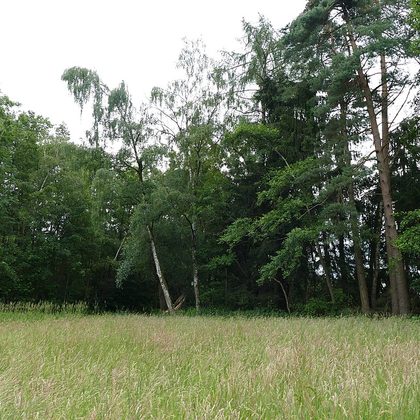
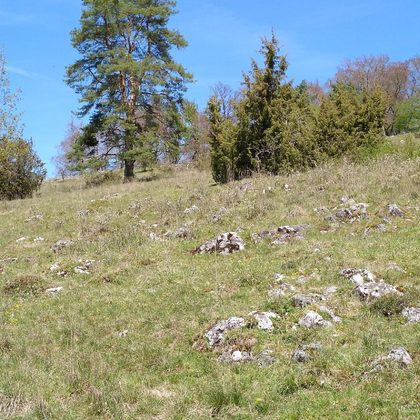
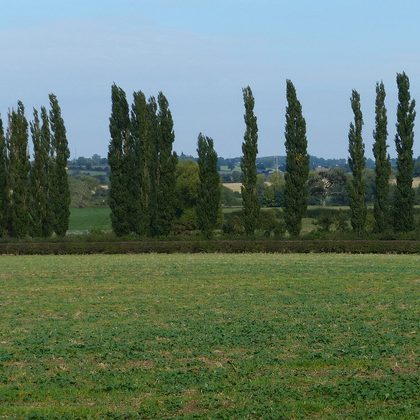
Range and movements
Breeds in a broad band across boreal Canada and the extreme north of the United States and winters from southern Mexico to northern South America. Within the map area it is a vagrant, and a scarce one: there are around a dozen records, all from the British Isles. The first was on Fair Isle in September 1975, which held two birds that autumn; Orkney, St Kilda, Yell, Fetlar, Barra and Skokholm have followed. The striking thing is the tightness of the dates: all but one of the records fall in September, while the other American warblers do not arrive until October. There is no accepted Dutch record. On the Azores, just off the edge of this map, it likewise amounts to no more than the odd bird.
Where and when to look
This is a species for whoever is on a northern island in September, working the gardens systematically. Look twice at any willow-warbler-like bird that is not quite right, and make yourself check the undertail: white means carry on towards this species, yellow means something else. Note also the short tail, the needle-fine bill and the grey legs. Photograph the bird from below — that is the picture a rarities committee asks for and precisely the one nobody takes. Do not count on a long stay: several of these birds were present for a single day.
Conservation status
Not globally threatened (IUCN: Least Concern), with a population in the tens of millions. Numbers swing hard from year to year, because the species profits from outbreaks of spruce budworm in the boreal forest: in an outbreak year far more pairs breed and clutches are larger, and afterwards the population falls back. Over the longer term a gradual decline has been measured. For the region of this guide it is a vagrant and nothing else. The question of origin is simple here: American warblers are not traded as cagebirds, and the fixed September dates and the northerly spread of the records fit birds carried across under their own power on a westerly airstream.
Scientific name
Leiothlypis peregrina (Wilson, 1811)
Wilson described the species in 1811 as Sylvia peregrina; because it was later moved to another genus, the author and year stand in brackets. The genus Leiothlypis was introduced in 2008 by Sangster. Leiothlypis is Ancient Greek, from leios 'plain, smooth' and thlypis, an unidentified small bird mentioned by Aristotle. peregrina is from Latin peregrinus 'wanderer, foreigner'. The specimen the first description was based on came from the Cumberland River, Tennessee.