All species › Passerines › Wagtails and pipits › Citrine wagtail
Citrine wagtail | Motacilla citreola
Citroenkwikstaart | Lavandera cetrina
A wagtail with a lemon-yellow head and a black collar across the nape — the adult male is one of the most striking birds in Europe and one of the easiest to name. The difficulty comes in autumn, when grey-and-white juveniles stand among yellow wagtails on a coastal marsh, and that is the plumage in which Britain nearly always sees it. Until recently a bird of Russia and Central Asia, it now breeds in Finland, the Baltic states, Poland and Belarus, and the western edge of its range has moved closer with every decade.

Voice
The call is a loud, slightly harsh and distinctly rasping tsreep or dzreep, one syllable, with a buzzing edge that suggests a bunting rather than a wagtail. For autumn birds this is the single most useful character the bird supplies itself, and many records are found on the call before the bird is properly seen. The song is a short, monotonous phrase of clear, high, canary-like notes repeated from a tussock, a low bush or a wire over wet meadow, and on the breeding grounds also in a brief song flight. Song from late April into July.
No freely licensed recording is available for this species yet.
Identification
Fifteen and a half to seventeen centimetres, with a tail shorter than a grey wagtail's but looking longer than a yellow wagtail's. The legs are black. The summer male cannot be mistaken: the entire head and the entire underside are bright lemon yellow, and a black band runs across the hind neck, separating the yellow head from the grey mantle like a collar. The back is clean blue-grey with no trace of green, the wing carries two broad white bars and a white edge along the tertials, and the tail is black with white outer feathers. The female is a duller yellow, with a grey-olive crown and ear surround that frames the yellow face, and shows the same broad white bars. The first-autumn plumage is what turns up here and deserves the attention: grey above with no olive at all, very white below, with a pale forehead, a broad pale lore and a pale supercilium that curves round the back of the ear coverts to close a complete pale surround. The two white wing bars are then strikingly broad, far broader than on any yellow wagtail.
Confusion species
Everything turns on juvenile yellow wagtails in August and September. Four points. Upperparts: clean cold grey on citrine, with no olive; always with a green or olive-brown cast on yellow wagtail. Underparts: white on citrine, at most a faint warm wash on the flanks; usually yellow-buff on yellow wagtail. Wing: two very broad, clean white bars against two narrower, dirtier ones. Head: the pale surround that closes right round the ear coverts, with a pale forehead and broad pale lore, against a supercilium that narrows in front of the eye and a darker lore. If doubt remains the call decides: a loud, harsh, rasping tsreep, with far more buzz in it than the full tswee-eep of a yellow wagtail. Eastern yellow wagtail sounds almost the same and can also look pale below, but it lacks the broad white wing bars and the closed pale ear surround, and has a longer hind claw. Grey wagtail is much longer-tailed, with pink legs and a yellow-green rump.
Habitat
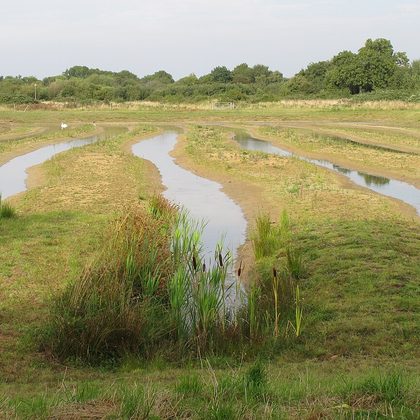
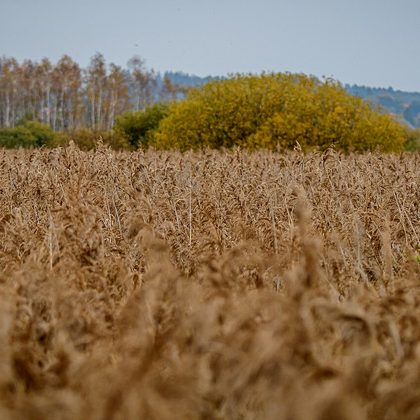
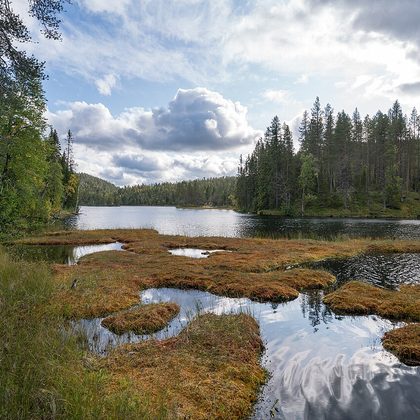
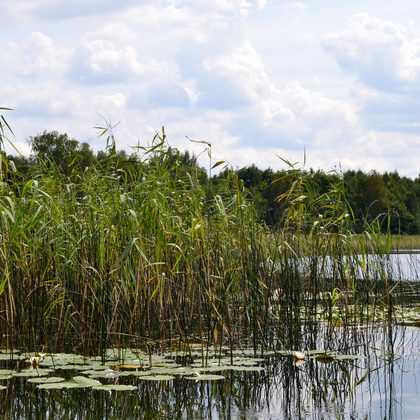
Wet, low, open ground: waterlogged hay meadows and sedge marsh, lake shores and river floodplains with seepages, silting pools, fen and, in the north of the range, wet tundra. Where arable and wet meadow meet, this is the bird of the lowest, wettest corner. The nest is a scrape on the ground in a sedge or grass tussock, usually on a drier spot in the middle of the wet. Outside the breeding season on muddy shores, coastal marsh, rice fields and the margins of sewage works.
Where the bird is most at home, classified with EUNIS — the European standard for habitats.
Range and movements
Breeds from Finland, Estonia, Latvia, Lithuania, Poland and Belarus east through Russia into Siberia and south into Central Asia and the Himalaya; all birds winter in southern and south-east Asia and around the Persian Gulf. The western edge of the breeding range has been moving since the 1960s — Finland first, then the Baltic states, then Poland from the 1990s, with scattered breeding further west in central Europe since. In Britain it has gone from a major rarity to a scarce but annual visitor, with something of the order of twenty to thirty records a year, most of them first-autumn birds on Shetland, Fair Isle and the east and south coasts between mid-August and early October, and a scattering of spring adults. There have been a small number of breeding attempts, including mixed pairings with yellow wagtail.
- Breeding (summer)
- Winter
- Passage
- Migration direction
- dark = core range, pale = thinly spread
Where and when to look
The second half of August and the first half of September, on a coastal marsh, a flooded field or a drying pool where a dozen or more yellow wagtails are feeding together. Work slowly through the flock looking for the bird that reads colder grey above and whiter below, then go straight to the wing: two broad, clean white bars on an otherwise dark wing is the sign. Listen at the same time for a harsh rasping call among the fuller notes of the yellow wagtails, and record it if you can. To see the adult male, a May trip to eastern Poland, Lithuania or southern Finland is the shortest route: in the wet meadows there he sits on the topmost stem, and there is nothing to work out.
Conservation status
Not globally threatened, with a large and increasing world population. The westward expansion of the breeding range has run for sixty years and continues; it is generally linked to a warming climate and to the availability of wet, extensively used grassland in eastern Europe. For Britain that has meant a steady rise in records, part of it genuine and part of it because observers now recognise the autumn plumage and record the call. The risks to the species are those of all wet-grassland birds: drainage, early cutting and the conversion of marsh edge to arable.
Scientific name
Motacilla citreola Pallas, 1776
Pallas described the species in 1776 and placed it straight away in the genus where it still stands. The genus Motacilla was introduced in 1758 by Linnaeus. Motacilla is the Latin name for the wagtail; it is really a diminutive of motare 'to move about', though from medieval times -cilla was wrongly taken to mean 'tail'. citreola is Latin for 'lemon-yellow', after the male's head and underparts. The specimen the first description was based on came from eastern Siberia.