All species › Passerines › Wagtails and pipits › Western yellow wagtail
Western yellow wagtail | Motacilla flava
Gele kwikstaart | Lavandera boyera
The yellow wagtail is a bird of low, wet, green country: grazed pasture, potato and bean fields, washland and coastal grazing marsh. In May the male perches on the topmost stem of a tussock or on a wire fence, brighter yellow than anything around it, and gives a full rising tswee-eep. What makes the species remarkable is the head: from Ireland to Turkey each region carries a different pattern, from all-yellow through blue-grey to jet black, and all of them belong to one species. In Britain they can turn up in the same field in a single May morning.

Voice
The call is a full, slightly rising tswee-eep, louder and more musical than the size of the bird suggests, usually given in flight and often the first sign that a party is coming over the field. Northern and Balkan birds call harsher and more rasping, with an obvious buzz in the tone, and anyone who hears that difference looks twice, which is exactly the point. The song is slight: two to four thin, scraping notes, tsree-tsree-tsrip, repeated from a stem, a wire or a clod, sometimes in a short fluttering song flight. Heard from late April into July.
No freely licensed recording is available for this species yet.
Identification
Smaller and markedly shorter-tailed than the other wagtails, 15 to 16 cm, with black legs and a fine black bill. The upperparts are olive to yellow-green — never grey — and the underparts yellow, on a spring male a clean lemon that carries right through to the under tail coverts. The wing is dark with two narrow pale bars, the tail black with white outer feathers, and the tail is wagged constantly, though in shorter, busier jerks than a pied wagtail's. Females are duller, greenish-brown above and pale yellow to off-white below, with a vague pale supercilium. Autumn juveniles are buff-brown with a dark loral line, a creamy supercilium and a necklace of dark spots; they can show almost no yellow at all, and then the olive-green mantle, the short tail and the call are what to work from. Flight is deeply undulating and low over the crop.
Confusion species
The work is not with other species but with the forms of this one. British and Irish breeders are flavissima: the whole head is yellow-green, with a bright yellow supercilium and forehead and a yellow throat, so the bird reads as yellow from bill to nape. Everything else is a scarce migrant here and worth checking. A blue-grey crown with a long, clean white supercilium running from the bill to the nape, a white stripe below the cheek and a yellow throat is the nominate flava, the blue-headed wagtail of the near Continent, which appears in small numbers each spring and occasionally breeds. A dark head with no supercilium at all but a yellow throat means either thunbergi of Fennoscandia, slate-grey with a blackish ear patch, or feldegg of the Balkans and Turkey, glossy jet black from crown to nape. A grey head with a white throat places the bird in the south-west: iberiae of Iberia and southern France shows a short white supercilium mainly behind the eye, cinereocapilla of Italy and the Adriatic barely a white spot. Note also that pairings of flava and flavissima produce pale-headed intermediates, the so-called Channel wagtail, which are best left unassigned. Females and autumn birds usually cannot be placed at all. Beyond the species, confusion is slight: grey wagtail is longer-tailed, blue-grey above with a yellow-green rump and pink legs; young citrine wagtails are grey and white with no olive anywhere and two very broad white wing bars.
Habitat
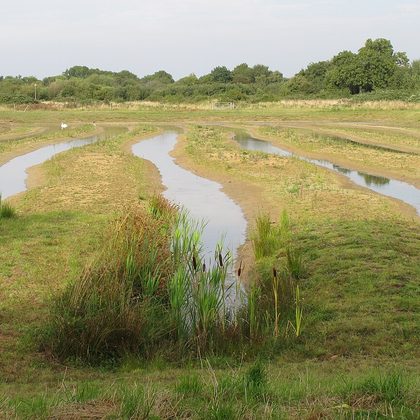
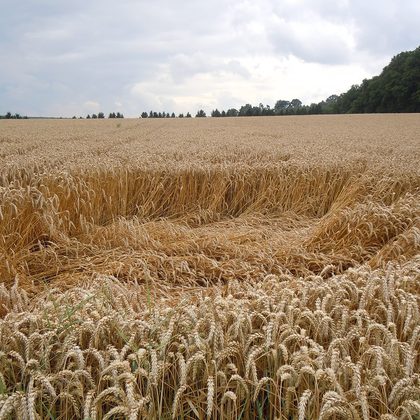
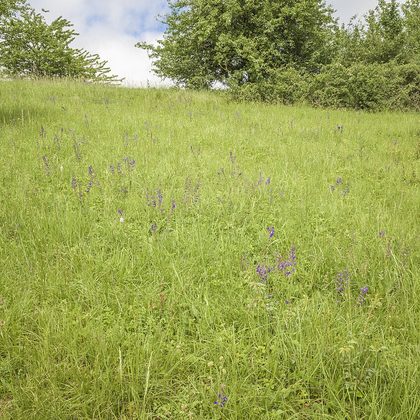
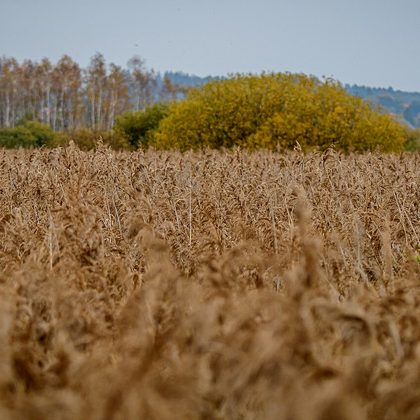
Open, low, damp ground with no tall vegetation, a few lookout perches and plenty of insects: extensively grazed pasture, coastal grazing marsh and washland, damp hay meadows and, increasingly, arable fields with a dense but not yet tall crop — potatoes, beans, peas, cereals. Livestock helps, because the flies gather around cattle and horses and the birds walk between their feet. The nest is a scrape on the ground under a grass tussock or between the potato ridges. On passage on saltmarsh, muddy margins, sewage works and bare fields, usually in loose parties.
Where the bird is most at home, classified with EUNIS — the European standard for habitats.
Range and movements
Breeds from Ireland east deep into Russia and from northern Scandinavia south to North Africa and Turkey, and winters almost entirely in sub-Saharan Africa. In Britain the breeding range has contracted sharply to the east and centre of England, with the Ouse and Nene washes, the Humber, the Somerset Levels and the arable of East Anglia and Yorkshire holding most of what is left; birds have all but gone from the west and from Wales and Scotland, and Ireland has lost the species as a regular breeder. Passage birds, including blue-headed and occasionally grey-headed forms, occur on both coasts in April and May and again in August and September.
- Resident
- Breeding (summer)
- Winter
- Passage
- Migration direction
- dark = core range, pale = thinly spread
Where and when to look
The first half of May, on a sunny, windless morning, along a washland fence line, a coastal grazing marsh or a newly emerging potato field. Look for the yellow dot on top of a tussock or on the wire and then take your time over the head: with the sun behind you the difference between a blue crown with a white supercilium and a slate crown without one is visible at fifty metres. Mid-May is the best chance of the northern form, which passes last and often in small parties on the coast. In August walk the same ground for the brown juveniles and work from the olive mantle, the short tail and the call.
Conservation status
Not globally threatened, but one of the clearest losers among British farmland birds and red-listed in Britain: numbers have fallen by well over half since the 1980s and the range has shrunk eastwards year on year. The causes run together: the loss of damp, herb-rich, extensively grazed pasture; earlier and more frequent cutting, which destroys nests on the ground; the drainage of wet meadows; and a general fall in insect numbers. Where the bird holds on it is now usually on arable land, and the management that helps is the same as for skylark — herb-rich margins, later operations and crops that still give cover into June. In the Mediterranean and in eastern Europe numbers are considerably more stable.
Scientific name
Motacilla flava Linnaeus, 1758
Linnaeus described the species in 1758 and placed it straight away in the genus where it still stands. He introduced the genus Motacilla in that same work. Motacilla is the Latin name for the wagtail; it is really a diminutive of motare 'to move about', though from medieval times -cilla was wrongly taken to mean 'tail'. flava is Latin for 'golden-yellow', after the yellow underparts. The specimen the first description was based on came from southern Sweden.