All species › Passerines › Wagtails and pipits › Gray wagtail
Gray wagtail | Motacilla cinerea
Grote gele kwikstaart | Lavandera cascadeña
The longest tail of any European songbird, and the bird makes the most of it: perched on a boulder in mid-current, pumping that tail well below the level of its feet, then away low over the water with a sharp metallic zi-zit. Its place is fast water — stony streams, weirs, mill races, hill rivers — and in winter it comes down from all of that into towns, onto flat roofs, sewage works and supermarket car parks, which is where most people first meet it.

Voice
The call is a sharp, hard, metallic zi-zit or zi-zi-zit, higher, thinner and more piercing than the chizzik of a pied wagtail, and it carries over the noise of running water — often it is all you get before the bird shoots past. The song is a short high series of those same notes with a rolling trill worked in, given from a boulder, a wall, a bridge parapet or a wire, and sometimes in a brief song flight over the water. Heard from February into July.
No freely licensed recording is available for this species yet.
Identification
Seventeen to twenty centimetres, more than half of it tail: the silhouette is the first thing to register, because no other wagtail looks so long and so thin behind. The upperparts are blue-grey and the rump yellow-green — back and rump are therefore different colours, and that is one of the sharpest characters the species has. The under tail coverts and lower belly are a clean lemon yellow all year, even when breast and flanks have gone pale in winter, so the bird looks as if it is wearing yellow trousers. The legs are flesh-pink, never black. A fine white supercilium runs over the eye and, on the male, a white moustachial stripe frames a jet-black throat, worn from late spring into summer. Females and winter birds have a white or faintly mottled throat. In flight a broad white wing bar shows against the black flight feathers, and the flight undulates more deeply than that of any other wagtail.
Confusion species
The recurring mistake is yellow wagtail, and four checks settle it. Tail: long and thin on grey wagtail, about half the bird; short and stubby on yellow wagtail. Back against rump: blue-grey with a yellow-green rump on grey wagtail, so two colours; uniformly olive-green on yellow wagtail, with no contrast at the rump. Legs: pink against black. And the calendar: a yellow wagtail in Britain in December does not exist, because it is in Africa. In summer the male gives it away outright — a long thin tail with yellow trousers above a jet-black throat is this species and nothing else. Pied and white wagtails have no yellow, a rump as grey or black as the back, and black legs. Young citrine wagtails are grey and white with no yellow, two very broad white wing bars and a far shorter tail.
Habitat
Fast, shallow water with stones, gravel and structure: streams and rivers over a hard bed, hill burns, waterfalls, weirs, locks, mill races, fish passes and culverts. The bird feeds walking and hopping over wet stones, among moss and along the edge of the foam, and takes insects in the air above the water as well. The nest goes in a niche just above the current: a hole in a retaining wall, among tree roots in a cut bank, under a bridge, in the masonry of a mill. In winter it is far less particular and turns up at sewage works, glasshouses, marinas, flat roofs, car parks and town canals.
Where the bird is most at home, classified with EUNIS — the European standard for habitats.

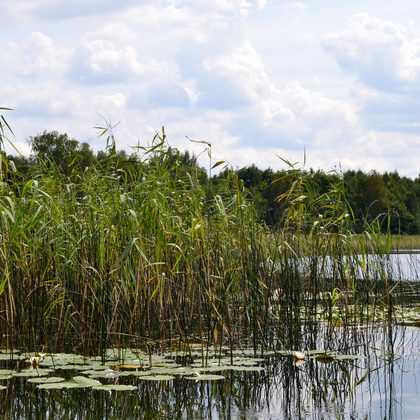
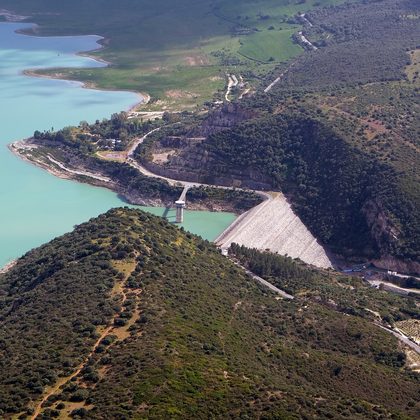
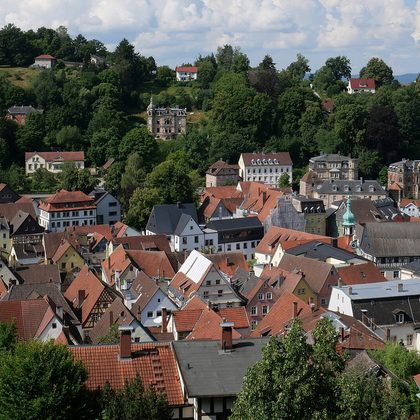
Range and movements
Breeds from Ireland and Iberia east to the Caucasus and on to Japan, and also on the Azores, Madeira and the Canaries and in the Atlas mountains; northern and eastern birds migrate, southern and western ones stay put. Britain and Ireland hold a substantial share of the north-west European population — of the order of forty thousand pairs — concentrated on the streams of the north and west but with a long-running spread into lowland England along weirs and mill streams. In winter the birds disperse widely, and many upland breeders move to lowland and urban water. In Iberia it is a common resident of hill and mountain streams from the Picos de Europa to the Sierra Nevada.
- Resident
- Breeding (summer)
- Winter
- Passage
- dark = core range, pale = thinly spread
Where and when to look
In winter, go to a weir, a mill race or a fish pass in the middle of a town. That is where the species is easiest between November and February: on the concrete lip of the weir, in the gutter of a factory roof, at the edge of a waterside car park, often at ten metres and entirely unbothered. For the full summer male with the black throat, April to June on a fast stony stream in Wales, the Pennines, the Lake District or the Scottish glens is the choice, and listen first — the sharp zi-zit carries over the water well before the bird appears.
Conservation status
Not globally threatened, but in Britain a species of the highest conservation concern following a long-term breeding decline, driven chiefly by the loss of insect life in streams, by acidification and diffuse pollution in the uplands, and by hard winters, which can remove a large share of the population in a single season. Against that, the bird has spread steadily into lowland and urban waters, where weirs, locks and mill races give it exactly what an upland burn gives it. The most direct damage is local: canalising, dredging and hard-revetting a stream removes both the stones it feeds on and the niches it nests in.
Scientific name
Motacilla cinerea Tunstall, 1771
Tunstall described the species in 1771 and placed it straight away in the genus where it still stands. The genus Motacilla was introduced in 1758 by Linnaeus. Motacilla is the Latin name for the wagtail; it is really a diminutive of motare 'to move about', though from medieval times -cilla was wrongly taken to mean 'tail'. cinerea is Latin for 'ash-grey', from cinis 'ashes', after the grey upperparts. The specimen the first description was based on came from Wycliffe, England.