All species › Passerines › Sparrows › House sparrow
House sparrow | Passer domesticus
Huismus | Gorrión común
No European bird lives closer to daily life than the house sparrow. It is in the gutter, on the café table, in the hedge by the front door, and for most people it is the first bird they could name. It is also the yardstick of the whole family: every other sparrow in this guide is described by the points on which it differs from this one, and once the grey-capped, black-bibbed male and the plain brown female are fixed in the mind, half the family comes free. It is at the same time the species that causes the most concern in north-west Europe, having gone from unremarkable to noteworthy in several large cities within a single lifetime.

Voice
The house sparrow's voice is one word in many keys: cheep. The song is nothing but a string of those chirps, delivered at an uneven tempo and in shifting tone by a male sitting conspicuously beside his nest hole — on a gutter, a chimney, an aerial or a shop sign — and it can be heard all year, most insistently from February into August. Beyond it come a sharp nasal churr-r-r when a cat or a sparrowhawk appears, a rolling chur-chur-chur from a flock taking off, and the soft continuous chatter of a whole colony inside dense ivy or privet, swelling before dusk into a murmur the whole street can hear. Everything is fuller and noisier than in tree sparrow, and without that species' wooden tapping note.
No freely licensed recording is available for this species yet.
Identification
A sturdy, short-necked sparrow with a heavy conical bill, a flat crown and a short tail; it does not walk but hops, both feet together. The summer male has a smooth ash-grey crown flanked by a broad chestnut band running from behind the eye around the nape, black lores, a plain greyish-white cheek with no spot, and a large black bib that runs from the chin onto the upper breast and ends raggedly at the sides. The mantle is chestnut with black streaks and carries a single narrow white bar across the lesser coverts; rump and underparts are plain grey. The bill is jet black. In autumn and winter pale feather fringes soften the whole pattern: the bib shrinks to a small grey smudge, the chestnut fades and the bill turns horn-yellow — the same bird, half rubbed out. The female is one of the most featureless birds in Europe: grey-brown, unstreaked below, with a broad pale supercilium that starts only behind the eye, a finely streaked brown mantle with warm buff feather edges, and a pale bill with a dark ridge. Juveniles resemble the female but are looser-feathered, with a yellow gape.
Confusion species
On a male three things together settle it: a grey crown, a cheek without a spot, and a bib that runs onto the breast. Every related sparrow breaks at least one of the three. The difficulty is the female, which is often named by elimination: look for the broad dull supercilium beginning behind the eye, the unstreaked underparts and the heavy bill. A female chaffinch is slimmer, with two broad white wingbars, white outer tail feathers and a greenish rump. Dunnock, still called hedge sparrow in places, has a thin pointed bill, a slate-grey head and breast, and creeps rather than hops. In the south of the region real care is needed: a male Spanish sparrow has an entirely chestnut crown, a far larger black shield on the breast and heavily black-streaked flanks, while a male Italian sparrow has a chestnut crown with a clean white cheek but only a small tidy bib. Their females cannot be separated from a female house sparrow in the field, so trust the males in the same flock. Tree sparrow and rock sparrow are treated elsewhere in this family and give themselves away by the black cheek spot and by the pale crown stripe with white tail-tip spots respectively.
Habitat
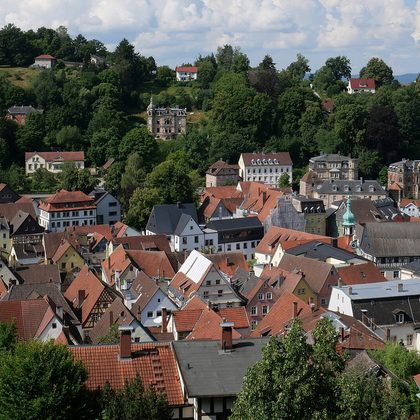
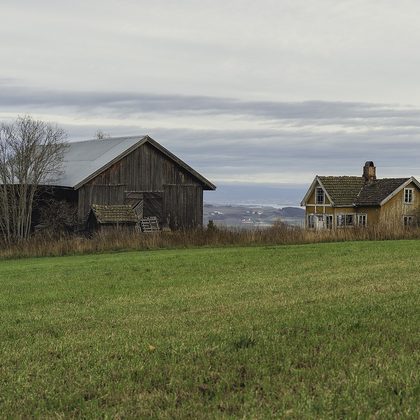
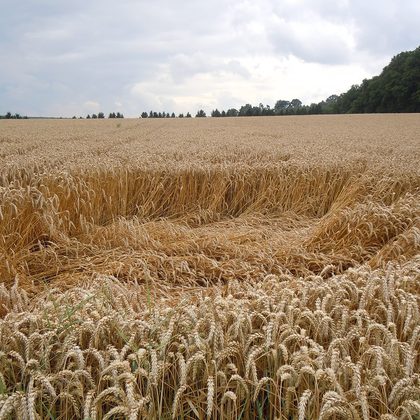
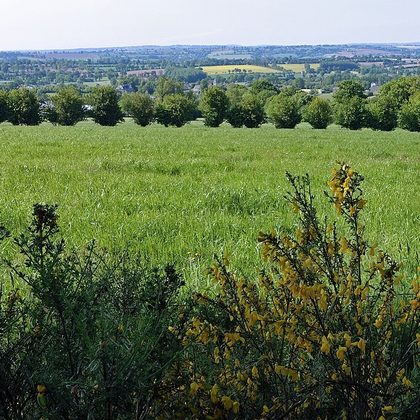
Anywhere people live and a hole exists high in a building or a tree: city centres, suburbs, villages, farmyards, industrial estates, campsites, allotments, town parks and docks. The nest is an untidy domed mass of grass, feathers, paper and plastic in a gap under the roof tiles, behind a gutter, in a cavity wall, a ventilation hole, a hole around a wall tie, a gable recess or a nest box, and in the south also free-standing in a tree crown or among the sticks of a stork's nest. Cover must stand close by — a thick hedge, ivy, a bramble patch or an untidy corner — into which the whole colony can drop at once. For the eggs and the first days of the young, insect-rich greenery is also needed within one or two hundred metres; a house sparrow rarely flies further. Its whole life is played out in a few hundred metres, which is why a colony that has gone comes back so slowly.
Where the bird is most at home, classified with EUNIS — the European standard for habitats.

Range and movements
From Iceland and northern Scandinavia to the edge of the Sahara, and eastwards across Asia; beyond that carried by people to the Americas, Africa, Australia and New Zealand. Within the map area there are three conspicuous gaps: the Italian peninsula with Corsica, Sardinia and Crete, where Italian sparrow takes its place, and most of the Canary Islands and Madeira, where Spanish sparrow is the sparrow of the villages. In Britain and Ireland it remains widespread but is far below its old numbers, with the sharpest losses in the big cities and the healthiest colonies on farms and in coastal towns. Across the North Sea the Dutch population, 600,000 to 1,000,000 pairs in 2018–2020, stands on the national Red List after a decline of more than half between the early 1980s and the 2000s, now levelling out. In Spain it is still almost everywhere, from Andalusian village squares to Pyrenean hamlets, although Spanish urban counters report the same emptying of city centres. It does not migrate: the bird you see in July is the bird of January.
- Resident
- Breeding (summer)
- Winter
- Passage
- dark = core range, pale = thinly spread
Where and when to look
The best way to learn it is a walk down your own street in late March or April, between eight and ten in the morning. Go slowly and listen for the chirping; every singing male sits within a few metres of his nest hole, so the colony can be mapped house by house. Watch the roof edge, the gap between two tiles and the hole under the gutter, and when a bird disappears inside with a grass stem or a feather the case is closed. A second fixed moment is the evening roost: stand by an ivy-covered wall or a privet hedge half an hour before sunset and wait for the murmur to build. And when travelling south, make a habit of checking the crown of the males in every sparrow flock — grey or chestnut — because that is where the separation from Spanish and Italian sparrow begins.
Conservation status
Not globally threatened (IUCN: Least Concern) and by some distance one of the most numerous birds on earth, yet in north-west Europe it stands on national red lists and has nearly vanished from some city centres. The causes are each identifiable and they compound one another. Nest holes go: roof renovation seals the gaps under the tiles with bird combs, facades are rendered smooth, cavity walls are insulated and old outbuildings are demolished. Cover goes: hedges and ivy give way to fence panels, and front gardens are paved, leaving no shrub to drop into and no bare soil to dust-bathe in. And food for the young goes: for their first days the chicks are fed on insects alone, and in a district of close-mown grass, swept pavements and few native shrubs there are hardly any in May. Smaller factors add to it, such as the loss of chicken runs and stables and the tidying away of rough corners. Recovery is just as concrete: a row of sparrow terraces or nest boxes under one roof edge, a dense native hedge beside it and a garden that is not scalped every week, and within a few years a colony is back.
Scientific name
Passer domesticus (Linnaeus, 1758)
Linnaeus described the species in 1758 as Fringilla domestica; because it was later moved to another genus, the author and year stand in brackets. The genus Passer was introduced in 1760 by Brisson. Passer is the Latin word for 'sparrow'. domesticus is Latin for 'belonging to the house', a reference to the bird's life alongside people. The specimen the first description was based on came from Sweden.