All species › Waterfowl › Ducks, geese and swans › Eurasian teal
Eurasian teal | Anas crecca
Wintertaling | Cerceta común
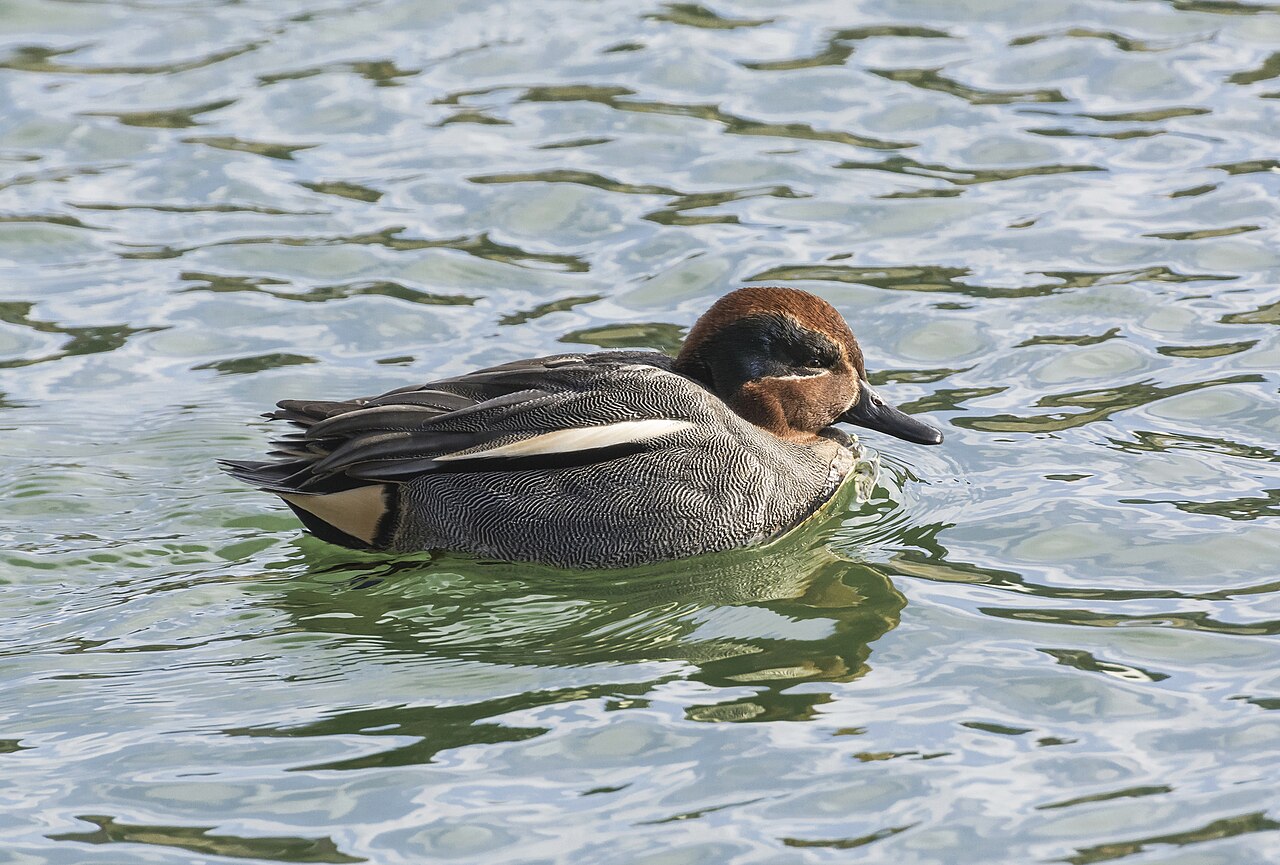
Europe's smallest duck, barely bigger than a pigeon and fast and agile in the air. Flocks tower off a muddy edge in a tight turn, sounding like a handful of small bells.
Click a thumbnail to switch the photo above.
Voice
The male gives a clear, short, bell-like whistle, krik or prrit, which in flocks sounds like ringing chimes and carries a long way. The female quacks high, thin and nasal. Heard most from October to March, often from unseen birds inside reed edges.
Recording: British Library — CC BY-SA 4.0 · Wikimedia Commons
Identification
Very small, short-necked duck with a slim dark bill. The male has a chestnut head with a green, yellow-bordered eye patch, finely vermiculated grey flanks crossed by a white horizontal stripe above the wing, and a yellow triangle under the black stern. The female is brown-spotted with a pale mark at the bill base; both sexes show a green speculum with a white leading edge. AviList 2025 places the American form, carried by other checklists as the separate species Anas carolinensis, within this species; that difference lies in how a list is drawn up, not in the birds. Drakes of that form show a narrow vertical white bar dropping down the side of the breast just in front of the folded wing, and lack the horizontal scapular stripe that runs along the flank. The pale lines framing the head pattern are faint or missing on them, so the head looks plainer. Females and immatures cannot be separated in the field.
Confusion species
Garganey has a longer, paler bill, a more sharply defined pale spot at the female's bill base, and blue-grey forewings. Size and the fast twisting flight rule out any larger duck. Within the species, finding the American form means working through parties of Teal bird by bird. Scan resting drakes from the side, the only angle that opens up the flank; a bird angled towards you shows the vertical bar but hides whether the horizontal stripe is there. Two questions decide it: is there a vertical bar on the side of the breast, and is the scapular stripe absent? Only a yes to both gives a good candidate. The pitfall is hybrids, which lay down both stripes halfway, each weaker than normal, and which usually keep part of the pale head framing as well. A bird that differs on one point only should be let go.
Habitat
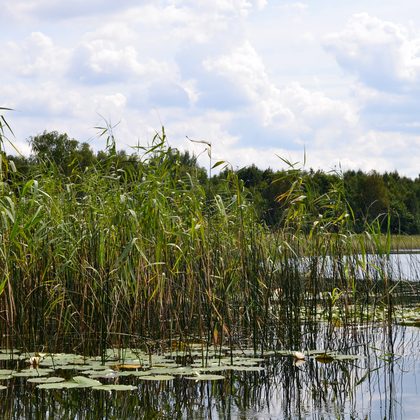
Shallow muddy waters with cover: bog pools, saltmarsh creeks, reed-fringed ditches, wet grassland and silting-up ponds. Breeds concealed in marsh, raised bog and dune slacks. Feeds by sieving along the waterline for seeds and small invertebrates, usually close against the vegetation.
Where the bird is most at home, classified with EUNIS — the European standard for habitats.



Range and movements
Breeds from Iceland and Scandinavia to central Europe, thinly and locally in the Netherlands. Dutch wetlands, especially the Delta and Wadden area, hold large winter numbers from northern Europe and Russia. In Spain it is an abundant winter visitor to Doñana, the Ebro delta and inland lagoons. The American form breeds across North America from Alaska to Newfoundland and winters south to Central America, and appears annually in small numbers in western Europe. In the Netherlands there were seventy-four accepted records up to and including 2014, and it has not been assessed since 2015, with a peak in March and April and a second in October and November. British records went from about a dozen before 1958 to over forty a year by the early 2000s, and have not been adjudicated as rarities since 1990; individual drakes return to the same pool in successive winters. In Spain it is still assessed, with records on the Cantabrian coast, in Galicia, the Ebro delta and the Guadalquivir marshes, almost always single drakes within flocks of common Teal. Almost every reported bird is a drake, which says mainly that females go unrecognised.
- Resident
- Breeding (summer)
- Winter
- Passage
- dark = core range, pale = thinly spread
How and when to look
Work muddy pool edges in October and November, soon after sunrise when birds emerge from the reed fringe. Stay low and quiet, because disturbed flocks leave at speed. Check every male for a vertical bar just in front of the wing, as the American form turns up almost annually, and photograph both flanks to save an argument later.
Conservation status
Numerous and widespread across the Palearctic, so not globally threatened. The Dutch breeding population is small and sensitive to drying out and the loss of small-scale wet marsh. As a winter visitor the species benefits from wetland restoration on floodplains and from reduced hunting pressure in parts of Europe.
Scientific name
Anas crecca | Linnaeus, 1758
Linnaeus described the species in 1758 and placed it straight away in the genus where it still stands. He introduced the genus Anas in that same work. Anas is the Latin word for 'duck'. crecca comes from kricka, the Swedish name for the bird, an imitation of the male's call. The specimen the first description was based on came from Sweden.