All species › Waterfowl › Ducks, geese and swans › Ruddy duck
Ruddy duck | Oxyura jamaicensis
Rosse stekelstaart | Malvasía canela
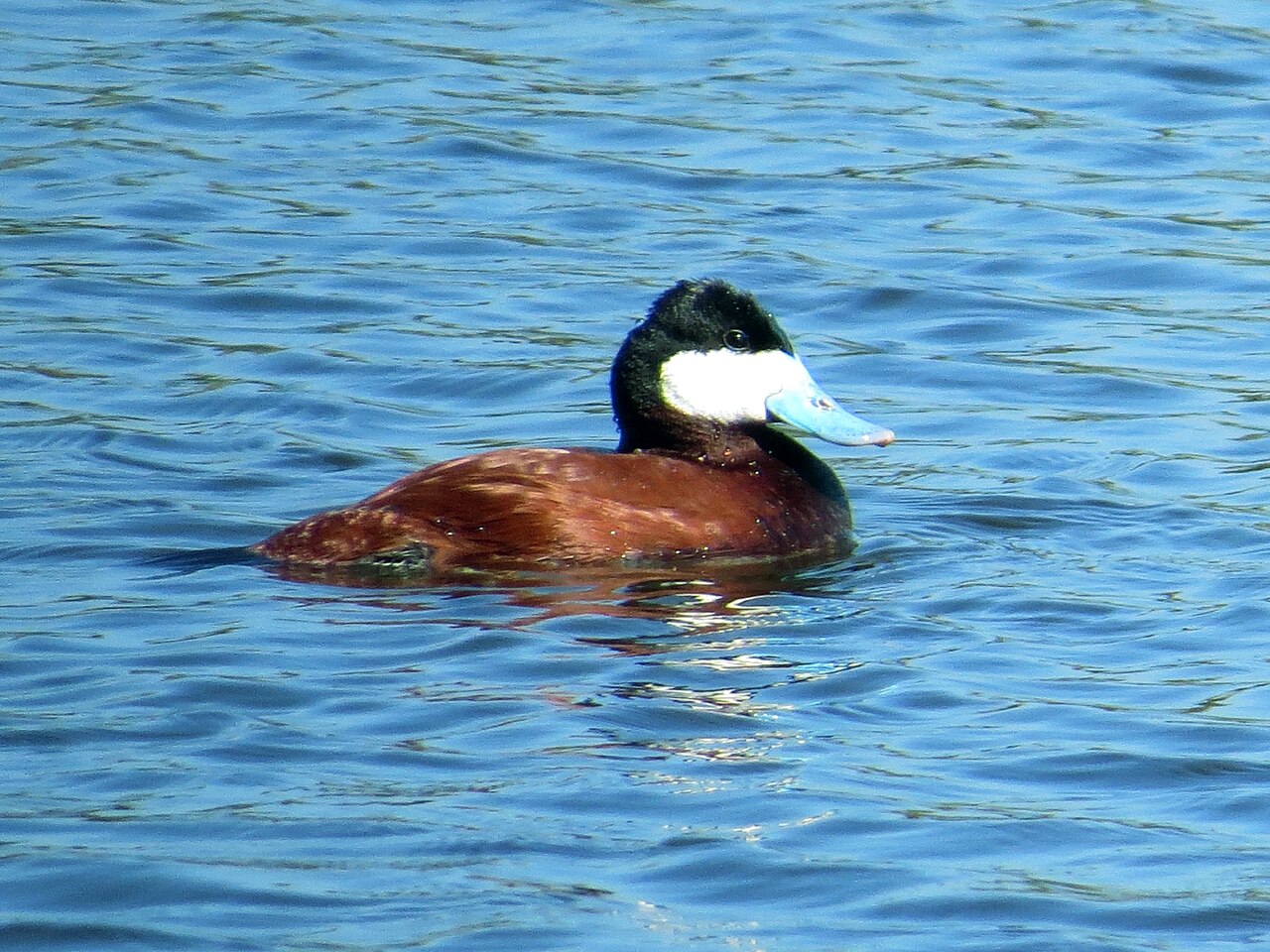
A small, stocky diving duck from North America with a heavy head and a stiff tail often cocked upright. In Europe it is an escape from collections and the target of active control.
Click a thumbnail to switch the photo above.
Voice
Practically voiceless. In display the male beats his bill rhythmically against his inflated breast, producing a hollow, accelerating tuk-tuk-tuk-turrr that ends in a belch while bubbles rise through the breast feathers. Seen and heard from April to June, mainly in the morning.
No freely licensed recording is available for this species yet.
Identification
Small and compact, with a big head, a short thick neck and a stiff fan-shaped tail that can be held vertically. The summer drake is chestnut with a black cap, gleaming white cheeks and a bright blue bill; in winter he turns dull grey-brown with a grey bill, but the white cheek remains. The female is brown with a single dark line across the pale cheek.
Confusion species
White-headed duck is what this is all about. Its drake has an entirely white head with only a black crown stripe and a strongly swollen blue bill base, whereas ruddy duck shows a black cap reaching below the eye. Hybrids are frequent and intermediate, for instance with dark smudging running across the cheek.
Habitat
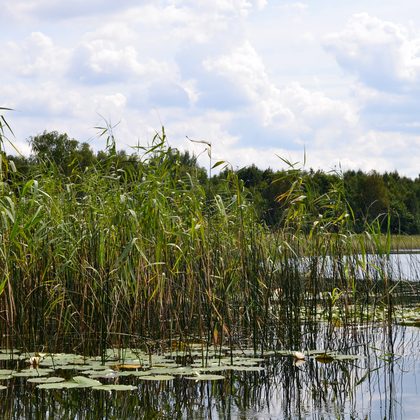
Shallow, nutrient-rich pools and lakes with a broad fringe of reed and sedge, where it dives for midge larvae and water plants. Also on town ponds and old clay pits. Nests low over the water in dense marginal vegetation and likes to stay in cover along the edge.
Where the bird is most at home, classified with EUNIS — the European standard for habitats.


Range and movements
North American by origin; in Europe it escaped from wildfowl collections in Britain and spread from there onto the continent. Because it hybridises with the endangered white-headed duck, an international eradication programme has been running for years and is all but complete in Britain and the Netherlands. In Spain every bird found near white-headed duck populations is removed.
- Resident
- Breeding (summer)
- Winter
- Passage
- dark = core range, pale = thinly spread
How and when to look
Chances are best in spring on shallow reed-fringed pools, when a displaying male comes out onto the open water in front of the reeds. Look early in the morning and check every small diving duck swimming with a cocked tail; report any sighting at once, as it matters for white-headed duck management.
Conservation status
Numerous and unthreatened in North America. In Europe it is not a conservation target but a control target, because genetic swamping of the white-headed duck threatens that species' survival. The eradication programme has reduced the European stock to a few scattered birds.
Scientific name
Oxyura jamaicensis | (Gmelin, 1789)
Gmelin described the species in 1789 as Anas jamaicensis; because it was later moved to another genus, the author and year stand in brackets. The genus Oxyura was introduced in 1828 by Bonaparte. Oxyura is Greek, from oxys 'sharp' and oura 'tail', after the stiff tail feathers the bird can hold upright. jamaicensis means 'from Jamaica', the island the first described specimen came from. The specimen the first description was based on came from Jamaica.