All species › Waders, gulls and terns › Gulls and terns › Roseate Tern
Roseate Tern | Sterna dougallii
Dougalls stern | Charrán rosado | Rosenseeschwalbe | שחפית ורדרדת | Sterne de Dougall
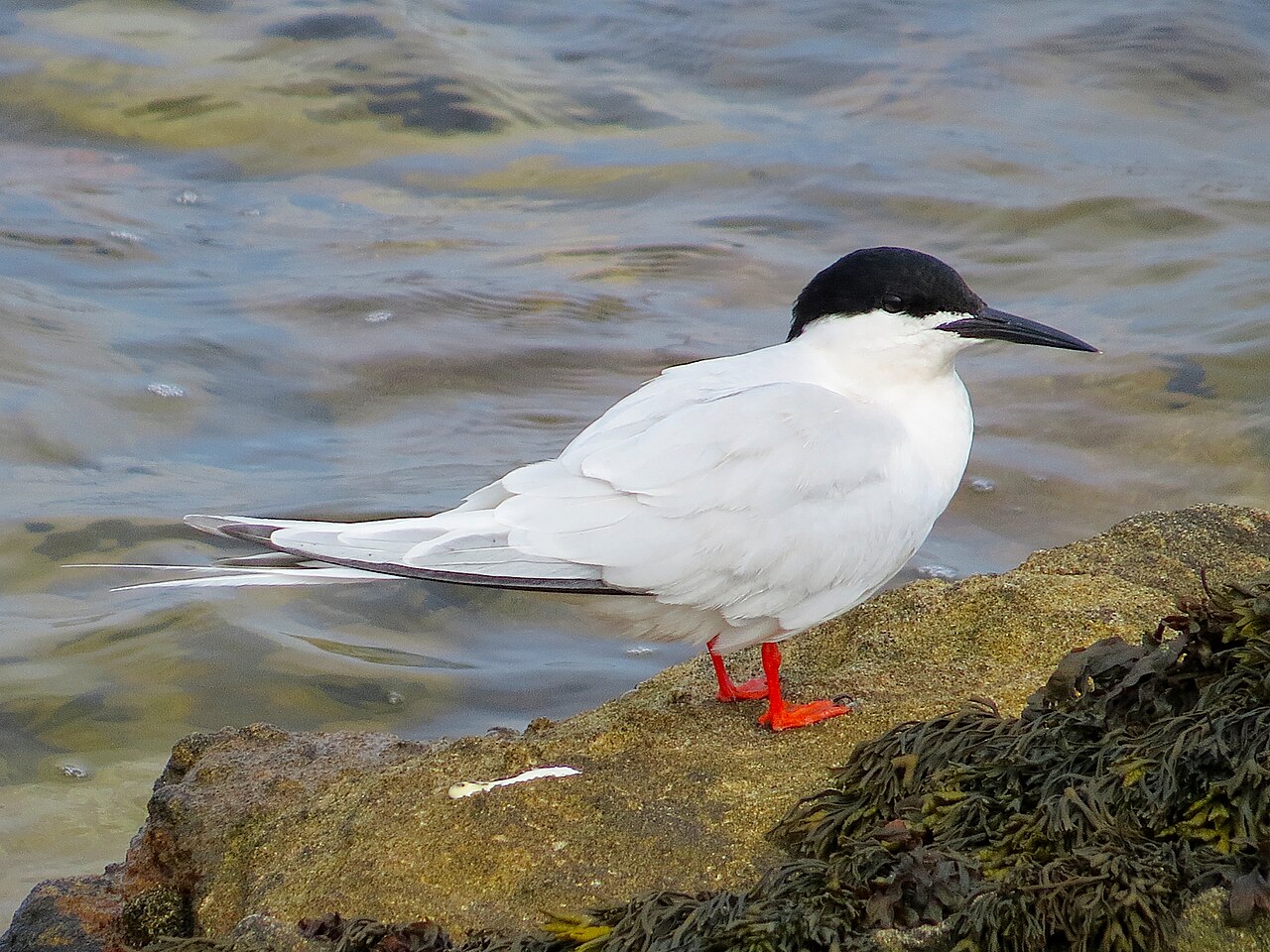
The palest and whitest tern in Europe, and also the rarest. To pick one out of a flock of Common Terns, look first for the two white tail streamers that trail like threads far beyond the wingtips, and then listen.
Click a thumbnail to switch the photo above.
Voice
Two sounds do the work. The contact call is a soft, two-syllable chu-vik with the stress at the end, close to the call of a Spotted Redshank, and it cuts straight through the racket of a mixed colony. The other is a rasping, grating aaach, shorter and harder than the scrape of a Sandwich Tern. Both carry over water at ranges where bill colour is long gone, and on a bird passing a headland the voice is often the only hard character on offer.
Recording: Doug Hynes — CC BY-SA 4.0 · xeno-canto
Identification
Common Tern sized but whiter, paler and far longer tailed. The upperwing is evenly pale grey with no dark wedge in the outer primaries; all that breaks it is a thin dark line along the leading edge of the hand. The bill is close to all black early on and takes a red base from around June, on some birds running half way to the tip. The legs are orange-red and clearly longer than an Arctic Tern's. Fresh birds carry a rose flush across the breast, visible only at close range in soft light and worn off within weeks. On a settled bird the white streamers project five to eight centimetres beyond the closed wingtip. Juveniles are coarsely scaled dark brown above with a dark forehead and black bill and legs. The length given here includes those streamers, as most field guides do; sources that measure the body alone come out some five centimetres shorter.
Confusion species
Upperwing, tail and voice carry the identification. From above Roseate is evenly pale grey: it lacks the dark wedge that spreads through a Common Tern's outer primaries as summer goes on, and it lacks the crisp narrow trailing edge of Arctic Tern, leaving only a thin dark line along the leading edge of the hand. The streamers are white and long enough to project well beyond the wingtip on a perched bird, further than on Arctic and much further than on Common, where they reach the wingtip at best. The bill is mainly black with a red base late in the season, against Common's orange-red bill with a black tip and Arctic's uniform blood-red bill. The rose flush on the breast is a supporting feature, not a reliable one: it fades fast and is not visible in hard light. In flight the bird looks shorter winged and longer bodied behind, with a faster, stiffer, shallower beat, as though flying at half amplitude, where Common and Arctic are looser and springier. When doubt remains, the call settles it. Sandwich Tern is larger and paler still but has a yellow bill tip, a shaggy crest and a quite different two-syllable screech.
Compare terns: bill, legs, head and tail side by side
Habitat
Nests on small rocky islands and shingle banks close inshore, favouring places where dense herb growth, loose stones or nest boxes give the chicks cover, so the nest itself is rarely in the open. Feeds over shallow water with a run of tide, over sandbanks and in tidal races, diving from greater height and at a steeper angle than Common Tern and staying under longer. The diet is almost entirely sandeel and young clupeids. After the breeding season birds gather on sandy beaches, groynes and piers, generally in mixed tern roosts.
Where the bird is most at home, classified with EUNIS — the European standard for habitats.




Range and movements
Rockabill, off Co. Dublin, holds by far the largest colony in Europe; Lady's Island Lake in Co. Wexford is the second, Coquet Island off Northumberland is also a regular site, and smaller numbers nest on islets off Brittany and on the Azores. Colour-ringed birds move freely between these places, so a bird at one colony is often a known individual from another. Elsewhere the species breeds in the Caribbean, along the eastern seaboard of North America and across the tropical Indian and Pacific Oceans. The European population winters on the coast of West Africa, concentrated in the Gulf of Guinea. Away from the breeding colonies it is a rare visitor across the rest of the map area, almost always between May and September and often in the company of Common Terns.
- Breeding (summer)
- Passage
- dark = core range, pale = thinly spread
How and when to look
Boat trips from Amble around Coquet Island in June and July give the easiest close views: landing is not allowed, but the birds come to the boat and the terraces are in plain sight from the water. At Rockabill and Lady's Island Lake the colonies themselves are closed, so work the post-breeding gatherings instead, from late July into September, in the tern roosts around Dublin Bay and along the Irish Sea coast. For anyone further from the colonies, autumn passage along the Cantabrian coast and Galicia between August and September is the best chance: from a headland in a northerly wind, work through every pale tern for long streamers and a bill too black for a Common Tern, with the sun behind you.
Conservation status
Not globally threatened, but the European population is so small and so concentrated that one bad season on one island shows up straight away in the total. Predation by large gulls, rats and mink, flooding of low-lying nest sites in summer storms and the overgrowing of nesting areas are the problems; on the West African wintering grounds terns are still trapped. Management on Rockabill and Coquet Island shows how quickly the species responds to nest boxes, vegetation management, wardening and the exclusion of ground predators.
Scientific name
Sterna dougallii | Montagu, 1813
Montagu described the species in 1813 and placed it straight away in the genus where it still stands. The genus Sterna was introduced in 1758 by Linnaeus. Sterna goes back to Old English stearn, which appears in the poem The Seafarer; the Frisians used a related word for terns. dougallii honours the Scottish physician and collector Peter McDougall (1777–1814), who supplied the first specimen. The specimen the first description was based on came from the Cumbraes, Scotland.