All species › Passerines › Leaf warblers › Greenish warbler
Greenish warbler | Phylloscopus trochiloides
Grauwe fitis | Mosquitero troquiloide
Greenish warbler is the leaf warbler edging into Europe from the east. It already breeds in the Baltic states, Finland and Poland, and every summer a singing male turns up somewhere in a British or Dutch coastal wood and holds a territory for weeks without ever finding a mate. It is an unassuming grey-green bird that gives itself away with a call like a Pied Wagtail in a bush.
Voice
The call is loud, sharp and clearly disyllabic — chis-weet or tslee-oo — with a second syllable that falls away, and it is so strong and so wagtail-like that in a coastal copse you look up to check whether a Pied Wagtail has gone over. That wagtail quality is the character: no other small leaf warbler in our area calls like it. The song opens with a single introductory note and then runs into a fast, high, jerky series of mostly descending elements in which short motifs are repeated a few times over; the whole thing lasts about two seconds and sounds like the call played off a reel. Singing males are tireless and keep at it from late May into July.
Recording: Jochem Verweij — CC BY-SA 4.0 · xeno-canto
Identification
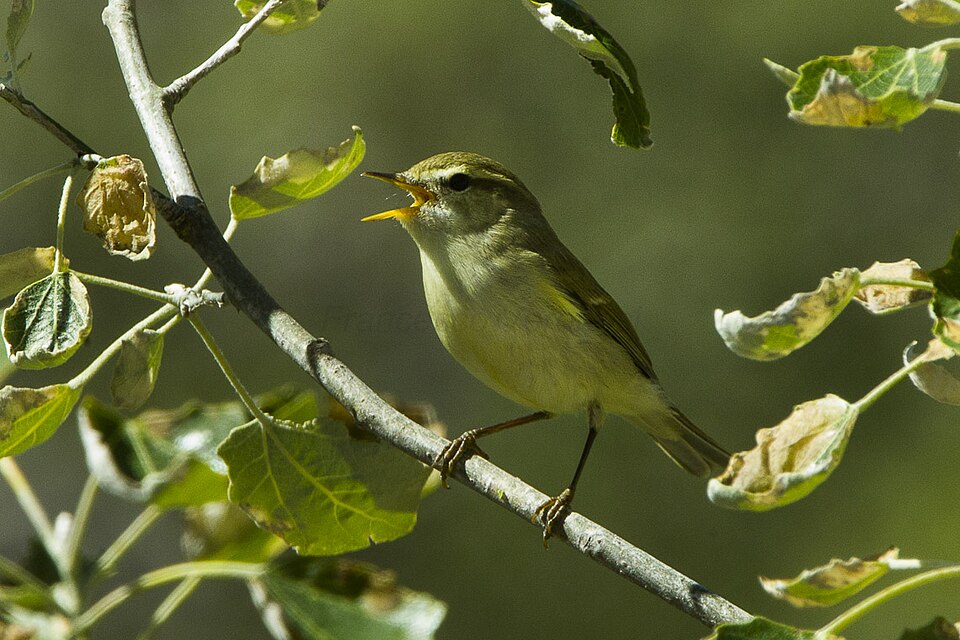
A shade larger than a Chiffchaff, slimmer and longer-winged, but smaller and finer than an Arctic warbler. Grey-green above without much sheen, silky white below with at most a dingy wash on the breast sides; almost nothing of the yellow a willow warbler shows. The head carries the key pattern: a long white supercilium, as broad in front of the eye as behind it, running right onto the base of the bill where the two sides often meet, with a crisp dark eye-stripe beneath. The wing shows a single narrow off-white bar across the tips of the greater coverts and nothing more — and on a worn autumn bird that bar can be all but rubbed away. Legs are grey to grey-brown and simply look dark in the field; the lower mandible is orange with no dark tip. Primary projection is short, a third to half the length of the tertials. It is a busy, tit-like bird that works constantly through the outer twigs.
Confusion species
Arctic warbler is the classic trap: bigger and heavier, with a stouter, deeper-based bill showing a dark tip to the lower mandible, a longer primary projection, pale orange-brown legs with yellow feet, and a supercilium that narrows in front of the eye, fails to reach the bill base and flicks upwards at the rear. Its call is a hard, dry zik, like a Dipper. Green warbler is far yellower: a yellow wash over supercilium, cheek and throat, brighter green above, a broader and yellower wing bar and often a faint second bar on the median coverts; its call is trisyllabic and rises at the end. Two-barred warbler shows two bars, the lower one long, broad and of even width along its length, and its superciliums very rarely meet above the bill. Yellow-browed warbler is smaller, with a pale crown stripe, two bold yellowish-white wing bars and broad white tertial fringes. Willow warbler and Chiffchaff have no wing bar at all, and Chiffchaff adds a short diffuse supercilium and a dipping tail. In every case the call settles it.
Habitat
Breeds in tall, damp broadleaved and mixed woodland with a dense shrub layer: birch and aspen wood, alder and willow along rivers, old spruce forest with a deciduous understorey, woodland edges, parks and large overgrown gardens. In the east of the range and in the Himalaya it climbs to the birch woods at the treeline. It feeds high in the canopy and in the outer branches, seldom low in the shrub layer. On migration in north-west Europe it lands instead in coastal copses, sea buckthorn and willow scrub close to the sea.
Where the bird is most at home, classified with EUNIS — the European standard for habitats.


Range and movements
Breeds from the Baltic states, southern Finland, Sweden, Poland and Belarus east across Russia into Siberia and south to the Himalaya and Central Asia; winters in India. The western edge of the range has shifted hundreds of kilometres over the past century and now lies inside the map area: the westernmost breeding records in Europe were on Schiermonnikoog, in 2003 and 2018. Along the North Sea coasts it is a scarce but annual visitor — a little over twenty a year in the British Isles since 2000 — with two peaks: singing males in late May and June, and migrants from mid-August to mid-September on the east coasts, with Norfolk, Northumberland, Shetland and Fair Isle taking the lion's share. In the Mediterranean it is a genuine rarity, with a few late-summer records on the Spanish east coast, among them the Columbretes and the Llobregat delta.
- Breeding (summer)
- Passage
- dark = core range, pale = thinly spread
How and when to look
Two moments. The first is the first half of June: walk a coastal wood or an old estate on the North Sea or Baltic coast and listen for a bird singing persistently with a jerky, high phrase that is emphatically not the descending sigh of a Willow warbler. Such males sing for days from the same few trees and, with patience, show well. The second is the last week of August after a few days of easterly wind, in sea buckthorn and willow scrub behind the foredune — and in September on the headlands and in the coastal marshes of the western Mediterranean: there you hunt a sound rather than a bird, and the sound is a wagtail-like chis-weet among the Chiffchaffs. Only then look for the supercilium running onto the bill and the single narrow wing bar.
Conservation status
Not threatened, with a very large and stable world population. In Europe the species has pushed its breeding range westwards since the middle of the last century, into the Baltic states, southern Finland and Poland, and that expansion is why singing males now appear on the North Sea coast each spring. Whether the westward shift continues is anyone's guess; the number of records in north-west Europe has certainly kept rising.
Scientific name
Phylloscopus trochiloides | (Sundevall, 1837)
Sundevall described the species in 1837 as Acanthiza trochiloides; because it was later moved to another genus, the author and year stand in brackets. The genus Phylloscopus was introduced in 1826 by Boie. Phylloscopus is Greek, from phullon 'leaf' and skopos 'seeker', from skopeō 'to watch': the bird that searches the foliage. trochiloides uses Greek -oides 'resembling' and means 'like trochilus', the willow warbler. The specimen the first description was based on came from Calcutta, India.