All species › Waders, gulls and terns › Plovers and lapwings › Sociable lapwing
Sociable lapwing | Vanellus gregarius
Steppekievit | Avefría sociable
A sandy-brown lapwing of the Kazakh steppe that in western Europe is almost always standing in a flock of Lapwings or Golden Plovers. Most finds are made in autumn, by an observer who kept scanning one flock a little longer than was comfortable.

Voice
Usually silent in mixed flocks, which is exactly what makes the search hard. On flushing or when uneasy it gives a harsh, short kretch or cherk, drier and flatter than the plaintive pee-wit of northern lapwing. On the breeding grounds this runs into a fast, angry rattling rek-rek-rek-rek. A single voice that does not fit the rest of a Lapwing flock is worth chasing down.
Recording: Marie-Lan Taÿ Pamart — CC BY-SA 4.0 · Wikimedia Commons
Identification
Slightly smaller and slimmer than northern lapwing, crestless, with long black legs and a short black bill. In non-breeding plumage, which is how it is nearly always seen here, the bird is sandy to greyish brown with a dirty white belly and a boldly marked head: dark crown, dark eye-stripe and between them a broad cream supercilium that meets on the forehead and again on the nape. Breeding birds have a jet-black crown, a clean white supercilium, ochre cheeks and a black belly patch shading to chestnut behind. In flight the upperwing splits into three zones: brown coverts, gleaming white secondaries and black primaries. Rump and tail are white with a black terminal band. Juveniles resemble winter adults but show pale fringes with dark subterminal lines above and a heavily streaked breast.
Confusion species
Northern lapwing is bigger and heavier, crested, broad-winged and looks pied with a green gloss, where sociable lapwing is sandy, crestless and stands taller. Golden Plover is shorter-legged, spangled gold, has a plain face and shows a uniformly white underwing without black in the primaries. The real trap is white-tailed lapwing: plain, unmarked head, yellow legs and an all-white tail with no terminal band. When in doubt work on the head pattern and the black legs, and wait for the flock to lift: the three-toned wing settles it.
Habitat
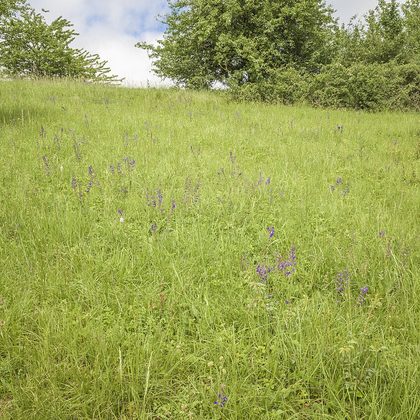
In Europe almost invariably on short dry grassland and bare arable: stubbles, ploughland, airfields, sea walls and grazed coastal marsh, always with Lapwings or Golden Plovers. In Spain, the wintering Lapwing flocks of La Mancha, Extremadura and the Guadalquivir valley are the logical place to look for it. On the breeding grounds it wants short, dry steppe with bare patches, typically near settlements and wherever livestock keeps the sward down; that grazing is not incidental to the species but a condition for it.
Where the bird is most at home, classified with EUNIS — the European standard for habitats.



Range and movements
Breeds on the steppes of Kazakhstan and adjoining southern Russia. Migration runs through south-east Turkey, Syria and Iraq to wintering grounds in Sudan, Eritrea, Israel, Arabia and north-west India, with the largest autumn concentrations at Ceylanpınar in Turkey and at Talimarzhan on the Uzbek-Turkmen border. In Britain and Ireland the species is an annual to near-annual vagrant in very small numbers, most records falling between late August and November, with a scatter of spring birds. In the Netherlands and Belgium it amounts to a few records a year to a few per decade, with a clear peak in September and October. In Spain it is a rarity assessed by the SEO/BirdLife rarities committee, with a handful of records scattered across the interior cereal plains, the Guadalquivir marismas and the Ebro delta, almost always single birds staying for weeks among Lapwing flocks.
- Breeding (summer)
- Winter
- Passage
- dark = core range, pale = thinly spread
How and when to look
From September to November work through large Lapwing and Golden Plover flocks on stubble and freshly drilled fields in north-west Europe, ideally after a spell of easterly winds; in Spain and Portugal it pays to check the big Lapwing flocks on the cereal plains and flooded dehesas from November to February, early in the day when the birds fan out to feed. Look for a bird that is sandier, crestless and stands higher on its legs; the head pattern jumps out the moment it raises its head. Stay with the flock until it flushes, because the white secondary panel against black primaries is the fastest confirmation at range.
Conservation status
Critically Endangered. Numbers fell through the twentieth century to a fraction of their former level, and the world population is counted in tens of thousands at best. Recent autumn counts of several thousand birds at Talimarzhan suggest the species is less thinly spread than long feared, but low adult survival remains the core problem. Hunting along the Middle Eastern flyway, the collapse of extensive grazing on the steppe and the ploughing of steppe grassland for cereals are the heaviest pressures.
Scientific name
Vanellus gregarius | (Pallas, 1771)
Pallas described the species in 1771 as Charadrius gregarius; because it was later moved to another genus, the author and year stand in brackets. The genus Vanellus was introduced in 1760 by Brisson. Vanellus is Latin for 'little fan', the diminutive of vannus 'winnowing fan'. gregarius is Latin for 'gregarious', from grex, gregis 'flock', after its sociability outside the breeding season. The specimen the first description was based on came from the Volga region, Russia.