All species › Passerines › Wagtails and pipits › Tawny pipit
Tawny pipit | Anthus campestris
Duinpieper | Bisbita campestre
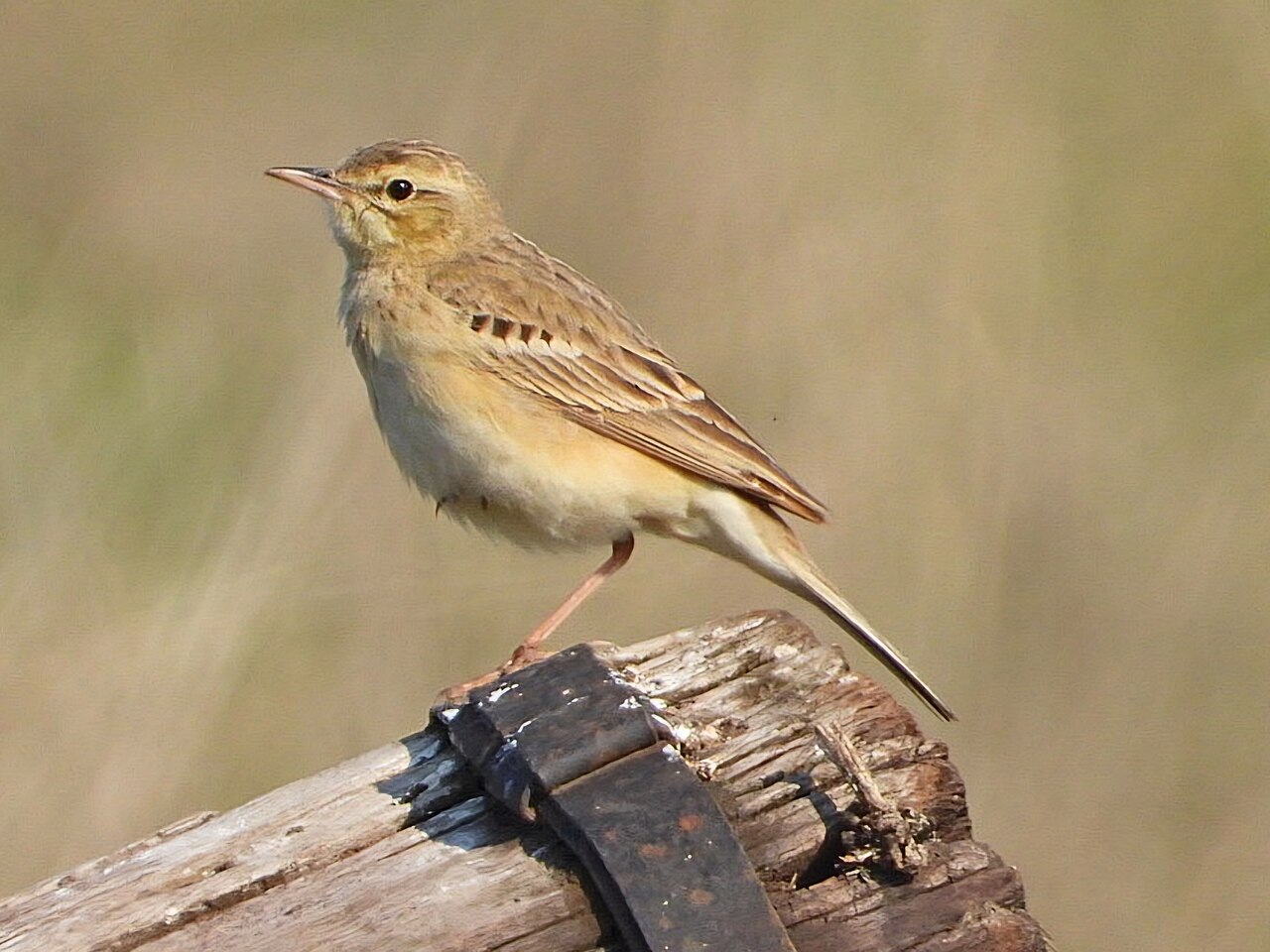
Tawny pipit is the pipit that does not look like one: big and pale sandy, with long pale legs, a clean unstreaked breast and a horizontal, wagtail-like walk across bare ground. It has never bred in Britain, and comes in a handful each autumn on the south and east coasts — but from Spain to Turkey it is one of the standard birds of hot, stony, open country.
Voice
The call is hard and sparrow-like: a short sharp tchilp or chup, usually given in flight, and a longer, more plaintive tsu-ee that recalls a yellow wagtail but is fuller and coarser. That short sparrowy note is the best character on a bird going over; it lacks the harsh grating quality of Richard's pipit and the thin high notes of meadow pipit. The song could hardly be simpler and is all the more recognisable for it: one two-syllable phrase, zree-lee … zree-lee … zree-lee, repeated slowly with long gaps, delivered in an undulating song flight in which the bird rises and falls with each phrase, or from a stone or a clod. It sings from April into June, mostly at first light and at dusk.
Recording: Sonothèque ADVL — CC0 · xeno-canto
Identification
Large for a pipit at 16–18 cm and strikingly pale: plain sandy-brown above with at most a hint of streaking, creamy to buff below and, the key point, with a completely clean, unstreaked breast. The face carries a long pale supercilium and a dark loral line running from bill to eye, which gives the bird its stern expression. The legs are long and pale pink, holding it well clear of the ground; the hindclaw is short and curved, not the long spur of Richard's pipit. The tail is long with dull white outer feathers. On the closed wing a single row of median coverts shows black centres with narrow pale fringes, forming a distinct dark bar across the wing — the best feature at range. It walks and runs in a horizontal posture, wagging its tail as it goes: more wagtail than pipit. Beware juveniles from July to September; they are streaked on the breast and mantle and lose the whole clean pale look, so fall back on the size, the long legs, the dark covert bar and the gait.
Confusion species
Short-toed lark shares the pale, clean-breasted look but is smaller and shorter-tailed, with a thick conical bill, short legs and a small dark neck patch, and it shuffles and crouches instead of striding. Richard's pipit is bigger and heavier, with a streaked breast, a much stouter bill, a very long hindclaw and a taller, upright stance, and its completely different, rasping call gives it away at once; on the Iberian Peninsula it is rare but annual, mostly in late summer and winter. Long-billed pipit of the Levant is the same size and equally plain, but heavier-billed, warmer buff below, with dull buff rather than white outer tail feathers, and it lives on stony hillsides rather than flat sand. Meadow and tree pipits are smaller, shorter-legged and always clearly streaked below; the confusion only runs the other way, through a streaky juvenile tawny pipit. On such a bird the dark bar of median coverts is often all that is left to go on.
Habitat
Flat, hot, bare, dry ground with plenty of open soil and only low, thin vegetation: drifting sand, cut heath, dry dune slacks, stony steppe and plateaux, vineyards and fallow, burnt slopes, gravel flats along dry riverbeds, sand pits and even airfields. The ground has to be warm and broken by bare patches; once grass and scrub close over, the bird is gone. The nest is a scrape on the ground, tucked against a tussock, a stone or the lip of a hollow.
Where the bird is most at home, classified with EUNIS — the European standard for habitats.




Range and movements
Breeds from Iberia, north-west Africa and the Canary Islands right across southern and central Europe, the Balkans and Turkey deep into central Asia; every bird winters in the Sahel and the African savannas. Within the map area it is a widespread breeder, with strongholds in Spain — both plateaus, the Ebro valley, Extremadura, Andalusia and the steppe country of the interior, at high densities in La Mancha, Los Monegros and the plains of Castile — and further in southern France, Italy, the Balkans, Turkey and the Maghreb. At the northern edge of that range it has vanished: the Netherlands, Belgium, Denmark and much of northern Germany and Poland have lost their last pairs. In the Netherlands it bred until the 1990s on the Veluwe, in Drenthe and on the sandy soils of North Brabant; numbers fell from several hundred pairs around 1970 to zero, and it has been extinct as a breeding bird there since the start of this century. What passes through now in north-western Europe is a scarce annual migrant, chiefly in the last week of August and the first half of September along the North Sea coast and the British Isles, with the odd bird in May.
- Resident
- Breeding (summer)
- Winter
- Passage
- dark = core range, pale = thinly spread
How and when to look
In May or June, park on a track across a Spanish or Turkish plateau and simply wait: the song flight, with its slow two-note phrase, is over the ground before you find the bird, and afterwards you will watch it striding from clod to clod. In August and September look for it in Spain on stubble fields, freshly ploughed fallow and field margins, often alongside wheatears and short-toed larks. In north-western Europe the same weeks are the window, on short turf and bare ground behind a south-coast beach, a Scilly airfield or a Wadden island. Ignore the colour and check three things: the clean breast, the dark bar across the wing coverts, and the long-legged, wagtail-like walk.
Conservation status
Not globally threatened (LC), with a vast range and a population in the millions, but in north-west Europe the species has been erased. The Netherlands, Belgium, Denmark and much of Germany and Poland have lost their breeding birds within a generation. The causes are the same everywhere: drifting sand and open heath grown over through nitrogen deposition, bare ground planted or sown, and the collapse of insect numbers on poor sandy soils. Numbers are falling in southern Europe too, where dry pasture and fallow are turned over to irrigated crops or close over once sheep grazing stops. In Turkey and the Maghreb, which hold most of the European population, it remains widespread and numerous.
Scientific name
Anthus campestris | (Linnaeus, 1758)
Linnaeus described the species in 1758 as Alauda campestris; because it was later moved to another genus, the author and year stand in brackets. The genus Anthus was introduced in 1805 by Bechstein. Anthus is the Latin word for a small bird of grasslands mentioned by Pliny the Elder. campestris is Latin for 'of the fields', from campus 'field, plain'. The specimen the first description was based on came from Sweden.