All species › Passerines › Swallows and martins › Barn swallow
Barn swallow | Hirundo rustica
Boerenzwaluw | Golondrina común
The swallow of the byre and the farmyard, with a deeply forked tail and a rusty-red face. It returns in late March or April.

Voice
A busy twittering song of squeaky and chirping notes, always rounded off with a grating rattling tsrrrr, delivered from a wire or from inside the barn between April and August. The flight call is a cheerful vit-vit; a passing cat or Sparrowhawk brings a sharp, persistent alarm.
Recording: Jonathon Jongsma — CC BY-SA 3.0 · Wikimedia Commons
Identification
Slim, with long pointed wings and very long outer tail feathers forming a deep fork, showing a row of white spots the moment the tail is spread. Upperparts glossy steel-blue, forehead and throat rusty red, with a complete blue breast band and creamy underparts. Males have longer streamers; juveniles are short-tailed and dull.
Confusion species
House Martin has a conspicuous white rump, a short forked tail and pure white underparts, and flies higher on flickering wings. Sand Martin is small and brown, with a brown breast band, short tail and fluttering flight low over water. Swift is bigger, wholly dark, scythe-winged and shows no white at all.
Habitat
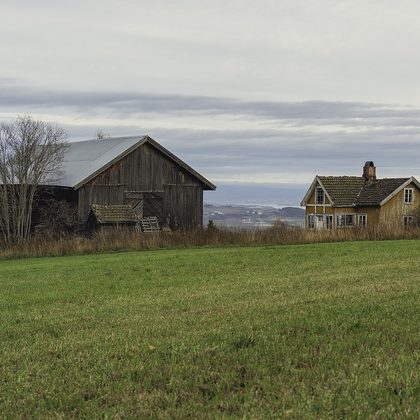
Farmyards, cattle sheds, barns and village edges with livestock, dung and muddy puddles, surrounded by grassland, ditches and fields full of flying insects. It nests on a beam or wall ledge indoors, and so depends on doors and hatches being left open.
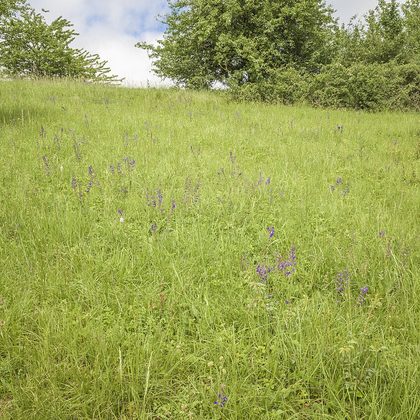
Where the bird is most at home, classified with EUNIS — the European standard for habitats.


Range and movements
Breeds throughout Europe, and its migration is a textbook case of leapfrog: the further north the nest, the further south the winter quarters. Birds from the British Isles, the Low Countries and central Europe winter in West Africa, the northernmost reaching South Africa; central and eastern European birds spread across a broad band from West Africa through the Congo to Zambia, and southern European birds stop in Nigeria and the Central African Republic. In north-west and central Europe common in farmland, especially around dairy farms and riding stables; around the Mediterranean common in villages and on cortijos, with a few wintering in southern Iberia; in North Africa and the Levant also present all year. Southbound movement begins in September, the Sahara is crossed in early October, and the first birds are back in Iberia in early March and in Italy at the end of March. On the way they roost in reedbeds in their thousands.
- Resident
- Breeding (summer)
- Winter
- Passage
- dark = core range, pale = thinly spread
How and when to look
In April and May work a dairy farm or riding stable and watch low over the pasture and along ditch banks; in cool, damp weather they hunt just above the grass. In August thousands gather at dusk in reedbeds.
Conservation status
Declining in the long term as stock is kept indoors year-round, as modern barns are sealed and smooth-walled, as insect numbers fall with intensive land use and as muddy puddles for nest material dry up. Drought in the Sahel and along the flyway plays a part too. Open barn doors, mud patches and artificial nest cups help immediately.
Scientific name
Hirundo rustica | Linnaeus, 1758
Linnaeus described the species in 1758 and placed it straight away in the genus where it still stands. He introduced the genus Hirundo in that same work. Hirundo is the ordinary Latin word for 'swallow'. rustica is Latin for 'of the countryside', after the farms and barns in which the bird nests. The specimen the first description was based on came from Sweden.