All species › Waterfowl › Ducks, geese and swans › Common goldeneye
Common goldeneye | Bucephala clangula
Brilduiker | Porrón osculado
A compact, big-headed diving duck that jumps clear of the water before submerging and rarely stays up for long. In winter light the male's white cheek spot glows like a lamp on dark water.

Click a thumbnail to switch the photo above.
Voice
Largely silent, but the wings produce a loud, high, singing whistle in flight that identifies the species without a view. In display the male gives a sharp, nasal zee-zeek while throwing its head right back onto its mantle. The female purrs low, grrr. Display starts in January.
Recording: Pascal Christe — CC BY-SA 4.0 · Wikimedia Commons
Identification
Stocky duck with a large triangular head, short neck and short dark bill. The male is white with a black back, a green-glossed black head and a round white loral spot. The female has a chocolate-brown head, grey body and a narrow white neck collar, with a yellow to wholly dark bill tip. Both sexes have a yellow iris and a large white wing panel.
Confusion species
Long-tailed duck and Smew are whiter and differently shaped, Smew being smaller with a serrated bill. The likeliest confusion is female Goldeneye with female red-breasted merganser, but that species is longer, redder-headed and has a thin red hook-tipped bill. Head shape and the short, high-crowned silhouette settle Goldeneye.
Habitat
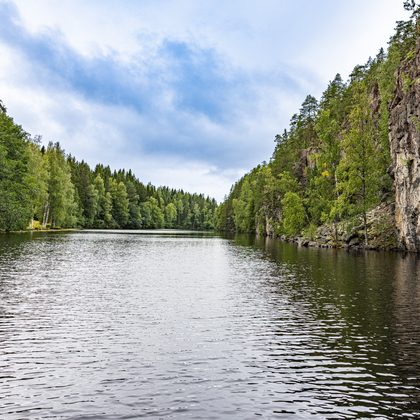
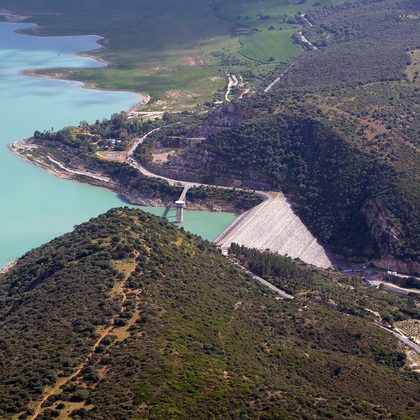
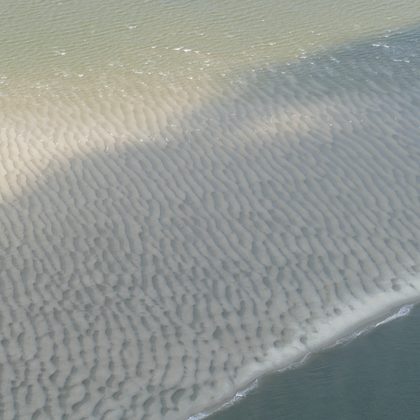
Winters on large deep waters: lakes, reservoirs, gravel pits, rivers, harbours and sheltered estuaries. Breeds in tree holes, usually old black woodpecker cavities, in boreal forest beside lakes and rivers, and readily uses nest boxes. Dives for crustaceans, insect larvae and bivalves, usually in small scattered parties.
Where the bird is most at home, classified with EUNIS — the European standard for habitats.

Range and movements
Breeds across the boreal forest belt from Fennoscandia east through Russia, with a small central European population. Winters in north-west Europe on large lakes, rivers and deltas, and sparsely in the Mediterranean, mainly on reservoirs and along the Atlantic coast of northern Iberia.
- Resident
- Breeding (summer)
- Winter
- Passage
- dark = core range, pale = thinly spread
How and when to look
Take a dyke along a large lake or reservoir in January or February and scope carefully, since Goldeneye usually sit well out. Wait for display, when males snap the head back onto the mantle and kick up a spray of water. Early light from behind you works best.
Conservation status
Not globally threatened and helped in parts of Fennoscandia by nest-box schemes. Loss of old cavity trees in production forest limits breeding sites, and acidification of boreal lakes reduces prey. Dutch winter numbers are falling as milder winters allow birds to remain further north and east.
Scientific name
Bucephala clangula | (Linnaeus, 1758)
Linnaeus described the species in 1758 as Anas clangula; because it was later moved to another genus, the author and year stand in brackets. The genus Bucephala was introduced in 1858 by Baird. Bucephala is Greek, from boukephalos 'bull-headed', from bous 'bull' and kephalē 'head', after the strikingly bulbous head. clangula derives from Latin clangere 'to resound', after the sound the bird makes. The specimen the first description was based on came from Sweden.