All species › Pelicans, herons and ibises › Herons and bitterns › Eurasian bittern
Eurasian bittern | Botaurus stellaris
Roerdomp | Avetoro común
The Bittern is a bulky, cryptically patterned heron of extensive reedbeds. It is hard to see; its booming call carries for kilometres on still evenings.

Voice
The male's boom is unique: a deep, resonant oomp, usually in series of three to five, preceded by soft gasping intakes of breath. In good conditions it carries three to five kilometres. Mainly at dusk and at night, February to June. Flight call: a short, harsh kau.
Recording: Miro Demko — CC BY-SA 3.0 · Wikimedia Commons
Identification
Heavily built heron, ochre to warm brown, densely marked with blackish streaks and blotches. Black crown and black moustachial stripe. When disturbed it adopts the bittern stance: neck stretched, bill pointing straight up, swaying with the reeds. In flight an owl-like silhouette: broad rounded wings, retracted neck and trailing legs.
Confusion species
Little bittern is far smaller and more contrasting. Juvenile Night Herons are smaller, colder brown and more finely spotted. In poor light a flying Bittern can suggest a tawny owl, but the projecting legs give it away.
Habitat
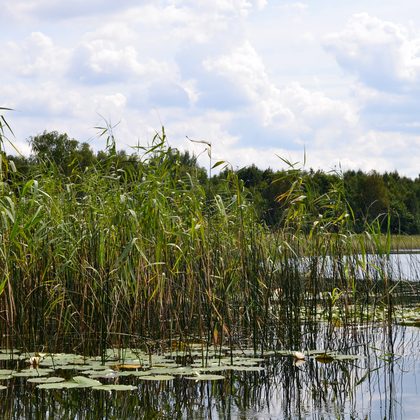
Large wet reedbeds with standing old reed, shallow fish-rich water and a long edge between reed and open water. Also reed fringes along turf ponds and storage basins, provided the area and water depth are sufficient.
Where the bird is most at home, classified with EUNIS — the European standard for habitats.


Range and movements
Scattered across Europe and Asia. Dutch strongholds are the Oostvaardersplassen, Weerribben-Wieden, Nieuwkoopse Plassen, Lauwersmeer and Zouweboezem. Severe winters can temporarily knock numbers back hard. In Spain it breeds in only a handful of wetlands, such as the Ebro delta, the Albufera and the Guadalquivir marshes.
- Resident
- Breeding (summer)
- Winter
- Passage
- dark = core range, pale = thinly spread
How and when to look
From late February to April, stand at the edge of a large reedbed on a windless evening and listen downwind. Views usually come by chance: a bird flying low at sunset, or one hunting closer to open water during a freeze.
Conservation status
Not globally threatened (IUCN: Least Concern), but in north-west Europe dependent on active wetland management. Drying out, scrub encroachment in reed and the loss of gradual shore zones are the main problems; the species is a target species for many Natura 2000 sites.
Scientific name
Botaurus stellaris | (Linnaeus, 1758)
Linnaeus described the species in 1758 as Ardea stellaris; because it was later moved to another genus, the author and year stand in brackets. The genus Botaurus was introduced in 1819 by Stephens. Botaurus is Medieval Latin for a bittern; the word combines Latin bos 'ox' with taurus 'bull', after the booming call (compare butire 'to boom'). stellaris is Latin for 'starred', from stella 'star', referring to the speckled plumage. The specimen the first description was based on came from Sweden.