All species › Waders, gulls and terns › Gulls and terns › Mediterranean gull
Mediterranean gull | Ichthyaetus melanocephalus
Zwartkopmeeuw | Gaviota cabecinegra
The mediterranean gull is a slim, long-legged gull that has gone from a Mediterranean rarity to a regular Dutch breeder in a few decades. Its wailing call over a black-headed gull colony is usually the first clue.
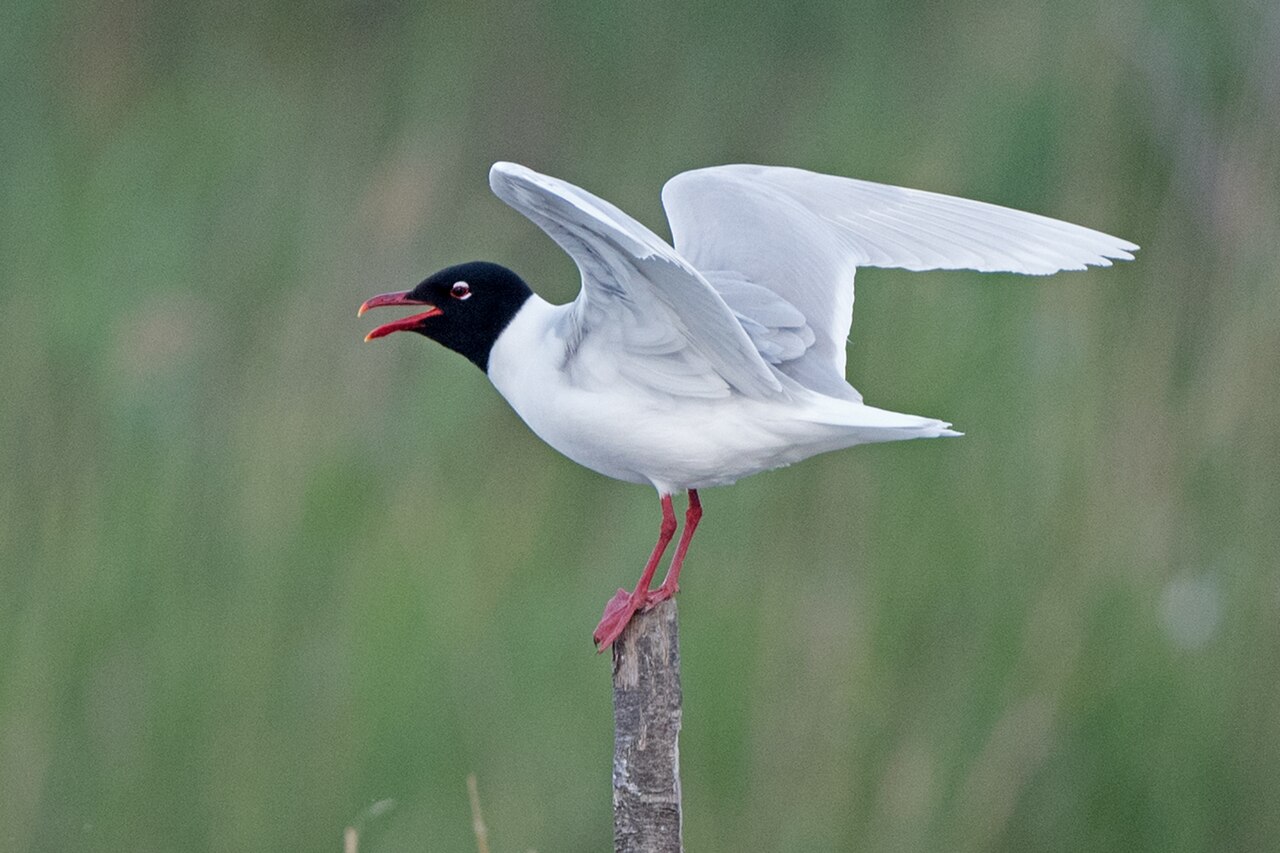
Click a thumbnail to switch the photo above.
Voice
Unmistakable and the best field mark at range: a plaintive, rising, nasal kyow or eh-yeah, suggesting a whining child or a mewing cat. It calls chiefly in flight over colonies and feeding areas from March to July, and so regularly betrays single birds among hundreds of black-headed gulls.
Recording: Noé Ferrari — CC BY 4.0 · xeno-canto
Identification
Summer adults have a deep black hood reaching the nape, broad white eyelid crescents, a heavy, drooping coral-red bill with a black band and yellow tip, and dark red legs. The mantle is pale silvery grey, paler than black-headed gull, and the wingtip wholly white. Winter adults show a dark mask; first-years a dark grey mantle, blackish outer wing and black tail band, second-years some black in the tip.
Confusion species
Black-headed gull is the real stumbling block: smaller, with a brown rather than black hood that leaves the nape white, a slimmer dark red bill and a white wedge in the outer wing with a black trailing edge. First-year mediterranean gulls recall first-year common gull, but show a darker mask, scaly scapular pattern, a paler inner-primary window and a straighter, thicker bill.
Habitat
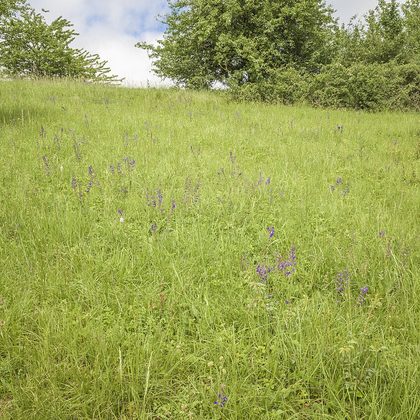
Breeds on islets, reclaimed ground, sand flats and saltmarsh, almost always within black-headed gull colonies. Feeds much on land: grassland, arable and freshly ploughed fields, taking insects, leatherjackets and earthworms. Outside the breeding season it uses beaches, harbours, estuaries and saltpans, often loafing with other small gulls.
Where the bird is most at home, classified with EUNIS — the European standard for habitats.




Range and movements
Originally a Black Sea species, it has spread strongly north-west since the 1970s. The Netherlands now holds colonies in the Delta, along the large rivers and on the Wadden islands. In Spain it breeds in the Ebro delta and southern saltpans and winters in numbers along both the Mediterranean and Atlantic coasts.
- Resident
- Breeding (summer)
- Winter
- Passage
- dark = core range, pale = thinly spread
How and when to look
Visit a black-headed gull colony in the Delta or along the rivers in April or May and use your ears before your eyes. Also walk arable land in March where gulls follow the plough: adults then stand out by their pale mantle and pure white wingtips even among hundreds of commoner birds.
Conservation status
It has increased substantially in Europe and expanded westwards; Dutch numbers grew strongly but are locally under pressure. Predation by foxes and large gulls, rank vegetation on breeding islands, flooding of low-lying colonies and disturbance are the main problems. Avian influenza has recently caused considerable mortality in several western European colonies.
Scientific name
Ichthyaetus melanocephalus | (Temminck, 1820)
Temminck described the species in 1820 as Larus melanocephalus; because it was later moved to another genus, the author and year stand in brackets. The genus Ichthyaetus was introduced in 1829 by Kaup. Ichthyaetus is Greek, from ikhthus 'fish' and aetos 'eagle', hence 'fish eagle'. melanocephalus is Greek, from melas 'black' and -kephalos '-headed', for the black hood of the breeding plumage. The specimen the first description was based on came from the Adriatic coast.