All species › Waders, gulls and terns › Plovers and lapwings › Northern lapwing
Northern lapwing | Vanellus vanellus
Kievit | Avefría europea
In the Low Countries the Lapwing begins its tumbling display flight over wet grassland early in spring. Seen close, its black turns out to shine green and purple.

Click a thumbnail to switch the photo above.
Voice
A nasal, plaintive pee-wit, which gives the bird its English name. In display it becomes a drawn-out, swooping kee-oo weet-weet, backed by the throbbing hum of the wings. Mostly March to May; winter flocks are largely silent.
Recording: Horsto — CC BY-SA 4.0 · Wikimedia Commons
Identification
Medium-sized plover with a thin upswept crest, broad rounded wings and a black-and-white effect that resolves into green and purple gloss at close range. Orange-buff undertail coverts and short reddish legs. Flight is a floppy, flickering flap. Males show a longer crest and black throat; winter birds have a white throat and buff-fringed feathers.
Confusion species
Distant flocks in flight recall Golden Plover, with which they often mix; Golden Plovers have pointed wings, faster beats and look golden rather than pied. On the ground the rare Sociable and white-tailed lapwings are the trap: sandy brown, crestless and with a pale supercilium.
Habitat
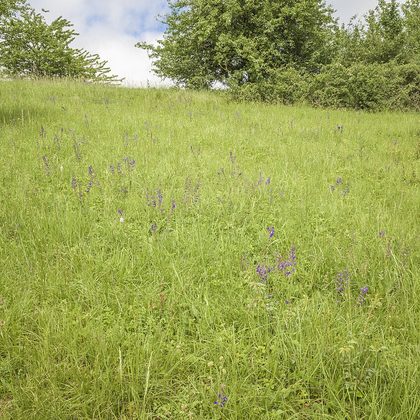
Open, short and damp grassland, spring-tilled arable fields, saltmarsh and drained mud, always with a clear horizon. In winter on ploughland, stubble and flooded meadows, and in the south of the map area also on flooded dehesa, rice fields and irrigated farmland, often in mixed flocks with Golden Plovers and black-headed gulls.
Where the bird is most at home, classified with EUNIS — the European standard for habitats.



Range and movements
Breeds from Ireland east into Russia, with the Dutch farmed countryside a stronghold, and a scarce, localised breeding population also in northern and inland Spain. Hard frost sends flocks streaming to France and Iberia, where flooded dehesa, rice fields and arable land in Extremadura, La Mancha and the Guadalquivir basin take the wintering birds.
- Resident
- Breeding (summer)
- Winter
- Passage
- dark = core range, pale = thinly spread
How and when to look
In Spain, from December to February, walk the cereal plains and flooded dehesa early in the morning, when the flocks get up to feed. For the display flight head to the Dutch farmland or northern Spain: March, early morning, along a wet polder road, with males tumbling and swooping low on humming wings. In December a sharp frost sets off big cold-weather movements to the south-west, worth watching from any open vantage point.
Conservation status
Near Threatened globally and one of the fastest declining meadow birds in the Netherlands. Earlier mowing, drainage, conversion of grassland to maize and heavy predation destroy clutches and chicks; wet, herb-rich fields with delayed mowing offer the best prospects.
Scientific name
Vanellus vanellus | (Linnaeus, 1758)
Linnaeus described the species in 1758 as Tringa vanellus; because it was later moved to another genus, the author and year stand in brackets. The genus Vanellus was introduced in 1760 by Brisson. Vanellus is Latin for 'little fan', the diminutive of vannus 'winnowing fan'. The specific name repeats the genus name. The specimen the first description was based on came from Sweden.