All species › Waders, gulls and terns › Auks › Razorbill
Razorbill | Alca torda
Alk | Alca común
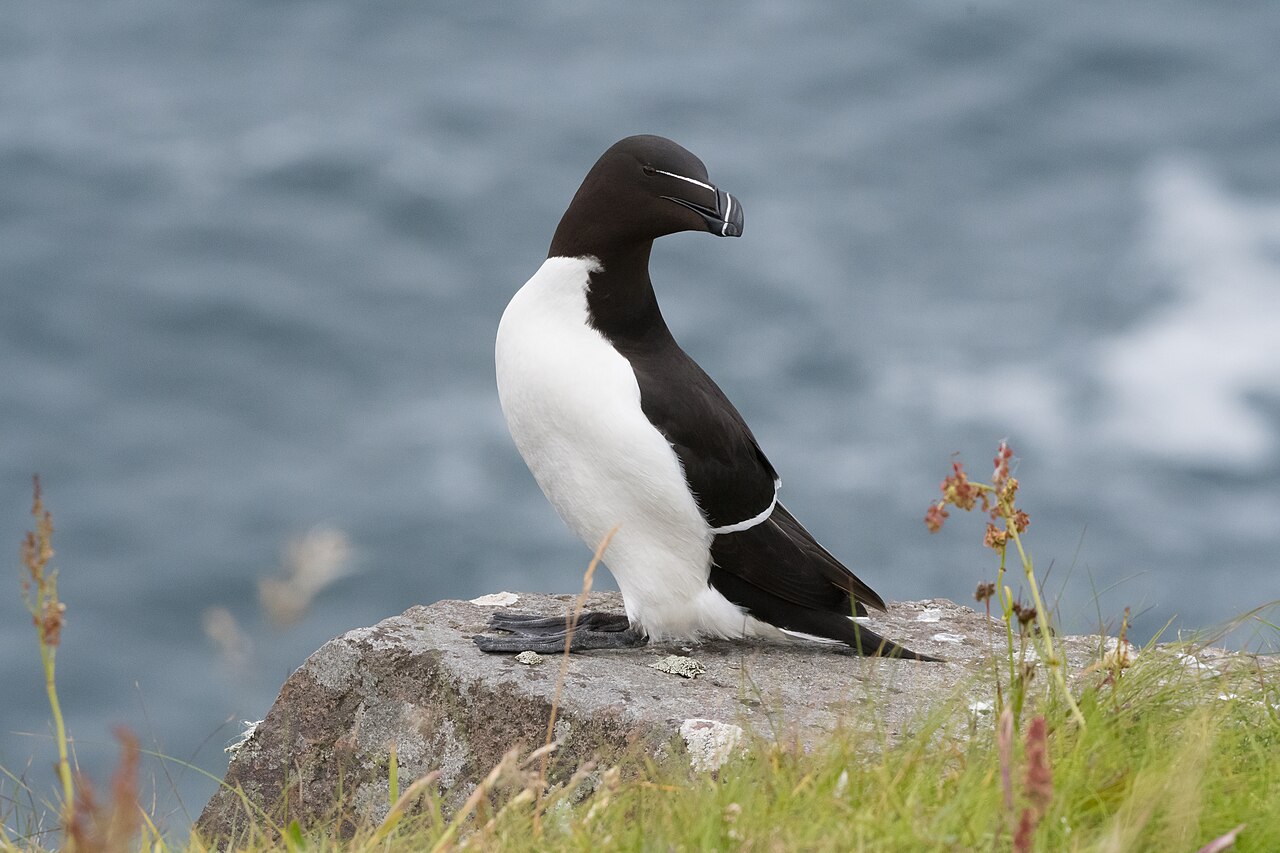
The Razorbill is the blackest and heaviest-billed auk of the North Sea, a bird of open water that only comes within reach of the coast outside the breeding season. See one alongside a Guillemot once and head shape alone will separate them from then on.
Click a thumbnail to switch the photo above.
Voice
Almost always silent at sea. At the colony a low, grating growl, orrrr or arr-arr, rising out of rock crevices and from under boulders and swelling into a gurgling background murmur when dozens call at once. Audible from April to July at cliffs in Scotland, Norway and Iceland; in Dutch waters the bird stays mute.
Recording: British Library — CC BY-SA 4.0 · Wikimedia Commons
Identification
Upperparts jet black, clearly darker than the chocolate-brown of a Guillemot, with a deep, laterally flattened bill that ends bluntly. In summer a white vertical band crosses the bill and a thin white line runs from the bill base to the eye. The tail is long and pointed and often cocked on the water; in flight it projects beyond the feet, whereas in Guillemot the feet project beyond the tail. In winter throat and cheek turn white to behind the eye, without any dark cheek stripe. In flight: fast whirring beats low over the sea, a white trailing edge to the inner wing, a white flank patch and a white underwing. First-years have a smaller bill without the white band.
Confusion species
Common Guillemot is the standing confusion species: browner, slimmer, with a pointed dagger bill and, in winter, a dark line running back across the white cheek. Atlantic puffin in winter shows a grey face, a short deep bill and above all a dark underwing, where Razorbill and Guillemot flash white. Little Auk is barely half the size, with a tiny bill and a blunt, bull-necked head. Brünnich's Guillemot, a rarity, is bulkier than Common Guillemot and shows a pale stripe along the base of the bill.
Habitat
Outside the breeding season wholly marine, over the shallow continental shelf where it dives for sandeels, herring and sprat. Breeds in rock crevices, under boulders and on sheltered ledges, not on the open ledges where Guillemots stand shoulder to shoulder. Wintering birds come close inshore during spells of persistent west to north-west wind.
Where the bird is most at home, classified with EUNIS — the European standard for habitats.


Range and movements
Breeds in Iceland, the Faroes, Norway, the British Isles and the western Baltic. No breeding pairs further south, but from October to March Razorbills are regular on the North Sea, turning up on seawatches and in beached-bird surveys. Further south it winters in the Bay of Biscay and along the Cantabrian and Galician coasts, in smaller numbers into the Mediterranean.
- Resident
- Breeding (summer)
- Winter
- Passage
- dark = core range, pale = thinly spread
How and when to look
Seawatch in a firm north-westerly gale between November and February, from a headland, breakwater or pier on the North Sea or the Atlantic coast, and count the first hour after sunrise: Razorbills pass low in small loose parties on fast beats. A ferry crossing of the North Sea or the Bay of Biscay in calm weather gives far better views, letting you compare head and bill with Guillemots sitting on the water. In every party, watch for birds flying higher and more directly than Guillemots and for the white flank patch flashing as they bank.
Conservation status
Not threatened; European numbers have grown in recent decades in Britain, Iceland and Scandinavia. Bycatch in gillnets, oil pollution and the collapse of sandeel stocks remain the main risks, and in some winters prolonged storms wreck large numbers of exhausted birds onto beaches. Avian influenza in 2022 mainly struck other seabirds, but caused local Razorbill mortality too.
Scientific name
Alca torda | Linnaeus, 1758
Linnaeus described the species in 1758 and placed it straight away in the genus where it still stands. He introduced the genus Alca in that same work. Alca comes from Norwegian alke, the name of this bird. torda goes back to törd, a Gotland Swedish dialect word for the same bird. The specimen the first description was based on came from southern Sweden.