All species › Waterfowl › Ducks, geese and swans › Black scoter
Black scoter | Melanitta americana
Amerikaanse zee-eend | Negrón americano
Treated on most lists as a species separate from common scoter since around 2010, on the strength of the bill pattern and above all the voice. In Europe it amounts to a handful of drakes, some of which turn up in the same stretch of coast for years on end. Identification comes down to one thing: how much yellow is on the bill, and exactly where.
Click a thumbnail to switch the photo above.
Voice
The common scoter group is the one scoter group that genuinely calls at sea, and here that pays off. The drake gives a clear, far-carrying whistle. On common scoter it is a short, muffled pyoo; on black scoter the note is held far longer, slightly quavering and mournful, more of a koo-lee that seems to run on for seconds. That difference in length is reliable and has produced several British birds: heard first in a whistling raft, then picked out with a scope. Away from the March to May display period both are largely silent.
No freely licensed recording is available for this species yet.
Identification
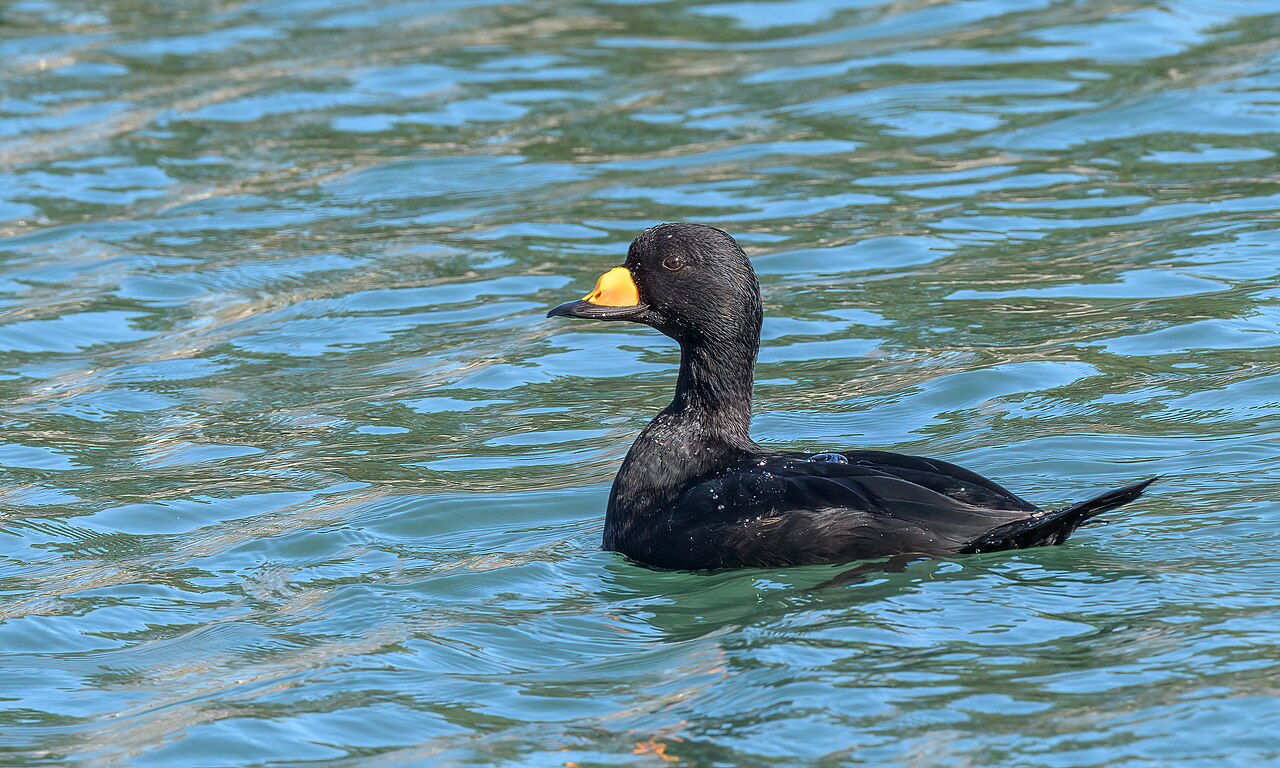
Identical to common scoter in size and build: a compact, wholly dark scoter with a pointed tail and no white in the wing. Adult drake: glossy black, with the entire swollen bill base bright yellow to orange, as though a large yellow blob had been pressed onto the bill; the yellow reaches back to the feathering and wraps over the top and sides of the swelling, with the rest of the bill black. The female is dark brown with pale cheek and throat cut sharply against a dark cap and a grey bill, exactly as in common scoter. First-winter males show almost no yellow and acquire it through their second calendar year.
Confusion species
Everything turns on common scoter. On a drake Common the knob at the bill base is black and the yellow is confined to a narrow strip along the culmen around and behind the nostrils; on black scoter the whole swelling is yellow or orange, wrapping over the sides, which makes the bill base look fuller and more bulbous. Black scoter also averages a rounder head, with a steeper forehead and a fuller nape, but those differences overlap and never carry an identification on their own. Adult drakes are workable, even at range, as long as the bird holds its head side-on. Second calendar-year males are unreliable: a half-yellow, half-dark bill panel fits a young common scoter just as well. Females and first-years cannot be separated in the field and are left unidentified; no proposed character stands up.
Habitat
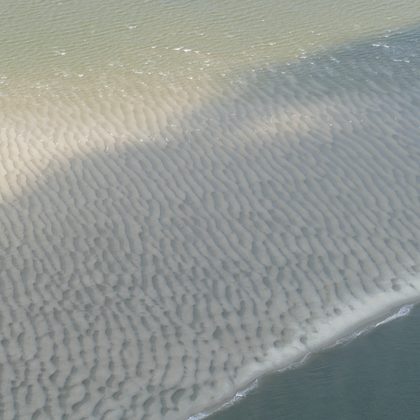
Shallow coastal seas over shellfish banks, always inside rafts of common scoter and so usually within a few kilometres of the shore. Also in tide races at inlets and off pier heads. Breeds beside lakes and tundra pools in Alaska and eastern Siberia; in Europe you will only ever see it at sea.
Where the bird is most at home, classified with EUNIS — the European standard for habitats.

Range and movements
Breeds in Alaska, north-east Siberia and eastern Canada and winters on both American coasts. Inside the map area a genuine rarity, centred on the British Isles, since 1987 and heavily weighted to Scotland; most records involve drakes returning to the same stretch of coast year after year — Llanfairfechan in Wales, Blackdog and Murcar on the Aberdeenshire coast, Lunan Bay, the Northumberland coast. On the North Sea coast of the Low Countries a handful of records between October and December, among them the first for Europe, from 1954 onwards, and since 2021 another returning drake; on the Cantabrian and Galician coasts a few records between October and March.
How and when to look
Take a headland or a pier where big moulting rafts of common scoter gather in late summer and autumn, and grind through them with a scope in flat calm. Do not look for black, look for yellow: every drake that turns its head gives you a fraction of a second on the bill base. On a windless evening in March or April it pays to listen first, and a whistle that plainly outlasts the rest of the chorus is the cue to comb that corner of the raft.
Conservation status
Assessed as Near Threatened. Numbers in Alaska and eastern Canada have fallen steeply within a few decades and the causes are not well understood. Gillnet bycatch, oil pollution, hunting along the flyways and changes in the shellfish banks have all been proposed. Because the birds concentrate in dense rafts at a limited number of sites, any single incident registers immediately in the totals.
Scientific name
Melanitta americana | (Swainson, 1832)
Swainson described the species in 1832 as Oidemia americana; because it was later moved to another genus, the author and year stand in brackets. The genus Melanitta was introduced in 1822 by Boie. Melanitta is Greek, from melas 'black' and netta 'duck'. americana is Latin for 'American', after the breeding range in North America and eastern Siberia. The specimen the first description was based on came from Hudson Bay.