All species › Kingfishers, bee-eaters and rollers › Bee-eaters › Blue-cheeked bee-eater
Blue-cheeked bee-eater | Merops persicus
Groene bijeneter | Abejaruco persa
A bee-eater that is mainly green: grass-green instead of chestnut and gold, with longer tail streamers and a coppery underwing. It belongs to hot dry country wherever there is water — river banks, irrigation canals and reed fringes in the middle of semi-desert.
Voice
A rolling prreep or dirrip, repeated in series and carrying far, but drier, shriller and more clearly two-syllabled than the liquid prruip of European bee-eater. Flocks call almost continuously while hunting; at the colony there is a hard rattling chatter as well.
No freely licensed recording is available for this species yet.
Identification
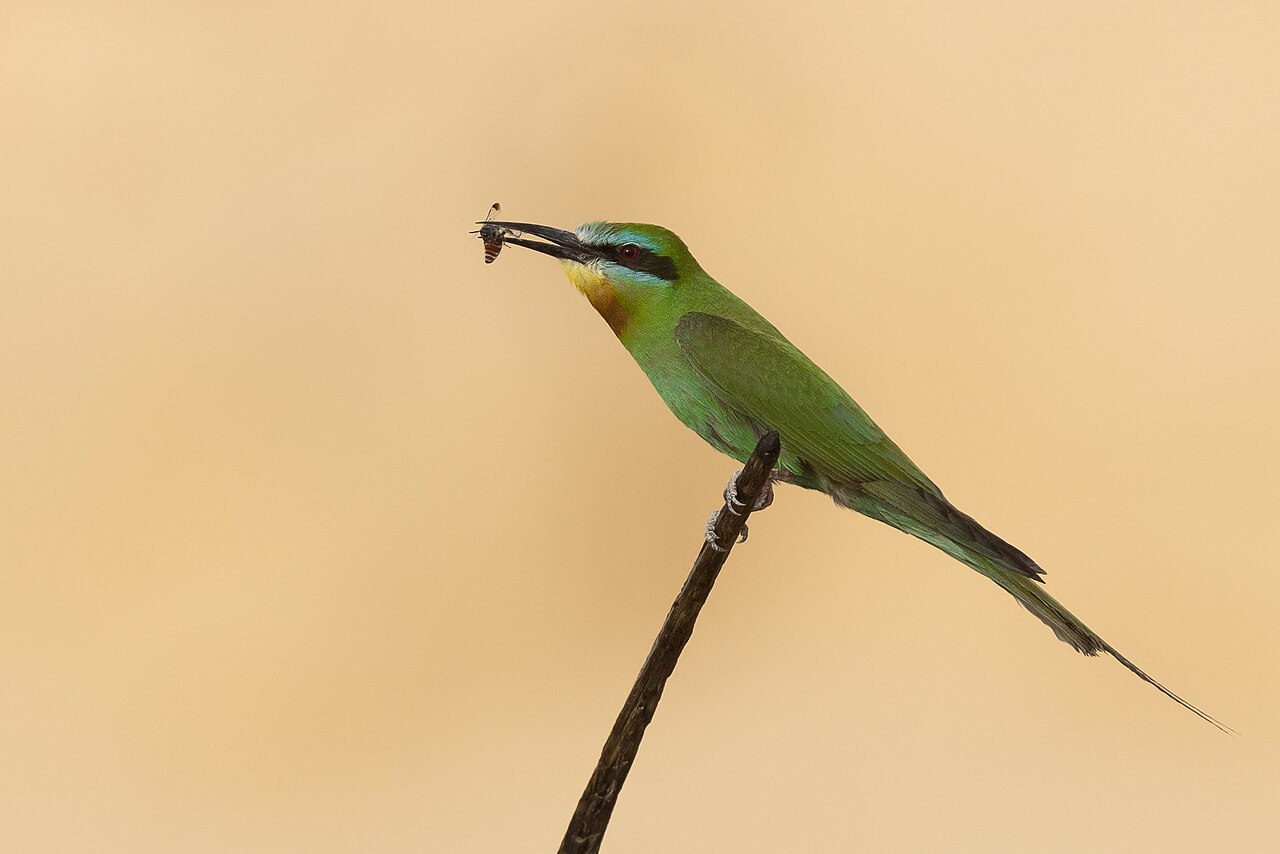
Slim, long-winged and long-tailed, with a long, fine, slightly decurved black bill. The length given here, 27 to 31 cm, includes the greatly elongated central tail feathers, which account for six to eight centimetres on their own; without them the bird is barely larger than a European bee-eater. The plumage is mainly grass-green, with a blue-green cheek patch below a narrow black eye-stripe, a pale yellow chin and a rusty throat. In flight the underwing glows warm copper; juveniles are duller and lack the streamers.
Confusion species
European bee-eater is the only real pitfall, and at reasonable range the difference is obvious: that bird has a chestnut crown and mantle, golden scapulars and turquoise underparts, while this one is green from head to tail. Check also the blue-green cheek below the black eye-stripe, the longer streamers and the coppery underwing, which shines through the wing against the light.
Habitat
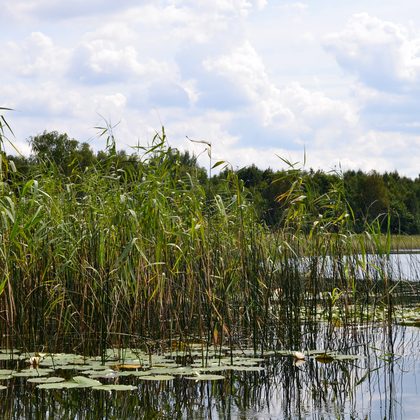
Hot dry country immediately beside open water: the banks of rivers and lakes, irrigation canals, reedbeds and tamarisk scrub, backed by bare sand flats, semi-desert and irrigated arable. Hunts low and easily over water and reeds, with a marked preference for dragonflies; the nest tunnel is dug in flat sand or in a low earth face.
Where the bird is most at home, classified with EUNIS — the European standard for habitats.


Range and movements
Breeds in North Africa and the Middle East: the Nile delta and valley, Israel and the Levant, south-east Turkey, Iraq and Iran, around the Caspian and further east, with a separate population along the southern edge of the Sahara in Morocco and Algeria. Winters in Africa south of the Sahara; on passage in Cyprus and the Maghreb. Elsewhere in the map area a rare vagrant, mid-May – late September: a few dozen records in the British Isles, a handful in the Low Countries, very few in Iberia and on the Canary Islands.
- Breeding (summer)
- Passage
- dark = core range, pale = thinly spread
How and when to look
Anyone who wants to be sure of it goes to the breeding range: the Nile delta, the coastal plain of Israel, south-east Turkey or the oases of southern Morocco, where it hunts over irrigation canals from May to August; on Cyprus it passes through on migration. Elsewhere it is a matter of waiting for a report, usually between May and September: on any reported bee-eater check the colour of mantle and shoulders — green, rather than the cheek, which is hard to judge in strong light — and look at the underwing as soon as the bird takes off.
Conservation status
Not globally threatened (IUCN: Least Concern), with a large range and locally high densities. Colonies disappear quickly where marshes are drained, banks are hardened and insecticides thin out the dragonflies, because the birds need both water and large insects within a few kilometres of the nest tunnel. Reed fringes and unworked sand flats along irrigation schemes matter far more than their bare appearance suggests.
Scientific name
Merops persicus | Pallas, 1773
Pallas described the species in 1773 and placed it straight away in the genus where it still stands. The genus Merops was introduced in 1758 by Linnaeus. Merops is Greek and means 'bee-eater'. persicus is Latin for 'Persian', after the eastern part of the breeding range. The specimen the first description was based on came from the shores of the Caspian Sea.