All species › Waterfowl › Ducks, geese and swans › Common eider
Common eider | Somateria mollissima
Eider | Eider común
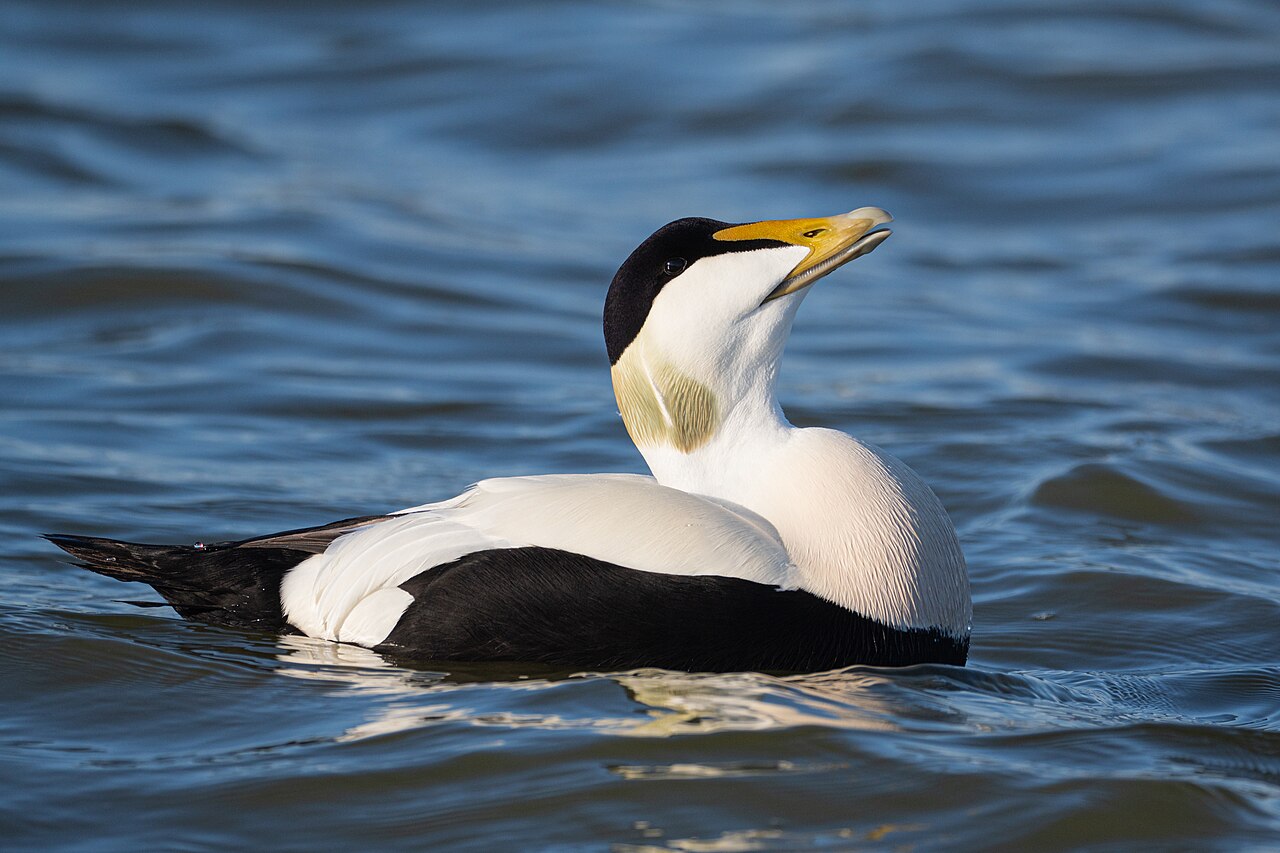
A heavy, wedge-shaped sea duck with a distinctive long sloping bill profile. Eiders breed on the Dutch Wadden islands and thousands winter in the North Sea coastal zone, working over the shellfish beds.
Click a thumbnail to switch the photo above.
Voice
In display the male gives a startled, almost human a-ooh-hoo that carries far over water. The female croaks low, korr-korr-korr. Heard mainly from January to April from displaying parties along the coast.
Recording: Aubrey John Williams — CC BY-SA 4.0 · Wikimedia Commons
Identification
The male is white above and black below, with a green nape patch, a black cap and a rosy flush on the breast. The female is warm brown with dense black barring that makes her invisible among seaweed. Both show the flat bill profile; males need three years to reach full plumage and pass through piebald stages on the way.
Confusion species
Females and young are confused with the rare king eider and with young common scoter. The long, straight forehead-to-bill line settles common eider; king eider has a shorter profile with an S-shaped feathering border. The dense barring separates females from plain brown scoters.
Habitat
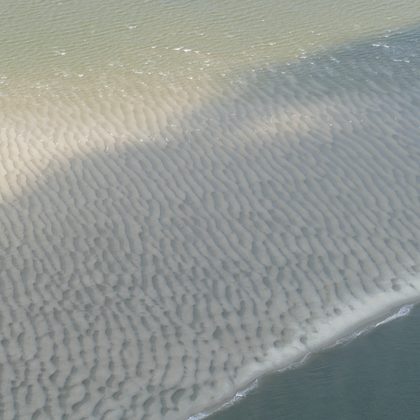
Shallow coastal water over hard bottoms with shellfish beds: tidal inlets, mussel banks, harbour moles, groynes and sheltered bays. Breeds colonially in dune vegetation, under creeping willow or elder scrub on the islands. Dives for mussels, cockles and crabs and swallows them whole.
Where the bird is most at home, classified with EUNIS — the European standard for habitats.

Range and movements
A circumpolar breeder of northern coasts, in Europe from Iceland and Norway through the British Isles and the Baltic to the Wadden Sea, where Vlieland, Terschelling and Texel hold one of the southernmost breeding populations. Further south along the Atlantic coast it is very rare, with occasional birds as far as the Cantabrian coast.
- Resident
- Breeding (summer)
- Winter
- Passage
- dark = core range, pale = thinly spread
How and when to look
Go to a sea dyke or harbour pier on the Wadden Sea, the North Sea or the Baltic between February and April and listen for the display calls on a calm day. Come around high water, when birds feed close inshore along the groynes and males posture at one another with raised heads.
Conservation status
Listed globally as Near Threatened after declines in the Baltic. Dutch numbers crashed through shellfish fishery and food shortage, and recovery is slow. Drowning in nets, oil pollution, disturbance at colonies, fox predation on the mainland coast and disease all add pressure.
Scientific name
Somateria mollissima | (Linnaeus, 1758)
Linnaeus described the species in 1758 as Anas mollissima; because it was later moved to another genus, the author and year stand in brackets. The genus Somateria was introduced in 1819 by Leach. Somateria is Greek, from sōma 'body' and erion 'wool': 'woolly body', after the down with which the female lines her nest. mollissima is the Latin superlative of mollis 'soft': 'very soft', after the eiderdown. The specimen the first description was based on came from the island of Gotland, Sweden.